
A fall in El Arenal: How safe are our sidewalks for older people?
A fall in El Arenal: How safe are our sidewalks for older people?
A 72-year-old tripped over an uneven pavement on Formentera Street in El Arenal and suffered serious facial injuries. The incident raises questions about sidewalk maintenance and the responsibility of the Llucmajor municipality.
Fall in El Arenal: How safe are our sidewalks for older people?
Key question: Why does a loose paving stone seem to be enough to seriously injure a 72-year-old?
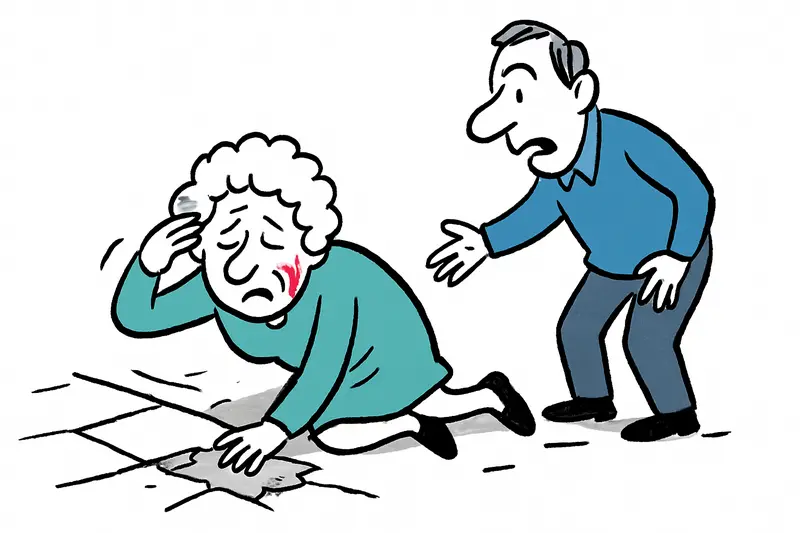
In the early evening, around 6:15 p.m., Conchi Martín, 72 years old and a resident of El Arenal for decades, set out on the short walk to the town's senior center. She knows Formentera Street like the back of her hand. Nevertheless, her shoe caught on an uneven spot in the sidewalk. She fell, suffering visible bruising across her face from one ear to the other, and was taken to Son Llàtzer hospital, where medical observation was ordered because of possible head injuries.
This woman's misfortune is not just an isolated fate. In many neighborhoods of Llucmajor you can see worn curbs, sunken slabs and patched areas that become slippery when it rains, a concern echoed in Frustration in Arenal: Residents demand clean streets and safe sidewalks. Anyone walking here in the late afternoon hears motorcycles rushing through the quarter from Camí Vell, the honk of a bus on the main artery, children calling from somewhere near the beach. Similar tripping incidents have caused serious injuries, such as a tourist tripping over an irrigation pipe and being struck by a car. Amid this soundscape, it is often precisely these small irregularities that unbalance older people.
Critical analysis: After the incident the municipality announced it would inspect the affected area and issue a new maintenance contract to secure the sidewalks. That is a step to be welcomed. However, it raises two questions: Why was a dangerous spot visible for so long? And why is an inspection carried out only after an accident? A repair and maintenance plan that works only reactively does not protect the most vulnerable citizens.
What is missing in public discourse: data and transparency. There are hardly any publicly accessible lists showing which sections of the municipality have priority, how many reports of sidewalk damage have been received in recent years, or what deadlines contractors must meet. The construction of sidewalks is not only a technical issue, it is a matter of justice: older people, those with walkers, and parents with strollers have a right to get from A to B safely.
An everyday sketch from El Arenal: In the evening sun regulars sit on the benches along the Passeig, a dog tugs on its leash, a vendor closes her small kiosk. Conchi knows the neighbors who helped her up. Scenes like these show how closely community and public space are intertwined. When public space fails, the neighborhood steps in. But tolerance must not become the long-term solution.
Concrete measures that can act quickly: First, a binding monitoring system for sidewalks in every locality of Llucmajor, with priorities based on risk (schools, senior centers, main routes). Second, a hotline or digital form with a visible processing deadline: report today, condition recorded within 48 hours, provisional securing within one week. Third, temporary measures such as warning markings, small ramps or wooden plates at critical spots until final repair. Fourth, transparent maintenance contracts: who is responsible, what response times apply, and what quality checks exist?
Long-term building blocks should be practice-oriented: enforce barrier-free standards, carry out regular inspections in cooperation with senior representatives and equip small local repair teams that can respond quickly. Funding is of course necessary. But often much can be achieved through better processes and clear responsibilities without immediately allocating large sums.
Medical aftercare is also important. In the case of a head impact, even if only bruising is visible externally, medical observation is advisable. Conchi's case shows that the municipality, the health system and social services should be better networked: if the hospital reports recurring causes of falls to the municipality, a learning process can emerge that prevents further accidents, as with the serious fall in Santa Ponça.
What we as neighbors, neighborhood groups or local initiatives can do: report visible hazards, support older people on the way to the town hall or to appointments, organize local balance and fall-prevention courses. Politics must respond, citizens can apply pressure, but above all: pay closer attention. A protruding paving stone is not a triviality.
Concise conclusion: A fall that ends in a hospital is one too many. The municipal administration's announcement to inspect the sidewalks and re-tender the maintenance contract is necessary. What we now need, however, are concrete deadlines, transparent lists of problem points and short-term protective measures at danger spots. The quiet promise, "we will look into it," is not enough. For Conchi and others time is a factor. Every day without repair increases the risk that a mishap turns into a serious tragedy.
Frequently asked questions
What’s the best time to visit Mallorca for warm weather and calm seas?
Is it safe to swim in Mallorca beaches year-round?
What should I pack for a Mallorca trip in summer?
How easy is it to move around Mallorca without a car?
What are good day trips from Palma de Mallorca?
What local foods should I try in Mallorca and any dining etiquette tips?
Are there family-friendly beaches in Alcúdia suitable for swimming?
How warm does the water get in Mallorca and when are the best beach days?
Similar News
Lightning strikes palm on Ibiza: Are we really prepared for autumn storms?
A lightning bolt into the crown of a palm in Port des Torrent shows how close danger and everyday life can be on the Bal...

Mallorca's Mills Receive a Makeover: Millions for 35 Monuments
The island council is providing around €2.5 million so that 35 historic mills on Mallorca will be restored in a conserva...
Protest camp in Palma: Why the Balearic Islands pay a real estate fund — and who pays for it
On Plaça d'Espanya activists discuss next steps while the Balearic government must recognise compensation claims by a re...
Haute Nuit in Puerto Portals: A Warm Night Between Catwalk and Sea
Yvonne Struzek and Felix Wille hosted the third "Haute Nuit" at the Lobster Club – 70 guests experienced fashion, haute ...
Closure of s'Albufera: Necessary construction or symptom of a bigger problem?
The s'Albufera nature park will be completely closed from October 5 to 18 for repairs to paths and observation hides. Ti...
More to explore
Discover more interesting content

Can Cap de Bou

Townhouse Lleo 72
