
So Many Tonnes: What Mallorca's Garbage Boats Accomplish — and What's Missing
So Many Tonnes: What Mallorca's Garbage Boats Accomplish — and What's Missing
23 boats patrol in summer, and 36.8 tonnes were recently pulled from the water. The fleet is shrinking — is that still enough to protect beaches and marine life?
So Many Tonnes: What Mallorca's Garbage Boats Accomplish — and What's Missing
Key question: Are 23 boats and seasonal operations from May to September enough to really keep the coasts clean?
Early in the morning on the Paseo Marítimo the sea still looks smooth, gulls circle, and a small workboat chugs out of the harbour. It's one of 23 boats operating this summer around Mallorca and the neighbouring islands. The crews work mostly between early May and late September, collecting nets, bottles, plastic fragments — and last year brought a total of 36.8 tonnes of waste ashore, about 32 percent more than the year before. More boats, more weight. That's the simple arithmetic.
The more complicated calculation is this: a little over a decade ago there were significantly more vessels in service. Fundació Marilles has crunched the numbers: before 2010 there were about 40 boats in operation; between 2004 and 2010 roughly 200 tonnes of waste were recovered annually on average. Today there are far fewer ships — 15 of them operating close to the coast, the others up to five nautical miles out. And according to the government, almost half of the recovered debris is plastic.
When you add the figures together you encounter two uncertainties. First: the fleet has shrunk over the years even though the burden from drifting debris continues to rise. Second: operations are concentrated in the summer months — precisely when beaches and coves are most sensitive to washed-up waste, but not necessarily when the largest inflows occur from heavy rains or autumn storms.
Critical analysis: the boats fish tonnes of waste out of the water, but they are a reaction, not prevention. When plastic pieces, cigarette filters and lost fishing nets end up in the sea, damage occurs long before the next cleanup boat arrives. The current strategy is piecemeal: it removes visible flotsam, it makes beaches look nicer — but it does not shift the balance from cause to effect.
What is missing from public debate is financing and accountability. Who pays if the fleet needs to be increased again? What incentives exist to make the few main polluters — for example recreational and commercial fishers, vessels without functioning waste reception, or unprofitable disposal chains on the mainland — change their behaviour? And where are systematic measurements that show where the waste comes from: tourism, overseas shipping, or river inputs?
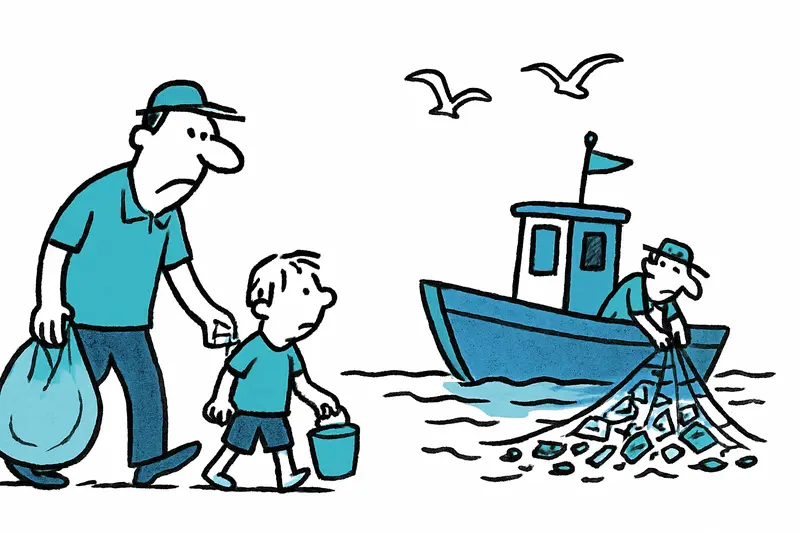
An everyday scene that illustrates the problem: on a hot August day at Cala Major a father hands his child a plastic bag with sand toys. In the distance you can see a small garbage boat hauling a line of bottles aboard. Heat shimmers, sunscreen scent hangs in the air, and yet what the crew brings to shore in baskets is often the same: packaging, bottles, single-use tableware. The crews' work is visible, but the causes remain invisible.
Concrete solutions that go beyond treating symptoms:
1. Year-round presence and flexible deployment. Not only May to September, but targeted operations during rainy and stormy periods when river runoff and storm surges bring large amounts of debris.
2. Expand the fleet according to priority rather than season alone. Small, nimble boats for coves plus one or two larger units for coordinated collection actions and heavy lifting.
3. Preventive measures on land. Filters at storm drains, better waste reception in ports, deposit or take-back schemes for single-use plastics, and intensified control of illegal disposal.
4. Data instead of estimates. Systematic monitoring using drones and satellites combined with beach and sea observations, so it becomes clear where the largest sources are — and who is responsible.
5. Cooperation instead of island dogma. Waste does not respect administrative borders. Coordination with neighbouring ports, shipping companies and mainland authorities is necessary, as are clear rules for fishing gear and sanctions for grave violations.
Some of these measures cost money; others mainly require administrative will. Both seem to be lacking so far, judging by the decline of the fleet since 2010. All the more reason to value the work of today's crews: 36.8 tonnes represent labour, sweat and often early mornings. But good work alone does not replace a strategy.
Conclusion: the garbage boats are indispensable — but they are not a panacea. Anyone who wants to protect beaches and marine life for the long term must think further: from the coast into the hinterland, from reaction to prevention. Otherwise, in a few years trash will still be fished out of the water, but the question why so much of it ends up in the sea in the first place will remain unanswered. And that is the real problem to tackle.
Frequently asked questions
When is the best time to visit Mallorca to avoid crowds and enjoy outdoor days?
What should I pack for a Mallorca trip?
Is the water safe for swimming in Mallorca and what should I watch for?
How can I get around Mallorca without renting a car?
What outdoor activities suit Mallorca, and what should I know about safety?
What’s the best way to experience Mallorcan food?
Are there family-friendly activities to do in Mallorca?
What weather patterns should I expect in Mallorca for planning outdoor days?
Similar News

No Identification Documents on the Steep Slope: Body near Tolleric Raises Questions
The body of an elderly man was found over the weekend in a wooded area near the cliffs of Tolleric. He had no identifica...

Arrest at the Port: Three Suspected Pickpockets Left Mallorca After Series of Thefts
The National Police stopped three men at Palma harbour who are accused of several thefts at the airport. How could the g...

Palma's Rental Bike Boom: More Bikes, More People, More City Life
Since Bicipalma was opened to non-residents, the system has noticeably grown. Students, residents and tourists bring lif...

Palma–Lyon in Winter: Two Weekly Flights Bring Fresh Momentum
From October Transavia France will connect Palma and Lyon in winter as well: Wednesdays and Saturdays, around 17,000 sea...

Budget holidays in Mallorca: What thriftier tourists really mean
Visitors are spending less: shorter stays, fewer restaurant visits, fewer excursions. A reality check for Mallorca's eco...
More to explore
Discover more interesting content

Boat Tour with BBQ along Es Trenc Beach

Private transfer from Mallorca Airport (PMI) to Pollensa
