
Hotel Fire in Can Picafort: Two Hours Outside — a Reality Check
Hotel Fire in Can Picafort: Two Hours Outside — a Reality Check
After a nighttime room fire at a hotel in Can Picafort, guests and staff had to wait outside for over two hours. A close look at safety, procedures and what urgently needs to be improved.
Hotel fire in Can Picafort: Two hours outside — a reality check
Why did holidaymakers have to stay outside so long in the middle of the night?
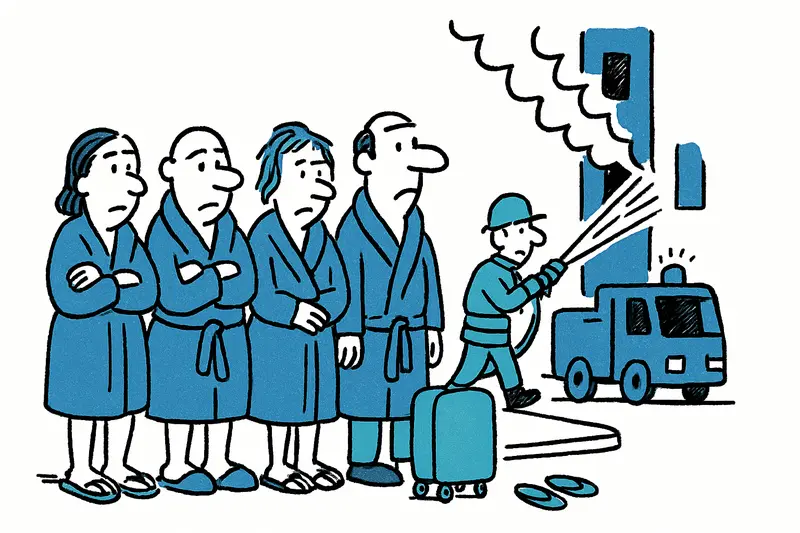
In the warm night, guests in bathrobes gathered on the pavement in front of the hotel, wheeled suitcases beside flip‑flops, the hum of air conditioners in the distance and the sirens of emergency vehicles racing in from the direction of Inca and Alcúdia (see Fire at Alcúdia Hotel: Evacuation Succeeds — What Lessons Will the Island Learn?). Around midnight a fire broke out in the complex in Can Picafort. The fire brigade arrived, and a patrol from the Tramuntana and two technicians were also alerted. Extinguishing work continued into the early morning; the fire was extinguished around three o'clock. Until about two a.m., evacuees had to remain outside because of heavy smoke.
Key question: Why did guests have to wait outside for more than two hours at night even though emergency services arrived relatively quickly, and what does that say about the state of fire safety in many tourist accommodations?
The facts are brief and clear: fire around midnight, quick alarm, units from several stations on site, firefighting until about three a.m., and heavy smoke forcing guests and staff out into the open. Between these points, however, questions remain: Were emergency exits and escape routes immediately usable? Did smoke detectors and automatic ventilation systems work? Was there a fixed assembly point and care for the evacuees? Such details decide whether an evacuation proceeds in an orderly manner or becomes a chaotic procedure in which people stand on the street for hours.
Public reports usually repeat only the emergency dispatch (see reporting on other incidents such as Fire in Port d'Alcúdia: Why the big scare is also a wake-up call for fire safety and Fire at Hotel near Cala San Vicente: A Wake-up Call for Fire Safety in the Off-Season). Missing are the voices from everyday hotel life: a waitress who triggered the alarm in the kitchen; an older guest with asthma coughing in the cold while trying to get a blanket; a night porter wondering whether the emergency lighting had really been checked regularly. These scenes shape how safe people feel at night—not the dry numbers of the incident log.
The critical analysis reveals three problem areas: First, prevention. Electrical faults are a common cause of fires in hotels; regular inspections of electrical systems, transparent maintenance records and functioning smoke detectors are not optional, they are mandatory. Second, evacuation logistics. A trained staff team, clear assembly points, blankets, water and a way to shelter guests temporarily—all of this must be available, especially at night. Third, communication. Guests must be informed, including in several languages: a night in an unfamiliar place can be frightening, and information in multiple languages calms people and prevents them from returning to an unsafe building.
What is missing from the public debate is the question of oversight: Are hotels inspected afterwards for deficiencies, are fines, requirements or deadlines issued for corrections? When inspections take place, their results are often not transparent to the public. Nor is there much discussion about how well staff are prepared for night evacuations—keyword: regular fire drills outside the high season, when many establishments operate with minimal teams.
Concrete measures that could help immediately include: mandatory semiannual inspections of electrical installations in accommodation businesses larger than X beds; required simulations for night evacuations with authority participation; standardized emergency kits at assembly points (blankets, water, first aid, contact list for interpreters); a digital reporting protocol that automatically notifies guests by SMS in the event of a fire; and a public registry of outstanding deficiencies that authorities can access to prevent repeat incidents.
On the ground in Can Picafort, the morning after such nights gives the promenade a different look: workers with brooms, delivery vans on the passeig, the sea calm, and guests speaking quietly about the night. Longstanding shopkeepers then tell of small fires that ended without major damage and of rooms where alarm signs were never renewed. These are the stories that authorities and operators need to bring together when it comes to real safety improvements.
Conclusion: It is reassuring that the fire brigade was able to extinguish the blaze. It is a warning sign that people had to stand outside for hours because of smoke. It is not only about technical failures, but also about organizational gaps: regular inspections, practiced evacuation plans, clear communication and a culture of responsibility in the industry. If all of this is improved, guests will no longer have to use Mallorca's cool night air as emergency accommodation.
Frequently asked questions
Is it still warm enough to swim in Mallorca in October?
What is the weather like in Mallorca in October?
What should I pack for a Mallorca trip in October?
Is October a good time to visit Mallorca for a quieter holiday?
Can you still go to the beach in Mallorca in October?
What is Palma de Mallorca like in October?
Is October a good month for hiking in Mallorca?
What kind of temperatures can you expect in Mallorca in October?
Similar News

From the Ruhr Area to the Tramuntana: Thorsten Legat and the FC Germania Mallorca Adventure
The former pro has not only taken the coaching role on Mallorca but also moved into a small island shared house, set amb...

Silent Conquest: What Mallorca's Wildlife Can Do Against Introduced Snakes
For years non-native snakes have been appearing on Mallorca. Who monitors the import routes, how effectively do authorit...
Stolen motorcycles in vacant factory: Guardia Civil finds 19 vehicles
In Inca, investigators discovered 19 motorcycles stolen between April and June. In an abandoned factory near Selva, many...
Storm in Majorca: 75 Responses, Uprooted Trees and Beached Boats – Who Will Draw the Lessons?
A sudden thunderstorm swept over the islands on Thursday evening, leaving uprooted trees, damaged boats and disrupted su...

Daily new boats: Mallorca and the Balearic Islands under pressure from rising arrivals from Algeria
For months, arrivals of boat migrants from Algeria have remained at a high level. Places are lacking, unaccompanied mino...
More to explore
Discover more interesting content

Boat Tour with BBQ along Es Trenc Beach
Private transfer from Mallorca Airport (PMI) to Pollensa
