
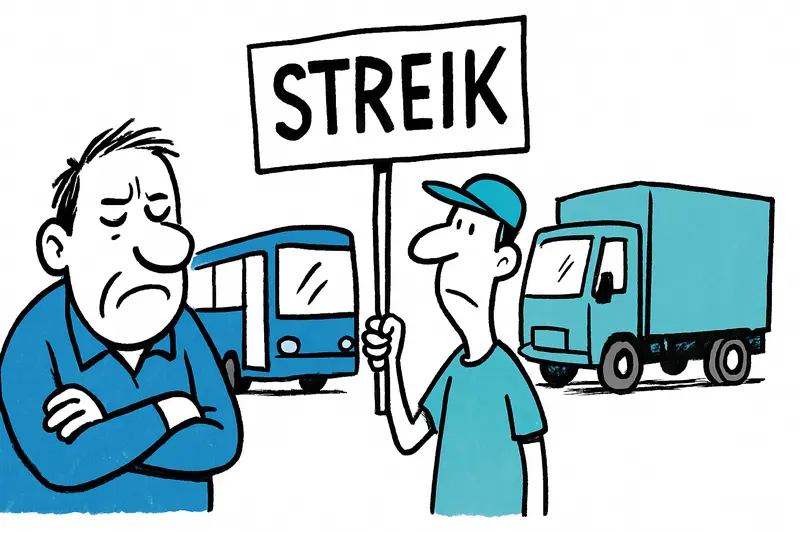
Indefinite Transport Strike: What Would Really Hit Mallorca
Indefinite Transport Strike: What Would Really Hit Mallorca
The UGT has announced an indefinite strike in the transport sector — as of June 8 buses and supply chains on Mallorca could come to a halt. A sober assessment: who would be affected, what's missing from the debate and which countermeasures are possible locally?
Indefinite Transport Strike: What Would Really Hit Mallorca
Key question: Can the island withstand the loss of bus and freight services — and who will pay the price?
The union UGT has announced an indefinite strike in the Spanish transport sector, with possible effects on the Balearic Islands. According to the union, around 7,500 people are employed in the transport sector in the Balearics. June 8 is being mentioned as a possible start date. The central demand: transport workers should be allowed to retire earlier without financial losses.
It may sound abstract, but it is not. On Mallorca much depends on the rhythm of buses, ferry connections and lorries: supermarkets, construction sites and clinics rely on regular deliveries. And in the urban landscape: on a Tuesday morning at the Estació Intermodal in Palma you see commuters with coffees in hand waiting for a reliable line. A complete standstill would suddenly shatter that routine. Similar disruptions occurred during the Ten Days of Bus Strike in Mallorca: How Long Can the Island Endure It?.
Critical analysis: the announcement is a strong bargaining chip. An indefinite walkout can quickly throw logistics chains off balance because warehouses only have a few days of buffer. On an island there are hardly any alternative routes: options like additional ferry departures or private hauliers are limited and expensive. Air links have seen their own interruptions, as outlined in Second Wave of Strikes Hits Mallorca's Airports — Travelers Must Rethink Plans Now. The dependence on road transport makes Mallorca more vulnerable than the mainland.
It is important to distinguish what is certain and what remains speculation. Established facts are the number of affected employees in the Balearics (around 7,500), the date the union has put forward (June 8), and the demand for early retirement without income loss. Not established are the scope, scale and duration of outages on the island — that depends on strike participation, countermeasures by employers and interventions by authorities.
What is often missing in the public debate: a look at the cascade effects. A halt in deliveries does not only affect supermarket shelves. It affects small craft businesses that need materials for construction sites in the morning; restaurant kitchens that require fresh goods daily; pharmacies and medical practices that depend on timely supplies. Also rarely mentioned is how a strike affects seasonal jobs: tourist businesses may be unable to reorder at short notice, events have to be reorganised, and guests experience service disruptions. Airline and airport staff actions, including Ryanair Strike in Mallorca: Who Pays the Price — and What Travelers Should Do Now, have compounded such problems.
Concrete everyday scene: on Avenida Jaime III in Palma traffic thickens, drivers honk because the ring road Ma-20 is congested. A delivery lorry stays longer than usual at an access point, suppliers rush between vehicles and market stalls. The voice of a bus driver on Plaça d'Espanya, often heard early in the morning, is missing this time. These create gaps that quickly become visible.
What can be done locally? First: short-term emergency plans. Municipalities should define priority routes and collection points — for hospitals, pharmacies and food deliveries. Second: staged negotiations. The Balearic government can act as mediator and hold targeted talks with industry representatives, transport companies and unions about transitional arrangements. Third: pragmatic personnel policies. Employers could consider on-call services, short-term bonuses and more flexible shift plans to stabilise critical supply chains.
Medium- to long-term solutions go deeper. The demand for earlier retirement touches the structure of the pension system, the workload and the attractiveness of jobs in logistics. Possible alternatives could include phased transition models, pension reductions with compensatory payments or tax-funded transition programmes — all measures that require political decisions and budget discussions.
A perspective missing from the debate is: how does a strike affect supply security in times of crisis? On an island redundancies are more expensive but necessary. A mix of stockpiling, local storage facilities and staggered delivery plans would reduce vulnerability.
Practical steps for citizens: plan supplies, be considerate with employers, consider alternative mobility options (car-sharing, ridesharing) and support local providers to create shorter supply chains. For companies this means updating emergency contacts and stretching delivery quantities over several days.
Pointed conclusion: an indefinite strike is a serious risk for Mallorca — not just a headline, but a strain on everyday life and the economy. At the same time, the workers' demand is not without legitimacy: transport work is physically and temporally demanding. The challenge is to find a balance that secures supplies, creates fair working conditions and does not make the island unnecessarily vulnerable. A dose of pragmatism, quick local mediation and concrete emergency plans would help to avoid escalation.
Frequently asked questions
How would an indefinite transport strike affect everyday life in Mallorca?
When could the transport strike in Mallorca start?
Will buses in Palma be affected by the strike?
Could supermarkets in Mallorca run short of goods during a transport strike?
What parts of Mallorca’s economy would be most affected by a transport strike?
What should people in Mallorca do if the transport strike lasts several days?
Why are transport workers in the Balearic Islands calling for an earlier retirement age?
Can Mallorca avoid serious disruption if a transport strike goes ahead?
Similar News

Magaluf: Watchtower Alarm – Lifeguards Pull Unconscious Beachgoer from the Water
After a drama in the late afternoon, two lifeguards at Magaluf beach rescued an unconscious 44-year-old man. He was stab...

Turquoise in the City: How dangerous is the color play of the Sa Riera?
The Sa Riera in Palma suddenly turned turquoise — a pretty motif, but behind the effect lies a discharge of saline waste...

Jeckliner at Sunnesching: Cologne spirit sets sail from Palma
In September 2027 the Mein Schiff 2 briefly becomes a floating carnival stage: four days with Cologne bands, comedy and ...
Finally Home: Mike and Leyla Heiter Buy Villa with Sea View in Mallorca
The reality TV couple Mike and Leyla Heiter have bought a house in Mallorca with a roof terrace and sea view. An Instagr...

Arrest after series in Palma: Who protects apartments from repeat offenders?
The National Police arrested a man in Palma who investigators say may have broken into several apartments. In one incide...
More to explore
Discover more interesting content

Can Cap de Bou

Townhouse Lleo 72
