
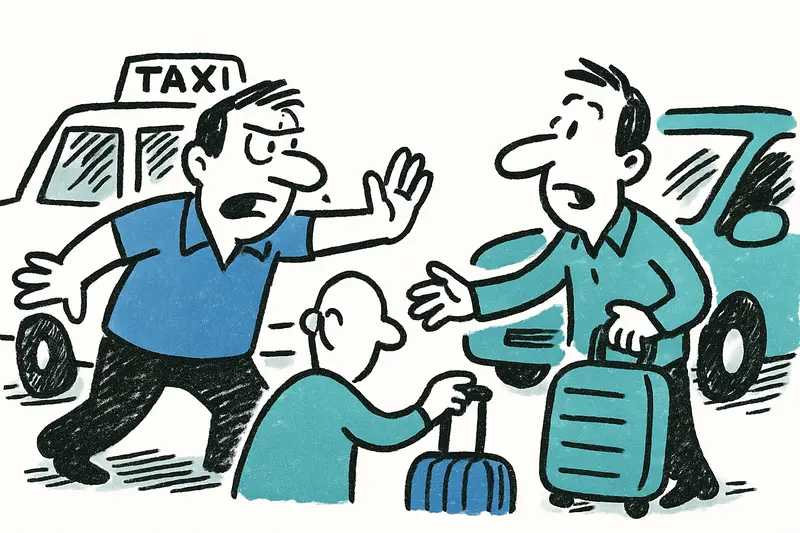
License Turmoil in Mallorca: How Many VTCs Does the Island Really Need?
License Turmoil in Mallorca: How Many VTCs Does the Island Really Need?
3,500 applications in Mallorca, 6,500 on Ibiza — the new wave of VTC applications is putting the islands under pressure. A sober analysis of what's politically missing and how everyday life and mobility can be protected.
License Turmoil in Mallorca: How Many VTCs Does the Island Really Need?
Key question: Does the new flood of permits displace local taxi drivers and upset the island's fragile balance?
At Passeig Mallorca, where the editorial office is located and in the mornings the taxi radio chatter drifts through the streets like background music, the issue is everyday life: drivers complaining about lost fares; tourists desperately searching for a free car with a suitcase in hand; and residents annoyed about conditions at airports and beach access roads. In the background a light wind and 13°C, some clouds over Palma — the weather matches the mood: cool and uneasy.
The facts are relatively clear: on the Balearic Islands there are thousands of applications from operators seeking chauffeur-driven rental car permits (VTC). Around 3,500 applications concern Mallorca, about 6,500 Ibiza — together roughly 10,000 requests. The authorities are legally obliged to examine these applications; a blanket dismissal is legally risky. At the same time, representatives of the taxi industry warn that a massive expansion of VTC offers could endanger jobs, prices and traffic burden.
Critical analysis: it is not just about numbers. Three legal points are tricky. First: the duty to carry out individual case reviews protects legal certainty, but it also means long procedures and uncertainty for existing providers. Second: applications requesting hundreds of licenses by a few companies raise questions about market structure. Third: past legislative decisions and insufficient regulation have left gaps that interested actors are now filling by legal means.
What is often missing in the public debate: reliable data. No one is disclosing how many additional trips can realistically be expected, how supply and demand shift in different seasons, or what impacts on parking space and air quality should be feared. There is also no clear inventory of enforcement capacity: how many inspections do municipalities and police carry out? Who sanctions illegal trips? These gaps favor simplified headlines instead of fact-based policy, as recent coverage about system failures shows IT outage threatens allocation of 650 vacation rental slots in Mallorca.
A slice of everyday Mallorca shows the situation: around 7 a.m. at Playa de Palma taxis park in a long row, a driver drinks coffee, exchanges figures and talks about a system that is becoming ever heavier. On the other side are young entrepreneurs who claim they would bring modern booking systems and flexible availability. Both sides have legitimate concerns. Between them sits the city — and an island that is narrow and has no room for unlimited expansion.
Concrete solutions that are legally sound and practically feasible can be formulated: first, a transparent, publicly accessible list of all applicants and the number of licenses requested per application so that no one operates in the fog. Second, a tiered review process: priority for local, small-scale operators; strict admissibility requirements when an application comprises hundreds of licenses. Third, piloted quotas: time-limited permits linked to utilization and traffic monitoring so that effects can be measured before permanent rights are granted — a debate similar to that surrounding recent changes to holiday rental allocations 650 new vacation rental license spots on Mallorca: Small number, big questions.
Further measures: technical integration between taxi dispatch systems and VTC platforms to reduce empty runs; binding proof of local economic anchoring (local establishment, employment records); and a scale of sanctions for violations that includes not only fines but also the revocation of rights in cases of repeated illegal operation. Regional coordination with municipalities is also important: what works in Palma does not translate one-to-one to a village in the Tramuntana. Transparency on enforcement is crucial, as shown by official statements that have questioned the scale of non-compliance in holiday rentals Only twelve out of 1,300: Island council downplays accusations of illegal holiday rentals.
Legally, the balance can be designed so that the administration carefully examines individual cases without falling into arbitrariness. That requires staff and clear criteria: protection of market shares, minimum service-quality requirements, environmental aspects (emissions, reduction of empty runs) and a staged model for the granting of licenses. These criteria should be subject to public consultation so that affected parties — taxi drivers, VTC operators, commuters — can have a say.
What is now missing is political leadership: decisions that are neither reflexively pro- nor anti-platform, but that concretely define concepts like "carrying capacity." The Balearic government has announced that it will consider the island context and set limits; that is good, but without transparent criteria there remains plenty of room for litigation and protests.
Conclusion: Mallorca needs rules, not slogans. Anyone who believes the issue can be solved with a simple stop overlooks legal obligations. Anyone who thinks the market will sort itself out overlooks the local dimension: narrow streets, seasonal peaks, neighborhoods that cannot absorb unlimited traffic. A pragmatic solution combines transparency-required reviews, time-limited pilot licenses, technical integration and tough sanctions for abuse. That way there is room for innovation, but not at the expense of those who drive taxis every day to feed their families and bring visitors to the island.
Frequently asked questions
Why is Mallorca arguing about new VTC licences?
Are VTCs legal in Mallorca if the authorities have not approved them yet?
Do more VTCs in Mallorca mean fewer jobs for taxi drivers?
What is the best time of year to get around Mallorca without transport delays?
How busy is Palma de Mallorca with taxis and VTCs?
Why do Mallorca taxi and VTC rules affect traffic so much?
What should travelers in Mallorca do if taxis are hard to find?
What transport controls does Mallorca need to keep the system fair?
Similar News
Near-miss on Lanzarote: Landing Ryanair Jet and Iberia Takeoff — what really went wrong
On Lanzarote there was a dangerous incident: A Ryanair flight (FR5910) from Dublin landed on runway 03 while an Iberia E...

Eurowings introduces new Premium Business seats on Mallorca routes
From December 1, selected Eurowings flights to Palma and other destinations will feature eight particularly generous sea...

Car on MA-13 near Inca in flames – a safety check for the island
A vehicle caught fire on the MA-13 towards Alcúdia on Tuesday afternoon. The driver was uninjured, the car was destroyed...

Real Estate in Mallorca: Fewer Buyers, Higher Prices — What's Behind It?
Sales on Mallorca are falling, yet prices continue to climb. Why fewer transactions do not equal relief — and what shoul...

Just Bought — Already Trouble: Water Damage in the Heiters' Villa and What Owners in Mallorca Should Know Now
A newly purchased sea-view property — and within days a water damage. What risks lurk in new properties in Mallorca, and...
More to explore
Discover more interesting content

Can Cap de Bou

Townhouse Lleo 72
