
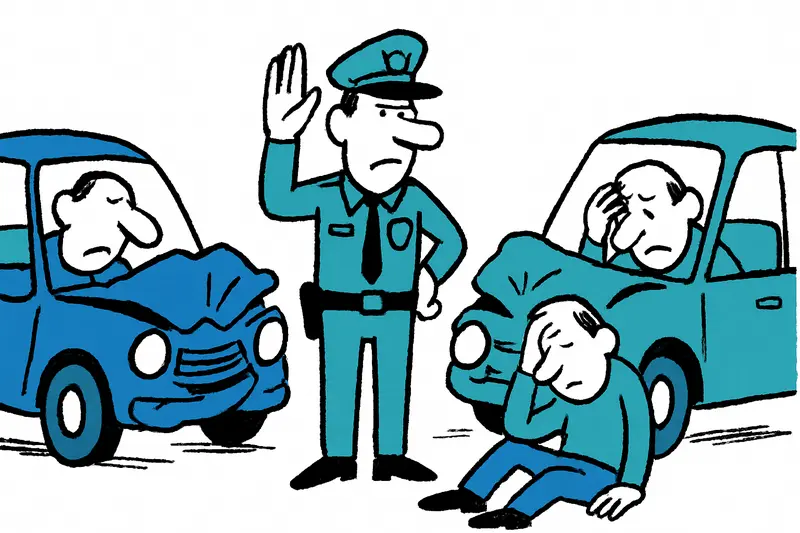
Five vehicles on the Ma-4030: Seven slightly injured — what must change now in Mallorca
Five vehicles on the Ma-4030: Seven slightly injured — what must change now in Mallorca
A collision between Sant Llorenç and Son Servera left seven people slightly injured. The Guardia Civil is investigating. Why isn't that enough anymore?
Five vehicles collide on the Ma‑4030 — seven slightly injured, one question remains: How do we prevent the next one?
Between Sant Llorenç and Son Servera yesterday a truck and four cars collided. Three injured were taken to hospital, four were treated on site. The Guardia Civil is investigating.
On the Ma‑4030, one of the country roads running here between fields, residential areas and small industrial zones, chaos broke out yesterday afternoon: flashing lights, ambulances and police diverting traffic. Seven people were slightly injured after the collision; according to available information three of them had to be taken to hospital, four received treatment at the scene. No official statements on the cause of the accident have yet been released; the Guardia Civil has opened an investigation.
Key question: What went wrong at this spot — and why aren’t we talking louder about safe passing conditions on our connecting roads?
First impressions point to the typical mix that often comes together here: narrow lanes, different vehicle types (from trucks to small cars), changing light conditions in the afternoon and vehicle movements sometimes influenced by agricultural traffic. Such circumstances require not only attention from drivers but also thoughtful infrastructure and visible rules, as argued after three serious accidents in one night. When the Guardia Civil later reports which factors actually played a role, that will be important. Until then it is already clear: these accidents are rarely just accidents.
Critical analysis: Often the debate after accidents remains superficial. We hear the number of injured, we hear about the intervention of rescue services — and then daily life shifts back onto the roads. What is missing is the systematic follow-up question: Is it the lane width, the lack of separation between heavy and light traffic, unclear junctions or missing speed controls? Without this deeper look, measures remain piecemeal. Past collisions such as the Crash on the Ma-10 underline the need.
What has been underrepresented so far in public discourse: the perspective of people who use these routes daily — students, commuters, delivery drivers, farmers. When market stall operators in Son Servera unload their goods in the morning or a bus stops at the Sant Llorenç stop, the flow of traffic changes. Such everyday situations are not marginal details; they are part of the problem and should be included in solutions.
Everyday scene from the island: Imagine the Ma‑4030 on a Wednesday morning. A small van struggles up the incline, a cyclist stops at the roadside to refill a water bottle, from a café on the plaza the smell of freshly baked Ensaimada drifts out. Exactly where the relaxed island life crosses the road, clear rules and visible safety are needed.
Concrete short-term measures that could have an effect without large budgets: temporary speed limits at critical sections, mobile speed checks by the Guardia Civil in coordination with the island government, rumble strips at the road edge and before junctions, additional reflective markings for poor visibility, and better routing coordination for heavy trucks, especially during peak times.
In the medium term planners and political representatives should consider two things: First, examining a permanent separation of heavy and light traffic where possible — for example through overtaking lanes or wider shoulders. Second, traffic monitoring along key connecting roads: measuring points that show when and how often speed is exceeded could enable targeted interventions instead of blanket bans.
The emergency chain also deserves attention: How quickly can rescue teams reach hard-to-access locations? How is first aid organized? A similar test occurred in the serious accident near Porto Cristo. Yesterday emergency medics were on site and treated four people directly at the scene. That is good — but it is not a substitute for prevention.
Who bears responsibility? Beyond drivers, authorities and municipalities are responsible for road conditions, signage and traffic management. The Guardia Civil is investigating the cause of the accident; the subsequent debate must reach decision-makers in Mallorca so words turn into measures.
Concrete proposal from everyday experience: A small task force made up of municipal representatives from Sant Llorenç and Son Servera, technicians from the road authority and local police officers could walk problem stretches informally, set priorities and test short-term measures — for example mobile signs or provisional safety fixes at tight curves.
Conclusion: Seven people slightly injured are a reminder that road safety is not an abstract issue but close to our daily lives. The Guardia Civil's investigation will clarify exactly what happened yesterday. The real task for us on the island afterwards remains: learn, improve, prevent. Otherwise in a few weeks we'll be telling the same story at another junction.
Frequently asked questions
What happened on the Ma-4030 between Sant Llorenç and Son Servera?
Why are country roads in Mallorca like the Ma-4030 more accident-prone?
What safety measures could help on the Ma-4030 in Mallorca?
Who is responsible for road safety on Mallorca’s local roads?
What should drivers watch out for on the Ma-4030 near Son Servera?
How quickly do emergency services respond after a road accident in Mallorca?
Can agricultural traffic affect driving conditions on Mallorca’s rural roads?
What kinds of road changes are being discussed for the Sant Llorenç and Son Servera area?
Similar News

The Painter Who Invented Himself: How a Young Viennese Drew Mallorca
A hundred years ago a 19-year-old draftsman arrived in El Terreno. His diary and sheets, long known under the pseudonym ...
Released with Conditions: The Plus Ultra Suspicion and a Mallorcan Finca as Residence
A Dutch entrepreneur, sought in connection with the Plus Ultra case, was extradited to Spain after his arrest in Germany...

Haute Nuit in Puerto Portals: Fashion, Art and Indulgence by the Water
On October 2 the Lobster Club in Puerto Portals will be transformed into a stage for curated fashion, art and culinary e...
Magaluf: Watchtower Alarm – Lifeguards Pull Unconscious Beachgoer from the Water
After a drama in the late afternoon, two lifeguards at Magaluf beach rescued an unconscious 44-year-old man. He was stab...
Turquoise in the City: How dangerous is the color play of the Sa Riera?
The Sa Riera in Palma suddenly turned turquoise — a pretty motif, but behind the effect lies a discharge of saline waste...
More to explore
Discover more interesting content

Can Cap de Bou

Townhouse Lleo 72
