
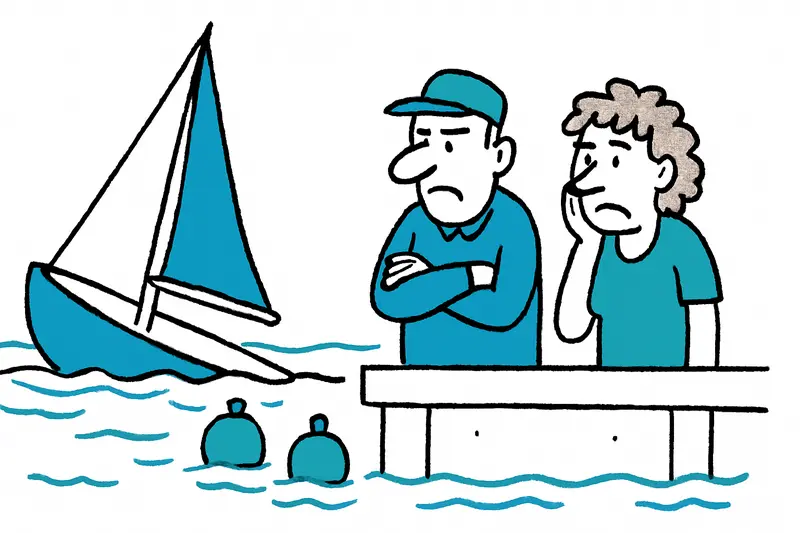
Sailboat sinks at the entrance to Port de Pollença – Who pays, who cleans up?
Sailboat sinks at the entrance to Port de Pollença – Who pays, who cleans up?
A sailboat at anchor suddenly sank in the late afternoon near the entrance to Port de Pollença. No one was on board, the owner is in hospital; salvage is unclear and the insurer apparently will not pay.
Sailboat sinks at the entrance to Port de Pollença – Who pays, who cleans up?
An unusual incident in the afternoon: buoys mark the danger, but answers are missing.
In the late afternoon a sailboat sank in the Illador area at the entrance to the port of Port de Pollença. The boat was at anchor, lost buoyancy over several hours and finally disappeared completely below the water surface. At the time of the accident no one was on board; according to current information no one was injured.
The emergency call was made to the 112 control center. Locals and skippers on site marked the spot with buoys to warn other vessels and secure the passage. The owner has been informed but is currently in hospital and therefore cannot take care of the boat himself. Early indications suggest that his insurance may not cover the salvage costs.
Key question: Who ultimately assumes responsibility — for the salvage, hazard mitigation and possible environmental damage?
This question sounds dry on paper. At the harbor, at the kiosk on the pier that afternoon: voices speculating about the incident, a few fishermen checking their nets, seagulls shrieking and the constant rolling of the waves. An older fisherman shook his head and said people must be careful that a wreck does not become a source of oil or fuel. That is not a minor concern: a sunken yacht can, if it releases diesel, oil or batteries, harm local ecosystems and pose a safety risk for bathers and shipping.
Critical analysis: The incident reveals several problem areas. First: information and coordination chains. An emergency call is one thing; the question is how quickly the harbor authority, coast guard and municipality can agree on a joint response so that the hazard is marked in yellow, affected lanes are closed and environmental risks are assessed. Second: liability issues. If the private insurer excludes salvage, the owner, the harbor and ultimately the public sector remain responsible — potentially at high cost Who Pays the Beach Bill? 365 Boats, €365,000 and an Unresolved Problem. Third: prevention. How often are boats at anchor checked? Is there a reporting procedure for extended stays at sea?
What is mostly missing in the public debate so far is the everyday perspective: for local people such cases are not just headlines Fishing boat accident off Portopetro: One dead, many unanswered questions, they mean work, extra costs and uncertainty. The fishermen, the charter captains, the operators of private boat rentals — all those people bear the consequences when fuel or wreckage is washed ashore. It is also rarely discussed how scarce resources are for urgent salvage operations and who funds emergency recoveries when insurers back out.
Concrete solutions that could be put on the table immediately:
- Short term: A mandatory reporting point for grounded or sunken wrecks and a clear checklist for first measures (buoys, NOTAMs/Notices to Mariners, initial pollutant checks).
- Medium term: An island emergency fund or reinsurance scheme involving the ports for cases in which private insurers do not pay.
- Preventive: Reporting obligations for extended anchoring near harbor entrances; regular inspections by harbor staff or the coast guard.
- Legal/Political: Clear rules on liability and mandatory insurance for seaworthy recreational and sport vessels; transparent reporting duties toward authorities, especially in cases where the owner is medically incapacitated Wrecks in the Bay of Pollenca: Municipality pays – but who bears responsibility?.
Such measures sound bureaucratic — and they probably are. But on Mallorca, where summer turns harbors and coasts into a constant workplace, practical rules are better than ad hoc solutions. The island already has plenty of experience with unpredictable boating and bathing conditions; a sunken sailboat at the harbor entrance can be seen as a prompt to organize procedures.
Everyday scene to finish: Shortly after the incident a few locals gather on the quay, a young charter captain pulls on his cigarette and says small yachts must be taken more seriously — not just the big ones. A cat wanders between terrace chairs, Spanish radio plays quietly in the background. This is life in Port de Pollença: calm mixed with a desire for clarity and quick solutions.
Punchy conclusion: A sinking recreational boat may look harmless until someone trips over it or fuel traces pollute the bay. The case outside Port de Pollença shows: quick action, clear liability rules and sensible funding for salvage are not luxury issues. As long as these gaps remain, every sunken boat is a small test of our willingness to protect harbor and coast together.
Frequently asked questions
When is the best time to visit Mallorca for beach weather?
Can I get around Mallorca without a car?
What should I pack for a Mallorca trip?
Are Mallorca's beaches safe for swimming for beginners?
How long should I stay in Mallorca to see the highlights?
What family-friendly activities does Mallorca offer?
Is Palma the best base for a Mallorca trip, or should I stay elsewhere?
How does Mallorca's weather change through the year?
Similar News

Released with Conditions: The Plus Ultra Suspicion and a Mallorcan Finca as Residence
A Dutch entrepreneur, sought in connection with the Plus Ultra case, was extradited to Spain after his arrest in Germany...

Haute Nuit in Puerto Portals: Fashion, Art and Indulgence by the Water
On October 2 the Lobster Club in Puerto Portals will be transformed into a stage for curated fashion, art and culinary e...
Magaluf: Watchtower Alarm – Lifeguards Pull Unconscious Beachgoer from the Water
After a drama in the late afternoon, two lifeguards at Magaluf beach rescued an unconscious 44-year-old man. He was stab...

Turquoise in the City: How dangerous is the color play of the Sa Riera?
The Sa Riera in Palma suddenly turned turquoise — a pretty motif, but behind the effect lies a discharge of saline waste...

Jeckliner at Sunnesching: Cologne spirit sets sail from Palma
In September 2027 the Mein Schiff 2 briefly becomes a floating carnival stage: four days with Cologne bands, comedy and ...
More to explore
Discover more interesting content

Can Cap de Bou

Townhouse Lleo 72
