
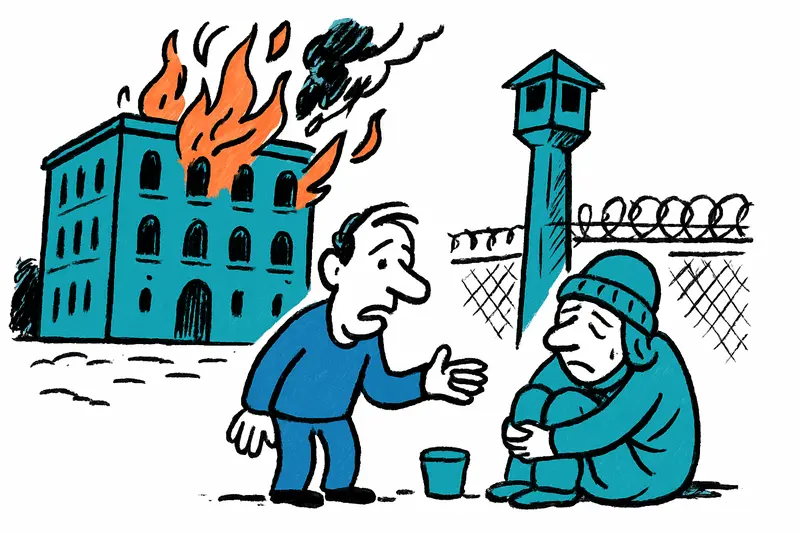
Major Fire at Palma's Old Prison — Who Protects the People in the Abandoned Building?
Major Fire at Palma's Old Prison — Who Protects the People in the Abandoned Building?
A major fire broke out overnight in Palma's prison, which has been closed for decades. No one was injured, but the recurring problem remains: people are sleeping in an unsafe building.
Major Fire at Palma's Old Prison — Who Protects the People in the Abandoned Building?
Key question: Why do fires keep breaking out there, and who takes responsibility for the people using the building as a shelter?
Around 1:30 a.m., sirens wailed through the dark streets of Palma. Several fire engines, police units and an ambulance were dispatched. Flames shot up from the main block of the old prison to the second floor, and thick smoke settled over the rooftops. Residents reported that the fire burned for several hours; in the morning the smell of soot still lingered in the air. No one was injured, unlike in a recent Fire near Porto Pi: five people injured.
The building has been empty for about 25 years. From time to time, people seek shelter there, sometimes in groups, sometimes alone — local aid workers estimate up to 200 people. Fires repeatedly break out in the structure. This time, initial indications suggest the blaze started in large piles of rubbish — a risk common to many abandoned buildings, as a recent fire on the outskirts of Palma showed: paper, clothing, wood scraps, gas canisters, everything can quickly act as an accelerant.
The scene in the early morning was typical for Palma in such cases: residents with cups of coffee, firefighters putting their equipment back into vehicles, police officers putting up cordon tape, and neighborhood children peeking from a distance. You hear street noise, a few birds, and mixed into these everyday sounds is the smell of extinguishing water and burnt waste.
Critical analysis: The recurring pattern — an abandoned, poorly secured building, people without stable housing, flammable materials, nocturnal fires — reveals a complex failure on multiple levels. It's not just about firefighting. It's about social support, urban planning responsibility and regular monitoring of vacant properties. Authorities and owners must ensure that such buildings do not turn into dangerous settlements. At the same time, there clearly is a lack of permanent services for people in need, otherwise they would not repeatedly seek refuge in a dilapidated prison.
What is often missing in public discourse is the perspective of those affected and concrete figures on shelter capacity on the island. One reads about firefighting operations and spectacular images, but rarely about how many emergency shelter places are actually available, how social services work night after night, and what alternatives exist to occupying abandoned buildings. Also underdiscussed is the question of ownership and why vacant properties are not secured or sensibly repurposed in the long term.
Concrete immediate measures that could take effect: regular clearing and proper disposal of accumulated rubbish in such buildings; short-term security measures such as locked access points, lighting and smoke detectors; coordinated operations by fire services, social services and municipal administration with a clear responsibility for caring for those affected; a concept for temporary accommodation with low-threshold access, medical contact points and rapid referral to permanent solutions; and finally, a registry of vacant buildings with condition assessments so priorities can be set.
In the long term, legal and planning measures are needed: simpler procedures for converting vacant properties into housing or social facilities, mandatory inspections by municipal authorities and financial incentives so owners assume responsibility. Fire and rescue services can improve technical procedures — for example agreed reporting chains when people are repeatedly seen in a building.
A snapshot of everyday reality: on a cool morning in Palma you see people from the neighborhood carrying blankets and scraps of clothing outside, volunteers with flashlights looking through corridors, and tradespeople examining emergency closures, similar to the response in Cala Major: six shops cordoned off. Such scenes are distressing because they show that a whole city, alongside an acute emergency, is also ignoring an ongoing social issue.
Conclusion: The fire at the old prison is more than a nighttime operation for the fire brigade. It is an alarm signal for gaps in housing and social policy, for insufficient control of vacant buildings and for missing accountability. The solution requires pragmatic action today and clear political decisions tomorrow. Until then, the recurrence of fires in such places — unfortunately — remains likely.
What matters now: Immediately secure the building, clear combustible waste, provide coordinated care for those affected and establish binding responsibilities between the owner, the municipality and social services.
Frequently asked questions
Why do fires keep breaking out at Palma's old prison?
Is it safe to swim or go out after a fire in Palma?
Who is responsible for abandoned buildings in Mallorca?
What should you do if you see smoke or a fire in Palma?
Why do people sleep in abandoned buildings in Palma?
How can abandoned buildings in Mallorca be made safer?
What does the old prison fire in Palma say about housing in the city?
Can abandoned properties in Palma be turned into housing or social facilities?
Similar News
Magaluf: Watchtower Alarm – Lifeguards Pull Unconscious Beachgoer from the Water
After a drama in the late afternoon, two lifeguards at Magaluf beach rescued an unconscious 44-year-old man. He was stab...

Turquoise in the City: How dangerous is the color play of the Sa Riera?
The Sa Riera in Palma suddenly turned turquoise — a pretty motif, but behind the effect lies a discharge of saline waste...

Jeckliner at Sunnesching: Cologne spirit sets sail from Palma
In September 2027 the Mein Schiff 2 briefly becomes a floating carnival stage: four days with Cologne bands, comedy and ...
Finally Home: Mike and Leyla Heiter Buy Villa with Sea View in Mallorca
The reality TV couple Mike and Leyla Heiter have bought a house in Mallorca with a roof terrace and sea view. An Instagr...

Arrest after series in Palma: Who protects apartments from repeat offenders?
The National Police arrested a man in Palma who investigators say may have broken into several apartments. In one incide...
More to explore
Discover more interesting content

Can Cap de Bou

Townhouse Lleo 72
