
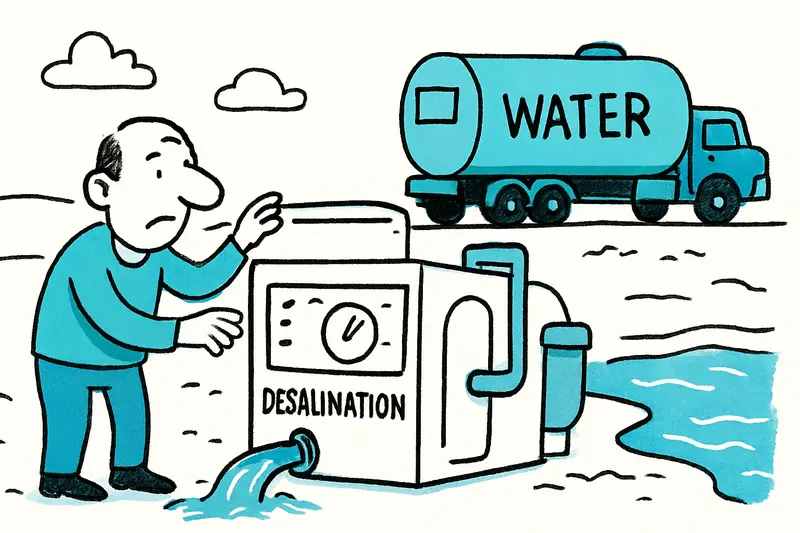
When the Sea Becomes the Reservoir: Mallorca and the Dependence on Desalination Plants
When the Sea Becomes the Reservoir: Mallorca and the Dependence on Desalination Plants
Sixty-two percent of Mallorca's drinking water now comes from seawater desalination. Energy demand, brine discharge and a lack of public debate about costs and alternatives remain. A critical assessment with practical solutions.
When the Sea Becomes the Reservoir: Mallorca and the Dependence on Desalination Plants
Key question: How far can Mallorca go when almost two thirds of our tap water now comes from the sea?
The sober numbers
Currently, desalinated seawater accounts for about 62 percent of the island's drinking water supply. Abaqua, the Balearic supply company, delivered a total of 29 cubic hectometers of water to municipalities last year. Of that, 18 cubic hectometers came from the desalination plants in Palma, Andratx and Alcúdia. A further 4.7 cubic hectometers came from the spring sa Font de sa Costera near Sóller, and the remaining roughly 6.3 cubic hectometers from underground sources. Around two thirds of this volume is consumed in residential areas; agriculture accounts for about 22 percent.
Critical analysis: Why the numbers hurt
Desalination solves the availability problem – but it shifts it. Seawater must be forced through reverse osmosis or similar processes at considerable energy cost. Energy means expense and greenhouse gas emissions, as long as the power mix is not fully renewable. Then there is the brine: a highly concentrated by-product returned to the sea. In theory the impact is locally limited if discharge occurs in well-mixed areas. In practice, however, the question remains how repeated discharges – combined with rising water temperatures and seasonal current changes – will affect the seabed and species composition in the long term.
What is missing from the public discourse
There is much talk about volume and availability, very little about long-term costs and the energy source. Who discusses the electricity bill of the desalination plants in the context of the island's climate targets? Who compares the cost per cubic meter with investments in water-saving measures, leak repair or rainwater retention? And: a blanket figure like “62 percent” hides seasonal fluctuations, as reported in Water shortage in Mallorca: As Gorg Blau and Cúber shrink — is Palma really prepared?. In summer, when tourism and irrigation increase at the same time, the ratio shifts even more toward desalination – which affects grid load, prices and ecology.
An everyday scene from Palma
Sunday morning at the Mercat de l'Olivar: vendors spray their plants in front of the stall, a contractor discusses a project for a new apartment building with an integrated cistern over coffee, and on the Paseo Marítimo a water tanker heads toward Andratx. Habits are simple: life means water—lots of water. Yet most people hardly think about the route the water took before it comes out of the tap.
Concrete approaches
1) Use energy smarter: Couple desalination plants as much as possible to renewable electricity, for example with PV installations near the plants or through power purchase agreements with local producers. 2) Manage demand: More graduated tariffs, savings incentives for businesses and tourism operators, mandatory water meters in holiday rentals and subsidies for water-saving fixtures. 3) Tighten infrastructure: Reduce distribution losses — modernize the pipeline network and systematically repair leaks. 4) More circular economy: Use treated wastewater selectively for agriculture and industry so that drinking water is not wasted on fields. 5) Aquifer recharge and rain retention: Promote buildings with cisterns, create urban catchment areas, store lost rainwater and deliberately replenish groundwater, supported by monitoring efforts such as Mallorca's network of groundwater probes and smart meters. 6) Fund research into brine use: Recover substances from brine or explore technologies for brine dilution and valorization.
Why this is realistic
Many measures cost less than the ongoing operation of large desalination plants when you project energy costs over decades. Small, well-targeted interventions — such as solar panels next to a plant or mandatory cisterns for new buildings — have immediate and locally visible effects. Communities in Felanitx or Sóller feel how investments in storage and efficiency pay off, as described in When the reservoirs shrink: How Mallorca's water shortage affects Palma and the villages; the experience exists and just needs to be scaled up.
Conclusion: Not a ban, but a brake
Desalination is not an evil technical finger-point, it is a fact: we use the sea so that it lets us drink. The real question remains open: do we want an island permanently relying on energy-intensive water production, or an island that manages its available freshwater more intelligently? Mallorca needs both: short-term reliable supply and a long-term strategy that integrates energy, ecology and price fairness. If, in five years, solar collectors on a desalination plant are clearly visible from the Paseo Marítimo, that would be a good sign. Until then: think, measure, act.
Frequently asked questions
How much of Mallorca's tap water comes from desalination?
What are the main environmental and energy concerns about seawater desalination in Mallorca?
What practical steps can people in Mallorca take to use less water?
How does Mallorca's water supply vary with the seasons?
Where does Mallorca's drinking water come from?
What important topics about Mallorca's water system are often missing from public discussion?
What concrete steps could Mallorca take to reduce reliance on desalination?
Is desalination a permanent fix for Mallorca's water supply?
Similar News

Human chain in Manacor: 80,000 chickens, many unresolved questions
Residents and animal welfare activists formed a human chain at the Son Brau estate to protest a planned poultry farm wit...
Unrest on the doorstep: What Barcelona's riots mean for Mallorca
128 arrests in Barcelona, numerous injured and devastated shops: Why the wave of violence 260 kilometers away can also b...

Why the unrest in Barcelona should be a wake-up call for Mallorca
A TikTok call led to nighttime violence and hundreds of arrests in Barcelona, many of them minors. What is behind the ph...
Palma under the microscope: 87 arrests over forged passports – what now?
The National Police stopped 87 people at Palma airport this year with allegedly forged documents. Why are controls alone...

When a Taxi Fare Dispute in Magaluf Turned Bloody: How Safe Are Passengers and Drivers?
In Magaluf a dispute over the fare escalated: a tourist, now 18, is accused of having seriously injured a taxi driver in...
More to explore
Discover more interesting content

Can Cap de Bou

Townhouse Lleo 72
