
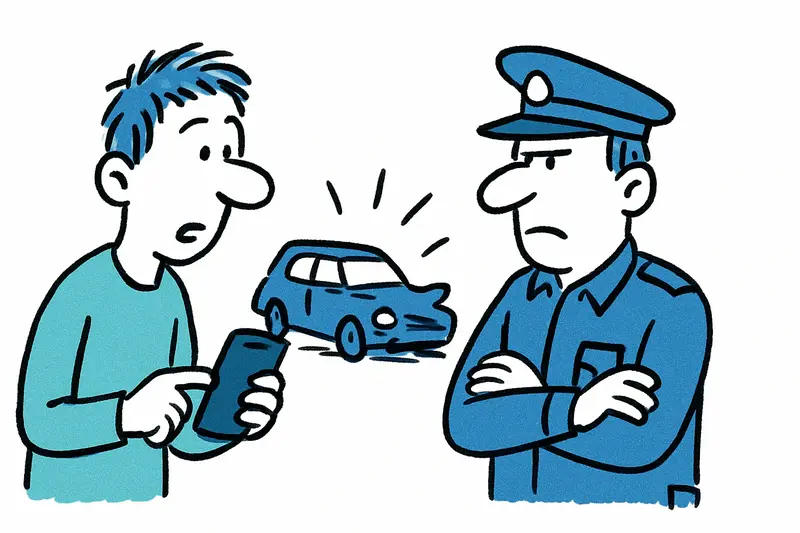
New witness information after fatal accident in Coll d'en Rabassa
New witness information after fatal accident in Coll d'en Rabassa
After the accident in Coll d'en Rabassa a witness has come forward: he says he saw the driver on his phone shortly before the collision. The phone was secured and investigations are ongoing.
New witness information after fatal accident in Coll d'en Rabassa
Key question: How reliable are the new leads — and do they provide enough to truly clarify what happened on the street?
A week ago a family in Coll d'en Rabassa experienced the unthinkable: a three-year-old girl died after being struck by a car on the sidewalk. Several relatives were seriously injured. The local police have now handed a report to the competent court listing new witness statements.
One witness said he had seen the driver on his phone shortly before the accident. According to the police report, the phone was found in the center console; officers secured the device. At the same time, investigators are looking into whether the driver may have suffered a medical episode. These are the facts, succinct and sober, as they are known so far.
Critical analysis
A single witness can be a puzzle piece — but often not the whole picture. Visibility conditions, viewing angle, the excitement at the scene: all of this distorts memories. Also problematic is the question of technical analysis. A smartphone in the center console does not automatically mean it was in active use, that the screen was lit, or that a call was in progress. Without detailed forensic examination much remains speculative.
The claim that someone saw the phone must be placed within a chain of evidence: accident traces, vehicle inspection reports, medical assessments of the driver's health, witnesses from different perspectives. If any of these elements are missing, the trial risks being worked out through conjecture instead of clear facts.
What is missing from the public debate
On Mallorca, blame is often assigned quickly before the facts are on the table, as in the case of After head-on crash in Palma: Fleeing and many questions – 31-year-old dies. Two things are frequently missing: transparent information on the status of the investigations, as in Fatal accident near Son Castelló: Three passengers come forward — where are the gaps in responsibility?, and an objective interpretation of technical findings. The perspective of the victims' family — how police and the justice system handle their rights and expectations — is also rarely discussed publicly, even in nearby incidents such as Chimney Explosion in Coll d’en Rabassa: 18-Year-Old Seriously Injured — Investigation and Safety Questions. There is also a lack of debate about how vulnerable traffic areas like sidewalks can be better protected.
Everyday scene from the island town
Picture the street in Coll d'en Rabassa on a mild December afternoon: delivery vans honk, an elderly woman pulls her rollator over the cobbles, children's voices from a nearby courtyard mingle with the sound of a bus driver shifting through the lane. It is in such seemingly ordinary moments that accidents happen — a second of distraction, a sudden medical episode, a misjudged distance. That is what makes the case so tragic and at the same time so hard to grasp.
Concrete solutions
1. Immediate technical examination: The secured phone must be forensically analyzed (usage time, active apps, call logs) — using a documented methodology that will hold up in court.
2. Independent vehicle inspection: Check brakes, steering and electronic systems. Sometimes technical faults explain accidents better than human error, as in Fatal crash at Son Castelló: More than an accident on the road to Sóller.
3. Medical evaluation: Rapid examinations of the driver's health (heart, metabolism, medication); assessments should come from neutral neurologists/cardiologists.
4. Corroborate multiple witnesses: Different perspectives, timestamps and points of agreement are more important than single dramatic statements.
5. Local safety review: Inspect sidewalks, curbs, sight lines and speed profiles in Coll d'en Rabassa and, if necessary, make short-term adjustments (bollards, 30 km/h zones, improved lighting).
Why this matters
Without a solid body of evidence justice remains incomplete — both for the victims' family and for the alleged driver. A transparent, thorough investigation is needed so that such a severe tragedy does not dissolve into endless speculation. The island community needs clear answers to maintain trust in police and the justice system.
Conclusion: The new eyewitness lead is one piece of the puzzle, but not yet proof. When technical and medical examinations are combined, the events can be reconstructed with greater certainty. And perhaps the case's review will make parts of Coll d'en Rabassa safer — not only for local residents but for the many families who use these streets every day.
Frequently asked questions
What do the new witness statements in the Coll d'en Rabassa accident actually mean?
Can a witness saying a driver was on the phone be enough to prove distraction in Mallorca?
What happens to a phone seized after a traffic accident in Mallorca?
Could a medical episode explain a crash like the one in Coll d'en Rabassa?
How reliable are eyewitness accounts after a fatal accident in Mallorca?
What safety changes could make streets in Coll d'en Rabassa safer for pedestrians?
Why do police investigations in Mallorca take time after a fatal road accident?
What should families expect after a fatal traffic accident in Coll d'en Rabassa?
Similar News
Released with Conditions: The Plus Ultra Suspicion and a Mallorcan Finca as Residence
A Dutch entrepreneur, sought in connection with the Plus Ultra case, was extradited to Spain after his arrest in Germany...
Haute Nuit in Puerto Portals: Fashion, Art and Indulgence by the Water
On October 2 the Lobster Club in Puerto Portals will be transformed into a stage for curated fashion, art and culinary e...
Magaluf: Watchtower Alarm – Lifeguards Pull Unconscious Beachgoer from the Water
After a drama in the late afternoon, two lifeguards at Magaluf beach rescued an unconscious 44-year-old man. He was stab...
Turquoise in the City: How dangerous is the color play of the Sa Riera?
The Sa Riera in Palma suddenly turned turquoise — a pretty motif, but behind the effect lies a discharge of saline waste...

Jeckliner at Sunnesching: Cologne spirit sets sail from Palma
In September 2027 the Mein Schiff 2 briefly becomes a floating carnival stage: four days with Cologne bands, comedy and ...
More to explore
Discover more interesting content

Can Cap de Bou

Townhouse Lleo 72
