
Nightmare in Son Banya: Saw at the Neck, Blood Outside the Station — What's Going Wrong?
A man in Son Banya was lured into a trap under the pretext of receiving money, threatened with a saw, severely beaten and robbed. A British couple was arrested. Our reality check asks: Why does violence repeat in this neighborhood — and what needs to change?
Nightmare in Son Banya: Saw at the Neck, Blood Outside the Station — What's Going Wrong?
Key question: How can Palma prevent places like Son Banya from becoming permanent stages for violence and crime?
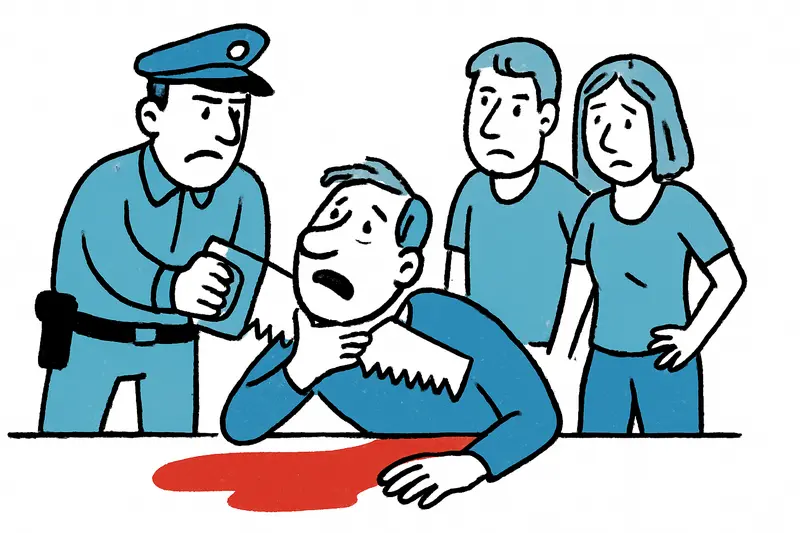
These are scenes no one in the city likes to see: A man stands bloodstained in front of the police station, reporting that he had been lured into a trap. He had followed an alleged debt collector, met with a couple — and ended up in a maze of shacks where one of the attackers put a saw to his neck before the assault escalated into a violent attack. According to the police, the man was seriously injured and later needed staples on his head and back; he is in hospital.
The suspected attackers, two British nationals in middle age, were arrested in their home and are being prosecuted for robbery and grievous bodily harm. After the assault, residents intervened and separated the victim from his attackers, while the couple apparently initially managed to flee.
Incidents like this are not mere headline material — they reflect structural problems. Son Banya has been a hotspot for years: precarious housing situations, open drug dealing, precarious living conditions, as a morning raid with helicopter lights showed.
Critical analysis: Short-term police presence stops outbreaks of violence but does not solve the causes. Raids can clean up streets for weeks, yet the trade returns and the hardships remain. Laws are enforced, perpetrators are arrested — but what is missing is a sustainable concept that links prevention, social support and law enforcement. If a person can be lured into a trap and threatened with a saw, this also reveals gaps in local prevention: missing contact points for conflict mediation, too little direct social work on site, and a situation where private disputes often escalate into violence.
What is missing in the public debate: concrete figures on repeat offenders, information on prevention programs and the consequences for victims. There is a lack of open debate about how justice, police and social services should be linked. Also rarely addressed: the responsibility of owners and administrators for neglected properties and the role of urban planning in the emergence of such neighborhoods.
An everyday scenario from Palma that illustrates the problem: On a cool afternoon in the residential areas near Son Banya, you see people carrying parcels, children on their way to school, neighbors chatting in front of houses. At the same time, tension lurks in some side streets: a hurried pedestrian, a furtive glance, the attempt not to stand out. This parallel world is sadly familiar — people live door to door with insecurity, without regular, clear help arriving.
Concrete solutions: First, strengthened and consistently coordinated social work on site. Instead of isolated deployments, there need to be fixed teams that build trust, recognize conflicts early and offer mediation. Second, targeted prevention programs for young people, training opportunities and perspectives so that drug dealing is not the only source of income. Third, a clear strategy for derelict properties: hold owners accountable, enforce repairs or enable interim uses by social initiatives. Fourth, police officers should not only react but regularly do foot patrols together with social workers to build rapport with the population. And fifth, victim support: quick medical and legal assistance, anonymous reporting through trusted channels and protective measures that prevent traumatized people from being left alone.
Practically implementable would be, for example, a "Community Response Team" made up of social workers, mediators and local police members that offers weekly fixed consultation hours near the neighborhood. Such low-threshold services reduce reluctance and can prevent disputes from escalating. In addition, a citywide mapping of hotspots is needed so that measures act preventively rather than reactively.
Pointed conclusion: The arrest of two suspects shows that the system can work, as in the arrest of an alleged drug boss in Son Banya. But arrests alone are a bandage, not a cure. Palma must mend the interfaces between police, justice and the social services that reach people on a daily basis. Son Banya is not "just a problem" on the margin — it is a test of how the city deals with poverty, exclusion and violence. If we do not deliver, the scene visible in front of the police station at the end of a long day will repeat itself.
The situation remains tense, and it is the responsibility of those in charge in the city and municipality to recalibrate the balance between order and support. For the neighbors, for the victim, for Palma as a whole.
Frequently asked questions
Why is Son Banya in Palma often linked to crime and violence?
What should visitors in Mallorca know about safety around Son Banya?
How does police action in Son Banya affect crime in Palma?
What kind of long-term solutions are being suggested for Son Banya in Palma?
What role do social workers have in preventing violence in Palma neighborhoods like Son Banya?
What happens to people who are injured in violent attacks in Palma?
Are there any signs that Palma is taking the Son Banya problem more seriously?
What does Son Banya tell us about urban problems in Mallorca?
Similar News
Magaluf: Watchtower Alarm – Lifeguards Pull Unconscious Beachgoer from the Water
After a drama in the late afternoon, two lifeguards at Magaluf beach rescued an unconscious 44-year-old man. He was stab...
Turquoise in the City: How dangerous is the color play of the Sa Riera?
The Sa Riera in Palma suddenly turned turquoise — a pretty motif, but behind the effect lies a discharge of saline waste...

Jeckliner at Sunnesching: Cologne spirit sets sail from Palma
In September 2027 the Mein Schiff 2 briefly becomes a floating carnival stage: four days with Cologne bands, comedy and ...
Finally Home: Mike and Leyla Heiter Buy Villa with Sea View in Mallorca
The reality TV couple Mike and Leyla Heiter have bought a house in Mallorca with a roof terrace and sea view. An Instagr...
Arrest after series in Palma: Who protects apartments from repeat offenders?
The National Police arrested a man in Palma who investigators say may have broken into several apartments. In one incide...
More to explore
Discover more interesting content

Can Cap de Bou

Townhouse Lleo 72
