
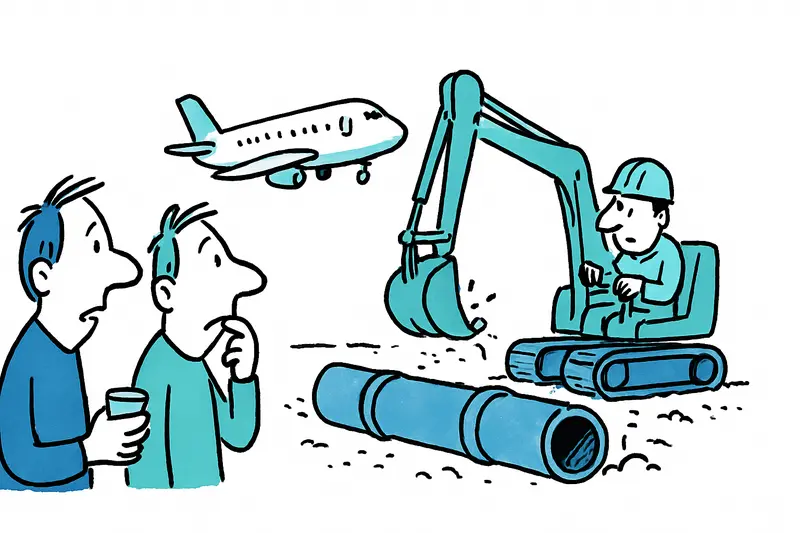
Nine months of construction at the airport: Three kilometres of sewage pipeline to be replaced
Palma Airport is getting a new, roughly three-kilometre-long sewage pipeline. The works will last nine months and may create problems for operations and nearby residents.
Nine months of construction at the airport: Three kilometres of sewage pipeline to be replaced
How can flight operations, the environment and residents' interests be protected at the same time?
At Palma Airport a major project is underway: a roughly three-kilometre-long fibre-cement sewage pipe will be renewed. The contract volume is about €1.3 million (excluding taxes), and the work is planned over a period of nine months. The pipe is considered old and vulnerable; recently cracks and faults have been repeatedly recorded that can endanger both airport operations and the environment because untreated sewage could leak out.
Key question: Can an operating airport be reconciled with extensive earthworks for nine months without noticeable restrictions or environmental damage?
The technical challenge is that parts of the old pipes run directly under the apron for general aviation. Interventions there during flight operations are hardly possible. According to plans, the new pipe is therefore to be laid in a more accessible route and no longer run under the general aviation area. This is intended to make future repairs easier and prevent similar incidents.
Specifically, temporary interruptions of the sewage network, odour nuisance, restrictions caused by crossings of the high-voltage network and traffic limitations in the area south of the runway may occur during construction. The permit parking lot could also be needed temporarily as a storage area for materials and machinery.
The airport operator has so far not provided detailed information on whether and to what extent flight movements will be affected. The tender conditions stipulate that the contractor must submit a plan to minimise risks and that the work should be adapted to ongoing operations as far as possible.
Critical analysis: The key figures sound factual, but gaps remain. Nine months is a long time; the possible consequences — from unpleasant odours to obvious interventions in operational areas — affect not only technical processes but also staff, commuters and neighbours. What happens in the event of an unforeseen damage incident outside planned working hours? Who bears the additional costs if, for example, extra measures are necessary to prevent environmental damage? Such questions have not yet been answered publicly.
What is missing in the public debate: transparency about the concrete schedules, binding time windows for noisy work, a comprehensible risk assessment for the environment and groundwater, and communication for affected users of the airport site. There is no easy-to-find telephone number or online contact point for residents and airport employees who want to report immediate disturbances during the construction phase.
An everyday scene from here: early in the morning, when the bus stops at Avenida Antoni Maura and luggage carts rumble across the paved apron, it quickly becomes clear how closely space and operations are intertwined at the airport. Airport staff stand together with coffee cups and look towards the runway; when excavators and trucks meet there, routine suddenly becomes a visible construction site. Residents south of the runway have experienced that even small interventions cause noticeable changes — after the work it often smells different, there is more truck traffic, parking spaces disappear.
Concrete solutions that should be implemented immediately: first, phased work planning with clear night and weekend windows, coordinated with quieter flight times. Second, use of technical methods that minimise excavation (e.g. partial use of pipe jacking or prefabricated pipe sections) to reduce time and odour release. Third, temporary containment systems and continuous sampling of the surrounding soil and groundwater so that potential leaks are detected and contained quickly. Fourth, a reliable communication channel — a hotline plus daily brief online updates — so that employees and affected persons know planned restrictions in advance. Fifth, coordination with the high-voltage network operator so that crossing works are safe and coordinated. And sixth, pragmatic solutions for parking users: designated replacement areas and clear signage so that arguments do not start daily during the holiday rush.
An additional point: environmental and health protection cannot be guaranteed by construction plans alone. Making measurement protocols public creates trust. Those who work at the airport or park there have a right to know what measurements are available before, during and after the work.
Conclusion: Replacing the sewage pipe is technically overdue and sensible in the long term. The conflict is that a major construction site is to take place in a highly frequented operation. Without transparent scheduling, tangible measures to contain odours and a reliable communication strategy, there is a risk of annoyance, reputational damage and, in the worst case, environmental incidents. A responsible project is possible — but only if those responsible provide clear answers now and do not only react when the first resident calls or an operational failure affects flights.
Frequently asked questions
How long will the Palma Airport sewage pipe replacement take and what does it involve?
Will flight operations be affected during the Palma Airport sewer pipe replacement?
What measures are planned to minimise disruption during the Palma Airport sewer project?
Why is the new sewer pipe being moved away from the general aviation area at Palma Airport?
Which areas around Palma Airport could see temporary changes during construction?
How can residents and airport staff stay informed about the construction near Palma?
What is the overall budget and scope of the Palma Airport sewer replacement project?
What environmental safeguards are planned for the Palma Airport sewer replacement?
Similar News

Pilot denies two drunk men boarding – Why a bachelor party en route to Mallorca got out of hand
In Klagenfurt a pilot stopped two heavily intoxicated men from boarding en route to Mallorca. Two police interventions, ...
Beach Emergency in Portals Nous: Why Seconds Can Decide Life or Death
A visitor from Asturias suffered a cardiac arrest on Friday afternoon off Portals Nous and was brought ashore after prol...

Arrest in Son Sant Joan: Tourist attacks taxi driver — what the incident reveals about the island
A dispute over a pedestrian crossing escalated at Palma Airport: a British tourist struck two taxi drivers and damaged a...

Rain in Sight – Will the Water Be Enough for Mallorca by the End of the Week?
Aemet predicts showers at the end of the week. But a few drops and a slight temperature drop are not enough to ease the ...

Community at Sea: A Sailing Club in Port d'Andratx Opens Its Hatches
In the harbor of Port d'Andratx, residents share a 13-metre sailing yacht, organize trips themselves and thus keep a sma...
More to explore
Discover more interesting content

Boat Tour with BBQ along Es Trenc Beach

Private transfer from Mallorca Airport (PMI) to Pollensa
