
Phone, Wheels on the Curb, a Dead Child: Open Questions After the Collision in Coll d'en Rabassa
Phone, Wheels on the Curb, a Dead Child: Open Questions After the Collision in Coll d'en Rabassa
A small mistake, a devastating outcome: After the fatal accident in Es Coll d'en Rabassa, witness reports about a phone at the wheel and marks on the curb are central. What is still missing — and what the investigation must establish.
Phone, Wheels on the Curb, a Dead Child: Open Questions After the Collision in Coll d'en Rabassa
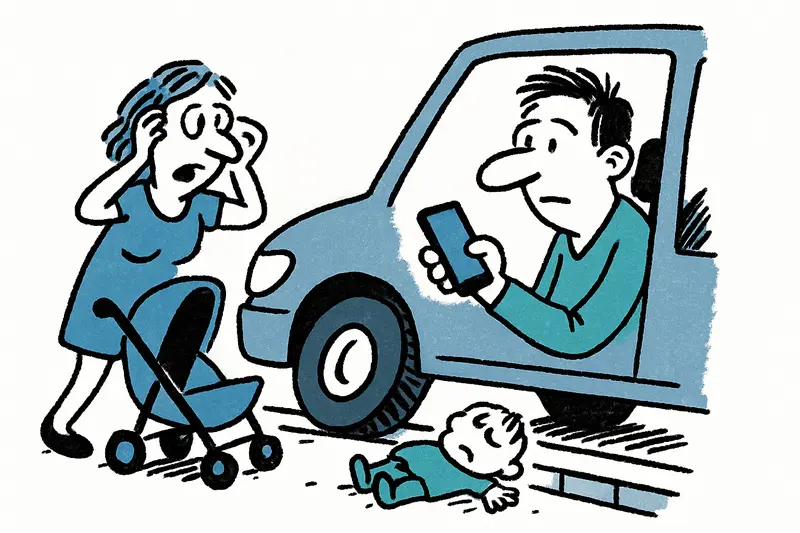
On early Sunday afternoon at the Bailén/Caimari intersection in Es Coll d'en Rabassa, a driver lost control of his white Mercedes, mounted the sidewalk and struck three members of a family, as reported in Tragedy in Coll d’en Rabassa: Child Killed on Sidewalk — Who Protects Our Pavements? The three-year-old girl, Elena, died at the scene; the mother and grandmother were taken injured to Son Espases hospital. The father remained uninjured in the parked Renault Scenic.
Key question
Was it truly a sudden medical collapse — or did the phone in the center console play a role? This single question runs through the facts known so far and separates possible negligence from a tragic medical emergency.
Critical analysis of the facts
The municipal police investigation has brought several elements together: a witness reports having seen the driver with a mobile phone shortly before the crash; the device was secured from the center console and is in police custody. The driver's wife described to police a strikingly unsteady driving behavior and reported repeated contacts between the wheels and the curb. Marks at the edge of the carriageway were found and are being analyzed. Alcohol and drug tests were negative. The driver himself stated he suffered a sudden health impairment.
From these points two competing hypotheses can be derived: either a sudden medical episode of the driver or a brief period of distracted driving — for example due to the phone. Both scenarios are compatible with the wife's statement and the tire marks; the witness tip about the phone makes the distraction hypothesis more likely, but it is not yet proof. Two things will now be decisive: the forensic analysis of the seized phone (timestamps, usage immediately before the crash) and the precise reconstruction of speed and trajectory by the accident analysis unit.
What is missing in the public debate
Public debate often resorts to blanket explanations — “medical collapse” or “accident without third-party involvement” — without asking the technical questions: Was there any recorded data in the vehicle (possible driver assistance systems, airbag control unit), are there GPS or mobile network data that can document the period of distraction, and how fast was the vehicle actually traveling at impact? Also missing is a closer look at the location itself: residents had already spoken of fast driving at this intersection and of many families with prams crossing the street. Such contextual information must be included in the assessment — not only to determine guilt, but to think about prevention. Similar investigative gaps were raised after the Fatal accident near Son Castelló: Three passengers come forward — where are the gaps in responsibility?
Everyday scene from Mallorca
Picture the corner: a blue sky with a light northeast breeze, the scent of the sea drifting from the coast, children's voices from the nearby football pitch mixed with the hum of motor scooters. Parents with prams cross the streets, delivery vans park along the curb. In exactly such moments a second of distraction at the wheel — a glance at the phone, a small evasive movement — is enough for a normal Sunday walk to become a tragedy.
Concrete solutions
It is not only about prosecution, but about measures that can prevent similar accidents. Suggestions that could have short- and medium-term effects:
1) Forensics and data analysis: Quickly evaluate mobile and app usage data, extract vehicle data (if available), secure dashcam or CCTV footage in the area.
2) Traffic calming at the intersection: Speed bumps, narrowed lanes, clearer zebra crossings and improved sight lines to reduce speeds, especially at times when children are present.
3) Controls and visible presence: More mobile patrols by municipal police in problematic residential areas, temporary speed displays and campaigns against distraction by mobile phone use at the wheel; such measures were urged after incidents like the After head-on crash in Palma: Fleeing and many questions – 31-year-old dies
4) Pedestrian infrastructure: Safer crossings, ramps instead of high curbs, lowered parking near intersections to prevent hidden parking and improve sight lines.
5) Public awareness: Involve local childcare centers, clubs and schools in Es Coll d'en Rabassa in prevention programs: short workshops, flyers and visible notices at playgrounds.
Concise conclusion
The facts show: there are serious indications of distraction by a phone, but no conclusive proof — not yet. For the affected family the outcome is nonetheless unbearably severe. For the community the incident means: the discussion about safe streets and sanctioning distraction must become practical. Police, city and neighborhood are now called upon to: clarify, inform, and change the place so that the next brief glance at a phone no longer decides between life and death.
The investigation continues; whether this was a medical emergency or a criminal offense will be decided by the judiciary. Until then Coll d'en Rabassa remains a street with a gap in the community — and with concrete possibilities to close it.
Frequently asked questions
What happened in Coll d'en Rabassa during the fatal crash?
Could phone use have played a role in the Coll d'en Rabassa accident?
What can cause a driver to suddenly lose control on a Mallorca street?
What should police check after a serious traffic accident in Mallorca?
Is Coll d'en Rabassa a dangerous area for pedestrians?
What safety measures could help prevent crashes like this in Mallorca?
What should I watch out for when driving in residential areas of Mallorca?
Why do traffic accidents in Mallorca often lead to wider public debate?
Similar News
Mistaken identity with fatal consequences: Brutal assault in S'Aranjassa — what's missing in the follow-up?
At S'Aranjassa a visitor to a finca was tied up, beaten and thrown out of a van. Three men have been arrested, including...
High heel slips, car accelerates: accident on Camí de Son Hugo
A woman lost a high-heeled shoe on the forecourt of the sports facility at Camí de Son Hugo. The car accelerated, mounte...

Phone Scam: How Two Hotel Employees at Playa de Palma Lost Thousands of Euros
One morning in September, two reception employees at Playa de Palma were pressured by alleged alarm-company staff — in t...
When the Wallet Becomes a Danger: Attack in Peguera and Lessons for Mallorca
In Peguera, two women are said to have stolen the wallet from a 75-year-old German couple. When the victim intervened, t...
Plata stays Plata: Young people take over, Llonguets remain
A small bar on Carrer de l'Argenteria will continue: Tolo Serra hands the place over to young Mallorcans at the end of t...
More to explore
Discover more interesting content

Can Cap de Bou

Townhouse Lleo 72
