
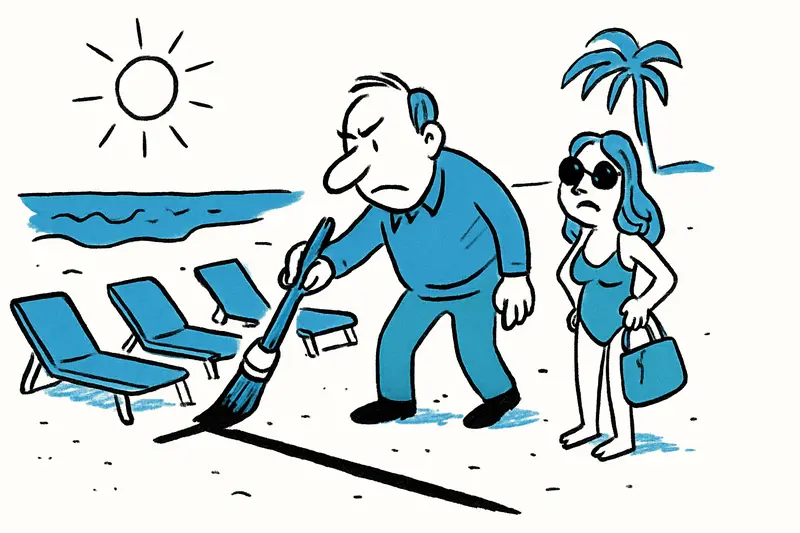
Palma must cut sun loungers: beach areas shrinking – who pays the price?
More than 1,000 sun loungers are to be removed in Palma, around 30 percent of the stock. Sand loss, smaller beach areas and new rules are changing the seaside landscape. An inventory with critical questions and concrete proposals.
Palma must cut sun loungers: beach areas shrinking – who pays the price?
Key question: Is cutting loungers enough, or do Palma's beaches need a more fundamental plan?
On a windy morning walking along the Paseo Marítimo you first hear the crunch of footsteps in the remaining fine sand, then the calls of the seagulls and the distant clatter of a beach umbrella. The news that Palma wants to save more than 1,000 loungers – roughly 30 percent of the previous stock – is not an abstract administrative notice; it has a face: narrower beach strips, gaps between loungers, and in some places people competing for less space (reported in Palma Cuts Sunbeds — What Will Happen to Our Beaches?).
The reasons are clear: sand loss and thus reduced beach areas force the city to act. Affected are well-known sections like Cala Major; here not only space for loungers disappears, but a kiosk also has to give way. At the same time, planning foresees that places like Arenal and Cala Major will in future allow so-called premium loungers. Balinese beds, on the other hand, are to be banned completely (as outlined in Palma awards beach concessions 2026–2029: millions, rules and sand loss).
Critical analysis: The measure seems sensible in the short term – fewer loungers means less overcrowding. But it does not answer the underlying question: why are the beaches losing so much sand, and who will finance a lasting stabilization? A pure reduction of inventory only shifts the problem to the edges. Beach concessions, seaside catering and tourist business models remain in place; as areas shrink, local usage density can even increase.
What is often missing in the public discourse is the perspective of long-term coastal management. It's not just about loungers and kiosks, but about maritime dynamics, building limits, rainwater retention inland and responsibilities between the municipality, island administration and concessionaires. Who decides on sand replenishment? Who monitors whether new construction inland diverts water and accelerates erosion processes? And: how will users be compensated when areas disappear?
Everyday observation from Palma: On a November afternoon in Cala Major you see retirees spreading their towels earlier than usual, families with children filling gaps between loungers, and suppliers maneuvering pallets of soft drinks past narrower paths. The kiosk owner packs his crates, quietly but visibly affected. These scenes are not just emotion; they are the economic reality for people who depend on the beach (see Emptier sunbeds, growing worries: How is Mallorca reacting to more frugal beachgoers?).
Concrete solutions that go beyond cutting loungers should combine several levels: first, targeted beach nourishment in critical sections with scientific oversight and transparency about timelines and costs. This must not become uncontrolled sprawl, but be based on coastal engineering expertise. Second, introduction of flexible concession models: those who use less area pay less or receive incentives for environmentally friendly alternatives (for example mobile shade structures instead of permanently installed loungers). Third, stricter requirements for coastal development and rainwater management inland to avoid further fueling erosion.
Fourth, involvement of residents and entrepreneurs: a small regular round table with representatives from hotels, beach operators, residents and environmental experts. Decisions must not depend solely on technical reports and short-term cost-cutting goals. Fifth, experimental concepts: natural dune restoration zones, planted sandbanks, seasonal rollbacks of concession areas for regeneration.
The question of premium loungers and the ban on Balinese beds reveals a social dimension: premium offers privilege wealthier guests while ordinary beach users find less space. From a municipal political perspective, this means that allocation criteria for beach areas must consider social balance. Otherwise a two-tier beach usage threatens – in the middle of a city that should declare its coast a common good.
Financing remains a central issue. Beach nourishment is expensive; private concessionaires are often unwilling or unable to bear the costs alone. Possible sources include EU funding programs for coastal protection, joint funds of the island and the municipality or reliable reserves from tourism levies. Transparency in accounting is indispensable here.
A pragmatic roadmap for Palma could look like this: an inventory with public measuring points (sand thickness, beach width, before-and-after photos), a three-year program for targeted nourishments combined with near-natural dune areas, adjustment of concession contracts to seasonal realities and permanent monitoring. Only in this way can another round of cuts be avoided reflexively.
Crisp conclusion: cutting loungers is a necessary buffer, but not a substitute for a coherent coastal strategy. Those who cut loungers today must decide tomorrow whether to buy sand back, redistribute space or change concepts. For the people on the coast, from the kiosk owner to the child with a sandcastle, the outcome matters. Palma needs an honest conversation about costs, responsibility and what beach culture is worth in a growing city.
Frequently asked questions
Why is Palma reducing sun loungers on its beaches?
Will Palma beaches feel more crowded after fewer loungers are installed?
What happens to Cala Major beach in Palma?
Are premium loungers allowed on Palma beaches?
What is the best way to protect Mallorca’s beaches from sand loss?
Who pays for beach replenishment in Palma?
How do beach changes in Palma affect local businesses?
What long-term plan does Palma need for its coastline?
Similar News

Caro Robens: 15 kilograms lighter — and again in the crossfire of online comments
Bodybuilder Caro Robens, who lives in Mallorca, has lost 15 kilograms. Her success on Instagram was met with applause — ...

Meager Industry in Mallorca: How the Island Can Be More Than Just Tourism
The industrial sector in Mallorca is shrinking, productivity is falling and firms remain tiny. The key question: can the...
Pre-Nit de l'Art: Galerie Mensing invites to a special evening with Tom Boston
Before the big art night, Galerie Mensing opens its doors: pop art, champagne, a DJ and a hand-signed print by Tom Bosto...

Sea view and more seats: Cappuccino Grand Café reopens in Port d'Andratx
After a long renovation, the Cappuccino Grand Café on the Port d'Andratx harbor promenade has quietly reopened. Larger t...

Enric Mas wins the Vuelta – a triumph that resonates in Mallorca
Mallorcan Enric Mas has won the 82nd Vuelta — the first Spanish overall victory since 2014. Cyclists and neighbors on Ma...
More to explore
Discover more interesting content

Can Cap de Bou

Townhouse Lleo 72
