
More buses, same jams: Palma's traffic stuck in a dilemma
EMT records millions more passengers — and yet long lines of cars still crowd Palma's main arteries. Why full buses don't automatically mean less congestion and what steps are needed now.
More passengers, same jams: Palma faces a traffic dilemma
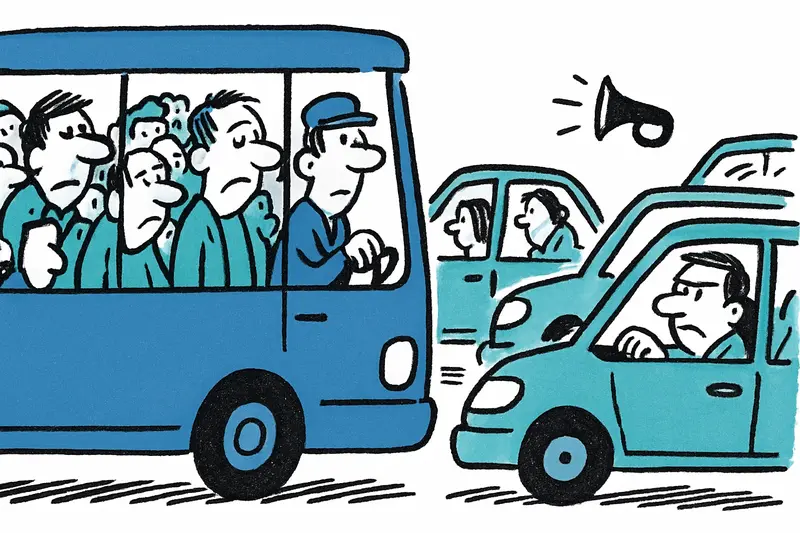
On one of those bright, windless mornings on the Via de Cintura, espresso still in hand, you first hear the hum of engines and then the constant honking. EMT buses roar by fully occupied, passengers with backpacks and shopping bags squeeze in through the doors — and yet the left lane remains a sea of cars. The numbers confirm the impression: EMT recorded a jump from around 40 to about 60 million passengers in the last two years. Still, the main arteries have not noticeably emptied.
The key question: Why doesn't higher public transport use mean less car traffic?
The answer is twofold and unspectacular: many new bus trips replace short walks or bike rides, while at the same time the number of people and deliveries moving through the city is increasing. What looks like success in statistics meets noise, exhaust and daily uncertainty about travel time in everyday life. Someone who used to stroll for five minutes down the carrer now takes the bus out of convenience — often even free for residents — and thus occupies capacity that does not automatically replace cars.
Aspects that are often left out of the debate
First: delivery and commuter traffic are growing. Online orders, more construction sites and new residential neighborhoods on the outskirts bring additional trips that converge in the morning and evening. Second: parking remains expensive and yet available. As long as it is easy to leave the car at the destination — whether at the supermarket or in front of the school — the barrier stays low. Third: modal split is complex; the decision about which mode of transport to choose depends on comfort, reliability and the last mile. Full buses show demand, but not necessarily a shift away from those who travel long distances by car in the morning and evening.
A bus driver I met on Passeig Mallorca put it succinctly: 'The buses are full, that you can see. But at the traffic light next to me — still the same caravans of cars.' The sounds of the city confirm her perspective: engines, tires on asphalt, a bicycle bell in the distance — and between them the voice of the timetable counting the stops.
Concrete consequences for commuters, residents and shops
On the central axes, the traffic counter still records around 14,300 vehicles daily — roughly the value from six years ago. For commuters this means unpredictable travel times, postponed appointments and higher operating costs. For residents: longer periods of noise, poorer air quality and less quality of life. For businesses, congestion can be both curse and blessing: deliveries become more complicated, while customers linger in the neighborhoods instead of darting across the city.
What is needed now: more than better buses
Full buses are a step forward — but not sufficient on their own. Palma needs accompanying measures that encourage the behavioral changes statistics have not yet delivered. Concrete steps could be:
- Expand and enforce bus lanes consistently: If buses get stuck in congestion, they lose attractiveness. Dedicated bus lanes and automatic monitoring relieve pressure and speed up public transport.
- Strengthen park-and-ride facilities on the city outskirts: Pick up commuters before they enter the center; with fast, reliable feeder buses and secure bicycle parking.
- Shift delivery times intelligently: Night deliveries for large retailers, staggered deliveries and fixed loading zones ease peak periods.
- Parking management and pricing: Less direct parking in the center, attractive public transport and bike incentives for commuters, targeted incentives instead of blanket subsidies.
- Micromobility and safe cycle paths: More continuous, protected bicycle corridors, better parking infrastructure and integration into public transport to solve the 'last mile' problem.
And finally: an honest discussion about land use. Housing construction on the outskirts brings people — and traffic. When new neighborhoods are developed, mobility concepts must be considered from the outset, not debated afterward.
A glimpse from everyday life in Mallorca
The solution is not a single lever, but a bundle of investments, regulations and behavioral changes. On a hot afternoon in Santa Catalina you see parents with shopping bags, cyclists on narrow lanes and tourists squeezing between delivery vans. There are opportunities: a more reliable bus connection can convince people to leave the car behind — but only if it is faster, more predictable and more comfortable than driving their own vehicle.
Conclusion: Palma's rising bus numbers are encouraging — they reflect a willingness to use public transit. But they will not bring noticeable relief to the streets on their own. That requires bolder planning, targeted interventions in parking and delivery flows and a willingness to change habits. Otherwise the morning coffee on the Via de Cintura may stay warm, but the traffic will remain loud.
Frequently asked questions
Why does Palma still have traffic jams even though more people are taking the bus?
Is Palma bus travel enough to reduce car traffic on its own?
What causes traffic congestion in Palma besides private cars?
What is park-and-ride and could it help traffic in Palma?
Why are bus lanes important in Palma?
How does traffic affect people living and working in Palma?
Is it still practical to cycle in Palma?
What needs to change in Palma to ease traffic long term?
Similar News
After Being Admitted to Hospital Again: Heinz Hoenig and the Questions We Should Ask in Mallorca
Long-time Mallorca resident Heinz Hoenig was admitted to hospital again. A clear “what next?” is missing from the covera...
Yellow Alert: Is Mallorca Prepared for the Next Rain Band?
Aemet has issued a yellow alert for the south, southwest and the island's interior. Thunderstorms and heavy rain are for...
Kegel brothers trial postponed: Why Mallorca must wait for a verdict
The trial of 13 German holidaymakers will not begin until May 2028. The long wait raises questions — for victims, defend...
Chaos on Palma's Runway: Why the Summer at the Airport Was So Disrupted
This summer laid bare where Palma airport is faltering: only just over half of departures were on time and seven percent...

Cocaine Offer on Ham Street: Why the Open Trade Should Ring Alarm Bells
In the middle of Pare Bartomeu Salvà a tourist was offered a packet of cocaine as part of a sunglasses deal. A short int...
More to explore
Discover more interesting content

Can Cap de Bou

Townhouse Lleo 72
