
Stones Instead of Help: Sandstone Blocks under the Jacint‑Verdaguer Bridge
Under the Jacint‑Verdaguer Bridge in Palma the island council has stacked sandstone blocks to keep homeless people away. A pragmatic fix for the cityscape — but not an answer to a social problem. Why deterrence is not the same as help and which steps are truly needed.
Sandstone Instead of Immediate Help: The Measures under the Jacint‑Verdaguer Bridge
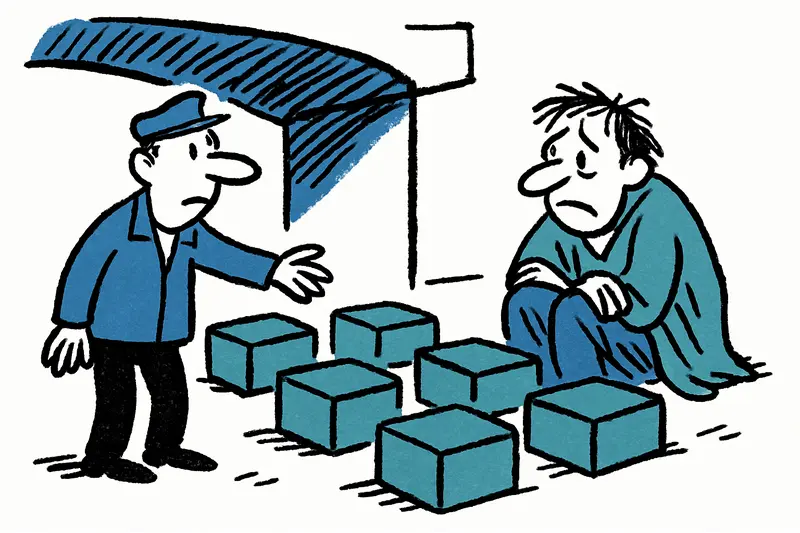
Yesterday morning, the sun high over Palma and a train whistling by as usual, I cycled along the Jacint‑Verdaguer Bridge. On the raised strip between the railway track and the footpath there were now evenly spaced sandstone blocks – neat, almost reverent, like a path through a quiet cemetery. No blankets, no cardboard, no improvised tents anymore. The island council states clearly: the stones are meant to prevent people from settling there, as noted in Bloques de piedra bajo el puente de Palma: ¿Disuasión en lugar de ayuda?. Brief, visible, deterrent.
Between Son Fortesa and Son Oliva: a quick tidy-up, big effect
The spot on the border between Son Fortesa and Son Oliva is narrow, noisy, used by commuters. After renovation work on the bridge the administration "restored" the area and placed the sandstone blocks. Residents say it looks cleaner and safer. An elderly man in the square who walks his dog every morning called it pragmatic: "At last it stops people camping here." In the background the usual sounds continued: children playing on the playground, the rattle of the tram, a street sweeper rolling by.
The downside of a "visible clean-up"
It's not that simple. Social initiatives that have been supporting people without housing for years speak of displacement rather than solution. People do not simply vanish; they move on — to other bridges, to parks or to less visible, more dangerous places, as documented in Homelessness on Paseo Mallorca: When the Park Bench Becomes the Final Address. "You protect the city's eyes, not the people," says an employee of a counseling center. The problem is shifted, the risks remain: worse hygiene, reduced access to support services, increasing isolation.
What is missing from the public debate
There are aspects that are rarely discussed: the administration's legal position in dealing with public spaces, the responsibility between the island council and the city of Palma, and the costs of long-term displacement. The psychological effect also plays a role — the feeling of being driven away makes it harder for those affected to seek help. And finally, monitoring is often lacking: where did the cleared people go, who recorded their data, what follow-up care took place? Reliable data is lacking, as highlighted in Mallorca's Streets Are Growing Longer: Why More Than 800 People Are Homeless and Nothing Solves It by Itself.
The central question
The guiding question is: should urban order be more important than social care? Deterrence creates short-term order and reassures neighbors. But is the city image more important than the dignity and safety of vulnerable people? Who bears responsibility when measures merely shift symptoms instead of tackling causes?
Concrete steps instead of symbolic gestures
If the island council really wants to make a difference, sandstone blocks are not enough. A structured plan with clear measures is needed. First: more affordable housing and guaranteed transitional housing — not just temporary emergency shelters. Second: mobile counseling services that are regularly present at hotspots, with dedicated contacts so trust can develop. Third: low-threshold day centers where people can shower, do laundry and receive advice. Fourth: targeted cooperation with established aid organizations — not only during clearances, but for follow-up care and reintegration.
What would be practicable
A practicable approach could look like this: in the short term, more sleeping places in vacant municipal buildings; in the medium term, a pilot project for 50 transitional apartments with support (social work, health, job placement); in the long term, citywide monitoring that transparently shows where cleared people went and how many actually find stable housing again. In parallel, municipal building plans should be reviewed to secure land for social housing — this is possible if political will and budgetary means come together.
My conclusion
As a neighbor who lives here, cycles and hears the train in the morning, the quick turn to aesthetics annoys me. Yes, the corner looks tidier. But cleanliness can look different too: with programs that bring people back into the system, not just out of sight. I expect more transparency from the island council: figures on where the affected people went, what alternatives were offered and which financial resources are now being invested in lasting solutions.
This is not a plea to keep places open where acute problems exist. It is an appeal not to confuse deterrence with policy. Otherwise, in the end there will only be neatly stacked stones — and the same names in the social reports.
If you are from the area: how did you experience the change? Do the residents who welcome the measure speak for the majority, or do you see displacement instead? Write to us.
Frequently asked questions
Why were sandstone blocks placed under the Jacint-Verdaguer Bridge in Palma?
Is it common in Mallorca to use physical barriers to discourage rough sleeping?
What are the risks when homeless people are moved from one place in Palma to another?
What help is available for people without housing in Palma and Mallorca?
What is the area like around the Jacint-Verdaguer Bridge in Palma?
Why do some residents in Palma support removing camps from public spaces?
What would a longer-term response to homelessness in Mallorca look like?
Does cleaning up a place in Palma really solve the homelessness problem?
Similar News

When coercive fines aren't enough: Could holiday rental owners soon face prosecution?
The island administration is stepping up action against unauthorized holiday rentals: high daily coercive fines up to €5...

Palma Airport on an Expansion Course — Who Decides How Much Growth the Island Needs?
Aena and Madrid are planning multi-million euro investments for Son Sant Joan and project higher capacities. Concern is ...
Who Gets Left Out? Why Overbookings Will Hit Many Mallorca Travelers This Summer
On hot check-in days at Son Sant Joan, frustrated travelers pile up. New figures from Reclamador.es show that a large sh...
When the Handyman Came: How an Engagement Ring Disappeared in Mallorca and What It Says About Trust
During a repair in Andratx a highly personal engagement ring went missing — a case that calls not only for punishment bu...
How Burglars Test Fincas in Mallorca — and What You Can Do About It
The Spanish National Police warn of a simple but effective trick: small markings on doors reveal whether a finca is occu...
More to explore
Discover more interesting content

Can Cap de Bou

Townhouse Lleo 72
