
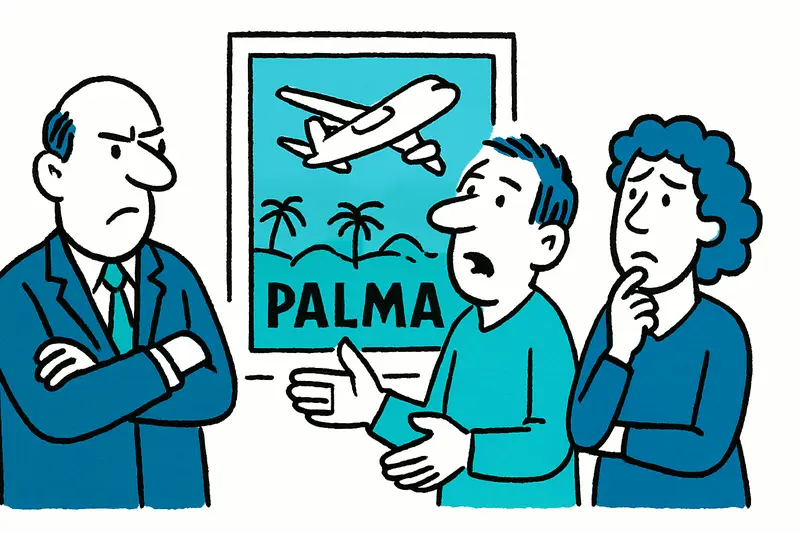
Parliament rebukes Aena chief after airport poster – Who is responsible?
Parliament rebukes Aena chief after airport poster – Who is responsible?
An advertising poster at Palma airport prompted the Balearic parliament to issue an official rebuke against Aena and the Spanish transport minister. The debate shows that a rebuke alone is not enough. Who decided to put up the image — and how can future image damage to the island be prevented?
Parliament rebukes Aena chief after airport poster – Who is responsible?
Key question: Is a rebuke enough, or does Mallorca need binding rules for airport advertising?
At Son Sant Joan, between baggage carousels and bus exits, a larger political aftermath is underway: an advertising banner that links Mallorca with binge drinking has prompted the regional parliament to publicly rebuke the president of the airport operator AENA under criticism: €10 million fine for facial recognition at Palma airport – a reality check and the Spanish transport minister. The Sparkassen financial group has since announced it will remove the poster. At first glance this seems like a case that can be resolved with a single gesture. On closer inspection, there is more to it.
In short: the rebuke is a strong symbol. But symbolic actions do not solve the processes that were decided in the airport hall: approvals, contractual clauses, and billing for advertising space. In the arrivals hall there are tourist groups with suitcases, older couples, families with children; at carousel 3 you see the same faces, often puzzled by slogans that do not reflect the Mallorca image experienced by those who live and work here.
Critical analysis: Who decides which advertising is shown? In many airports there are agencies that manage inventory, Aena awards spaces to third parties, and advertisers supply motifs. This leads to several weaknesses: conflicts of interest exist (see Ryanair vs. Aena: When an Airline Dispute Lands on Mallorca), review mechanisms are often guided by cost rather than cultural fit, and political bodies react late when the damage is already visible. The rebuke shows who is politically dissatisfied; it does not automatically identify where prevention must take place.
What is missing from the public discourse: transparency about the contract chain for outdoor advertising, clear guidelines for cultural sensitivity, and a reporting channel for citizens who spot problematic motifs. There is also a lack of a fast escalation option that would allow a local authority to have inappropriate advertising temporarily removed within hours — instead of relying on voluntary statements from advertisers.
Everyday scene from Mallorca: late one morning taxi drivers sit in front of the terminal café, discuss travel waves and shake their heads at the headlines (such as Who Is to Blame? Dispute Between Ryanair and Air Traffic Control Causes Trouble in Palma), while young receptionists from Palma laugh because such posters neither describe their work nor the regular guests of the island. A cleaner wipes a stain from the floor, looks at the banner and says: "That's not our Mallorca." Such feedback rarely reaches politicians and businesses directly — and when it does, often too late.
Concrete solutions
1) Advertising rules with an island check: introduce a short review process for large-format advertising at the airport in which a local panel (representatives of municipalities, the tourism board, and civil society) can check for cultural suitability. This check should be mandatory, not just advisory.
2) Transparency obligation: publish all advertising contracts and decision paths in summarized form so it is clear who bears which responsibilities.
3) Emergency mechanism: establish a quickly convenable body with the authority to temporarily remove advertising until a final review is completed.
4) Contract clauses: include codes of conduct in concession contracts that provide for sanctions if advertising content harms the island's interests.
5) Preventive training: provide training for agencies and advertisers on local context and sensitive topics so errors occur less frequently.
What a rebuke can achieve — and what it cannot
The rebuke is a clear political signal. It creates pressure, leads to recall actions and to discussions about image management. But it does not replace structural change. A one-time removal of the poster mitigates the immediate damage but does not fix the gaps in the approval process and does not affect the economic incentives that lead to controversial motifs being displayed in the first place.
Concise conclusion: Mallorca needs practice, not a punchline. If the island no longer wants to be misunderstood as a party backdrop, committees and rules must be created to review airport advertising for its impact before it is displayed. A rebuke is the wake-up call — everyone who lands, works or lives here must wake up.
Frequently asked questions
Why did Mallorca’s parliament rebuke the Aena chief over the airport poster?
Who is responsible for advertising shown at Mallorca Airport?
Can Mallorca remove offensive airport advertising quickly?
What kind of rules could Mallorca introduce for airport advertising?
What does the Mallorca airport poster row say about the island’s image?
What happens at Son Sant Joan when controversial ads appear?
What can travelers expect at Mallorca Airport if an ad campaign causes a controversy?
Why do people in Mallorca want more transparency over airport ad contracts?
Similar News

Found dead in Son Gotleu: Dog walk ends fatally — what is missing in the investigation?
A 68-year-old man was found dead on Sunday morning on Tomás Rullàn street in Son Gotleu. According to his partner, he ha...
Theft at Playa de Palma: How safe are tourists at night?
At Playa de Palma street vendors snatched a gold chain worth around €5,000 from a tourist. The National Police intervene...
Smoking Weed at the Ballermann: Why a Ten-Euro Joint at Playa de Palma Ends in Handcuffs
A street purchase for 10 euros at Playa de Palma led to an arrest. Why a simple joint on holiday can have serious conseq...
Push-ups on the Sea: Why Prone Paddlesurf is Taking Off in Mallorca
Those who crawl belly-down across the water aren't signaling for an ambulance but curiosity: prone paddlesurf — long, na...

When Bouncers Run Amok: Emmy Russ and the Question of Safety at the Ballermann
An incident at the Megapark involving reality TV figure Emmy Russ raises broader questions about the oversight of securi...
More to explore
Discover more interesting content

Boat Tour with BBQ along Es Trenc Beach

Private transfer from Mallorca Airport (PMI) to Pollensa
