
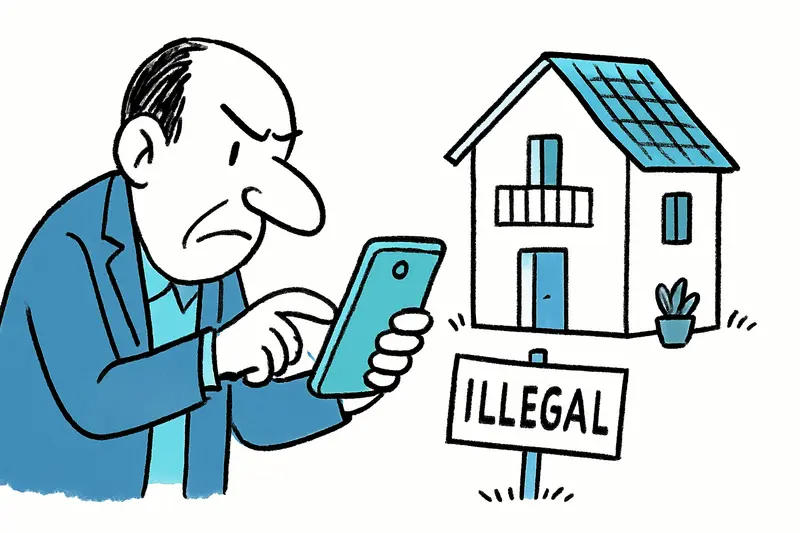
PSOE deliberately books illegal holiday apartment in Palma — What does the action reveal?
PSOE deliberately books illegal holiday apartment in Palma — What does the action reveal?
With a targeted booking, the PSOE in Palma drew attention to holiday apartments without a valid license. What does this reveal about enforcement, platforms and housing?
PSOE deliberately books illegal holiday apartment in Palma — What does the action reveal?
Key question
Can a single, deliberately booked holiday rental shed more light on a structural problem — or does the action remain symbolic as long as enforcement and data are lacking?
Brief summary of the facts
Members of the Socialist Party booked a holiday apartment in Palma that, according to them, cost around 160 euros per night and was offered on the platform with an apparently false license number. The party filed a complaint. The responsible tourism department rejects the allegations and points to crackdowns since 2023; it also says Airbnb was required in autumn 2025 to remove roughly 2,300 listings and cites fines of over €300,000 for illegal holiday rentals in Llevant.
Critical analysis
The action is a wake-up call, but not proof of a standalone failure. It highlights three things: First, there is a discrepancy between registration rules and on-site inspections. Second, platform checks are not flawless — false numbers and incorrect entries repeatedly appear, as in Eleven holiday apartments without a license in Palma's Old Town. Third, the tangible consequences for locals emerge on the street: fewer long-term rental apartments, rising prices, and neighborhoods that change step by step.
What is often missing in public discourse
Voices of those affected are missing: people who had to move away because of rental pressure, or older neighbours who can describe the noise from constantly changing guests. There is a lack of clear, accessible data: how many licenses are active, how many listings actually match the registration number? Analyses point to significant gaps, such as nearly 8,000 unregistered holiday apartments in Mallorca. And there is a lack of transparency about which sanctions were actually imposed — fines only deter if they are levied and collected.
An everyday scene in Palma
Early morning on Carrer de Sant Miquel: a baker slides loaves into the oven, motor scooters buzz by, a woman with shopping bags stops and says she saw a neighboring building last summer whose windows remained closed for months — the apartment was constantly listed on booking platforms. Such small observations are not proof on their own, but they tell of a daily life in which apartments increasingly function as a source of income rather than as homes.
Concrete, feasible solutions
1) A public, searchable register of all registered holiday apartments with verification numbers and a real verification stamp. 2) Platform obligation: booking sites must verify registration numbers automatically before a listing goes live. 3) Stronger cooperation between municipalities, regions and platforms with standardized interfaces for cross-checking. 4) Mobile inspection teams in municipalities that prioritize on-site complaints. 5) Higher and effectively enforceable sanctions against professional providers who thin out the housing market. 6) Incentives for owners to return to the regular rental market, for example through tax benefits for long-term rentals. 7) An anonymous reporting function for neighbours, complemented by clearly communicated processing times. 8) A monitoring report published twice a year that provides figures on removals, fines and complaints.
Why these solutions are realistic
Software-supported checks exist, registries are technically feasible; it is often not about invention but about political will and resources. If platforms are forced to validate data, the number of fake listings will be reduced. If municipalities are better equipped, abuse can be stopped more quickly.
What the current debate might overlook
The discussion is often framed as a showdown between a party and the administration — but it is about a web of tax laws, tenancy law, platform power and local interests. The debate around fines and housing questions is explored in Palma targets holiday rentals: fines, Llevant and the big question about housing. And: no measure is sustainable without the participation of local people. Politics must explain how housing for residents is preserved without simultaneously devaluing entire neighborhoods.
Concise conclusion
The PSOE's booking is more than a political statement: it is a symptom of a system in need of repair. Anyone who wants to restore the balance between tourism and social housing must provide two things: reliable data and an enforcement architecture that not only produces headlines but works on the ground every day.
Frequently asked questions
How do I know if a holiday apartment in Mallorca is legal?
What happens if you book an illegal holiday rental in Palma?
Why are illegal holiday apartments such a big issue in Mallorca?
When is the best time to visit Palma if I want a quieter stay?
Can Mallorca towns really check whether holiday rental licences are valid?
Are Airbnb and similar platforms supposed to remove illegal listings in Mallorca?
What do neighbours in Palma do if they suspect an illegal holiday apartment?
What would help reduce illegal holiday rentals in Mallorca?
Similar News

When the Wallet Becomes a Danger: Attack in Peguera and Lessons for Mallorca
In Peguera, two women are said to have stolen the wallet from a 75-year-old German couple. When the victim intervened, t...
Plata stays Plata: Young people take over, Llonguets remain
A small bar on Carrer de l'Argenteria will continue: Tolo Serra hands the place over to young Mallorcans at the end of t...
Unnoticed in the Luggage Compartment: How a Boy Traveled More Than 100 Kilometers in a Team Bus
A minor traveled in the undercarriage of a team bus for more than 100 kilometers until his cries for help were heard. A ...

Cap Vermell Grand: Second Michelin Key – a Gift for the East
The Cap Vermell Grand in Capdepera has been awarded its second Michelin key. For the region this elevates the luxury off...
Eurowings lets four aircraft carry names – a friendly idea that also reaches Mallorca
Eurowings is launching a campaign: four Airbus A320s are to carry the first names of people who help others in everyday ...
More to explore
Discover more interesting content

Can Cap de Bou

Townhouse Lleo 72
