
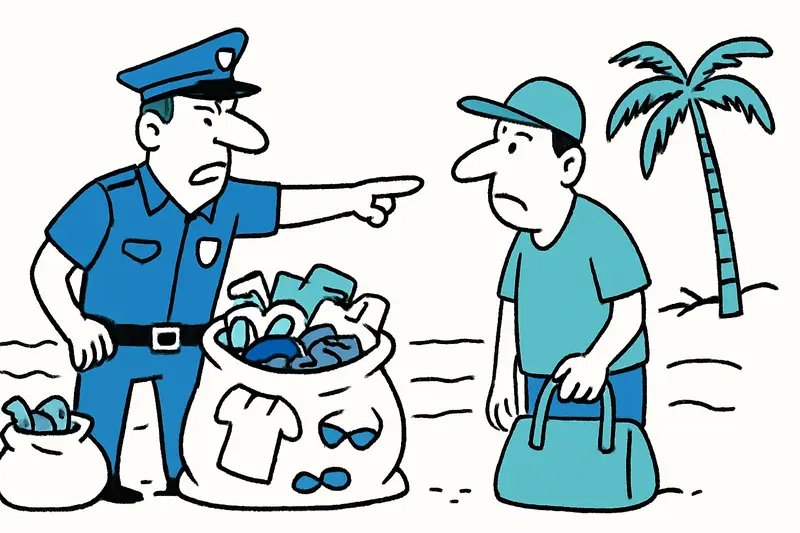
Raid at Playa de Palma: More than 5,700 Counterfeits — and What's Missing
Raid at Playa de Palma: More than 5,700 Counterfeits — and What's Missing
During a six-hour targeted operation at Playa de Palma, the local police confiscated over 5,700 suspected counterfeit items. 21 shop operators are under investigation. Is that enough?
Raid at Playa de Palma: More than 5,700 Counterfeits — and What's Missing
Checks in 21 shops, 85 officers, 80 sacks of goods — focus remains forward-looking
The local police of Palma carried out Raid at Playa de Palma: Nearly 6,000 Counterfeits — What’s Really Behind It on a Friday morning. Between around 11:00 and 17:30, 21 shops on the streets Cartago, the Carretera de l’Arenal and on Plaza Maravillas were inspected simultaneously. In the end more than 5,700 seized items — T-shirts, bags, caps, sportswear, sunglasses, trousers and other accessories — were packed in 80 sacks ready for removal.
85 officers were deployed, including 26 trainees; the operation was supported by two on-duty officers and coordinated by an inspector. Experts from the affected brands worked with the task force to determine whether the items were genuine counterfeits. Investigations were opened against 21 individuals for alleged violations of industrial property rights; there were no arrests.
Key question: Are such large-scale checks sufficient to permanently curb the problem of illegal trade in tourist zones like Playa de Palma?
Short answer: No, at least not on their own. The raid sends a clear signal — but alone it is not enough to change the system behind the street and shop offerings.
Why? First, there is a demand that is fueled seasonally and locally: sun-seekers who want to quickly buy a branded shirt, a cheap bag or sports sunglasses. Second, the control windows are currently punctual and concentrate on peak times; supply chains and wholesalers who provide the goods often remain outside the view of short-term operations. Third, seized goods and investigations are only the first step; the legal follow-up, fines or even confiscation of sales proceeds determine the deterrent effect.
What is often missing in the public debate: the perspective of honest local traders and employees who are already up early this season. I stood one afternoon on the Carretera de l’Arenal, where traffic becomes heavy in the afternoon and seagulls circle over the roofs. In front of a small shop boxes were being sorted, vendors tried to remain calm, tourists tried on caps — a scene oscillating between hustle and uncertainty. Such everyday scenes show that checks also have social consequences: existential fears of small shops, mistrust towards suppliers and craftsmen, but also relief among consumers seeking legitimate vendors.
What is missing in the approach so far? Three points stand out: better tracing of supply chains, permanent controls combined with preventive measures and clear sanctions under law and order. Cooperation with brand experts is right and important, but it is not enough if products are already distributed in large quantities before arriving on the island.
Concrete proposals that could work locally:
- Supply chain initiative: Customs, Guardia Civil and local police should pool information to target large suppliers and intermediaries.
- Year-round control plan: Not just focus weeks in high season, but regular, unannounced checks reduce short-term circumvention strategies.
- Scaled sanctions and expedited procedures: Administrative fines, seized profits and clear rules for handing over goods create deterrence.
- Education and labeling: A simple info sheet in several languages for tourists and visible labeling for licensed vendors could influence demand behaviour.
- Local incentives for legal vendors: Bureaucratic relief, joint initiatives by cooperative shop owners and quality checks help highlight reputable businesses.
The recent raid joins a series of operations across Mallorca: Big Blow Against Product Counterfeiting: What Mallorca's Role Really Reveals. This shows the problem is broader than a single street.
Conclusion: The 5,700 seized items are a visible result of intense police work — an operational success. But anyone who wants to keep Playa de Palma clean in the long term must think beyond one-off major operations: target supply chains, organise sustainable control density and set clear rules that protect both consumers and honest traders. Until then the raid remains an important but incomplete puzzle piece.
Frequently asked questions
What is the best time to visit Mallorca for sun and beach activities?
What should I pack for a Mallorca beach trip?
Is the sea in Mallorca safe for swimming?
Can I get around Mallorca without a car?
What activities are good for families visiting Mallorca?
What should I know about Mallorca's weather in winter?
Are there major festivals or events to plan around in Mallorca?
How can I stay safe in Mallorca's sun and outdoors?
Similar News
Failed before the first flight: How Fischer Air's plans for Palma were ground down
Announced routes, repeated postponements and now apparent insolvency: Why the Fischer Air project for Mallorca is not me...

Seconds in the Water: 19-year-old Fights Her Way Out of Flooded Car in Palma
A 19-year-old managed to rescue herself from her half-submerged car after sliding under the Verge de Lluc underpass. Res...

Between Dream and Reality: Thorsten Legat and the Challenges of FC Germania Mallorca
The former Bundesliga pro has assembled a colorful squad in a short time. But how realistic is the grand plan for promot...

Arrest warrant at check-in: Why two travelers at Cologne/Bonn Airport suddenly had to pay
At Cologne/Bonn Airport, federal police in mid-September found two German passengers subject to enforcement measures. Bo...

Balearic Islands as a New Route: A Reality Check on Rising Boat Migration
For the first time the Balearic Islands are ahead of the Canary Islands in boat arrivals. What do the numbers really say...
More to explore
Discover more interesting content

Can Cap de Bou

Townhouse Lleo 72
