
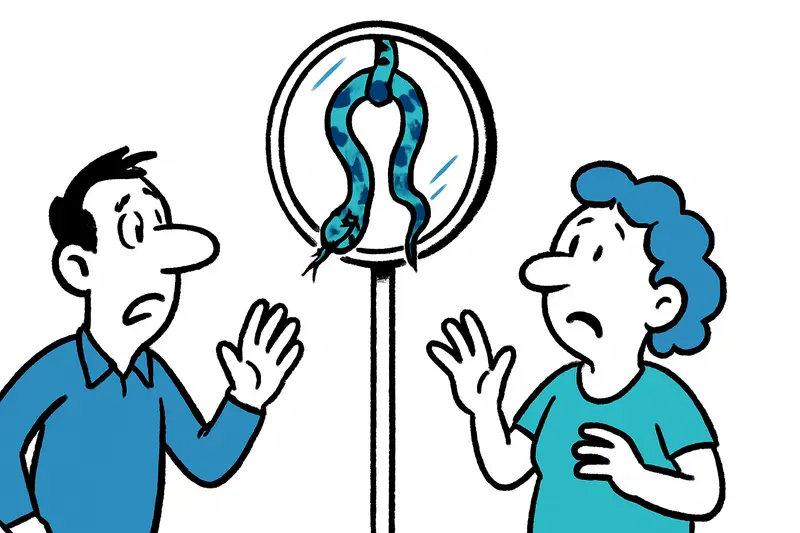
Selva: Dead horseshoe snake on traffic mirror - more than a macabre photo?
Selva: Dead horseshoe snake on traffic mirror - more than a macabre photo?
In the village of Selva a large dead horseshoe snake hung from a traffic mirror. The local police suspect it was not a natural death. A reality check: what does this say about handling, protection and prevention in Mallorca?
Selva: Dead horseshoe snake on traffic mirror - more than a macabre photo?
Lead question: Who hung the snake - and why isn't an Instagram notice a sufficient answer?
Over the weekend officers from the Selva local police discovered a large dead snake hanging from the post of a traffic mirror at an intersection. The police's Instagram post indicates it was a horseshoe snake and that the head and front part of the body were badly damaged — so not a natural death. The scene provoked disgust and questions: was this an act of provocation, a warning to residents, or plain vandalism?
On the village square on such a summer morning you often see the same picture: bakers loading bread into cars, the chirping of crickets from the olive trees, older women chatting at the bus stop. Exactly where people pass by, the dead animal had been put on display. One photo, two days on social media — and then? The police removed the reptile. Apart from a note to report the find, nothing more was visible, a shortcoming also noted in Too Many Dead Animals at the Roadside: Why Mallorca's Roads Are Becoming Death Traps.
Viewed critically, the incident raises puzzles. The horseshoe snake is increasingly present on Mallorca as an invasive species, as discussed in Why Snakes Are Appearing More Often in Mallorca Now — Danger, Causes and What We Should Do. That does not make it a wild enemy, but the species affects native birds and amphibians, as highlighted in Alarm at the Malgrats: Invasive Snakes Threaten the Sargantana. At the same time this appears to be a clear case of possibly criminal cruelty: an animal that was presumably mistreated and displayed publicly. In many European legal systems that counts as animal cruelty; in Spain the rules are comparable depending on the severity. So why not immediately a police report number, a case file reference or an appeal for witnesses?
Public debate often lacks two things: first, transparency about what happens after such finds, second, clear information about what citizens should concretely do. An Instagram post may seem informative at first, but it is hardly a substitute for opening an investigation or coordinated clarification work.
Concrete measures that should take effect on Mallorca: local find-and-report protocols, a graduated approach to invasive species (capture, document, identify, dispose), and a mandatory reporting chain between the police, the municipality and COFIB. The latter already exists informally — COFIB (Consortium for the Rescue of Wildlife of the Balearic Islands) can be reached by phone at +34 653 57 41 45 and by email at ofidiscofib@gmail.com — but these contacts must become part of a communicated emergency plan.
More importantly: municipalities like Selva should show visible prevention. Information leaflets at the town hall, notices in supermarkets and short briefings for street cleaning staff help ensure that a dead find does not become a macabre social media scene. School projects about dealing with wildlife could also help reduce prejudices.
Low-threshold reporting systems are also technically feasible: a central municipal number that forwards suspected cases to COFIB, or an app that sends images and location — of course accompanied by clear instructions: do not touch, inform emergency services or COFIB. For immediate protection it also makes sense to train police and municipal workers on proper protocols: how to document, how to recover, how to dispose safely.
Legally, the island administration could make it clear that intentional killing or mistreatment of wild animals will not go unpunished. That does not necessarily mean more repression, but it does mean: make investigation paths transparent, strengthen reporting obligations and present the pursuit of offenders as an option. Without such steps, a macabre photo remains only an attention stunt.
An everyday scene in Selva makes this clear: while the corner baker finishes the croissant shift, tourists briefly stop, look at the photo on the mirror post and shake their heads. Locals who have seen snakes more often react more matter-of-factly: "The horseshoe snake is here, but something like that is disrespectful," says a woman while holding back her grandchild. This mix of familiarity and outrage is typical — and it shows where the work lies.
Conclusion: The discovery of the dead horseshoe snake in Selva is more than a curious find. It is a focal point for three problem areas: invasive species management, animal protection and municipal information policy. Anyone who sees only a social media spectacle here misses the opportunity to introduce clear rules — for handling wildlife finds, for faster cooperation with COFIB and for visible prevention in the villages. Otherwise the story will end with just the photo — and the question of who hung it will remain unanswered.
Frequently asked questions
What is the best time of year to visit Mallorca for pleasant weather and fewer crowds?
What should I pack for a Mallorca trip to cover sun, beach days, and countryside walks?
Are Mallorca beaches suitable for swimming all year, or are there limits?
What are practical ways to get around Mallorca without renting a car?
What are family-friendly activities to enjoy in Mallorca?
Do people in Mallorca speak English, and should I learn basic Spanish or Catalan phrases?
What foods should I try while visiting Mallorca?
Is hiking in Mallorca safe, and what should I know before setting out for trails?
Similar News

Released with Conditions: The Plus Ultra Suspicion and a Mallorcan Finca as Residence
A Dutch entrepreneur, sought in connection with the Plus Ultra case, was extradited to Spain after his arrest in Germany...

Haute Nuit in Puerto Portals: Fashion, Art and Indulgence by the Water
On October 2 the Lobster Club in Puerto Portals will be transformed into a stage for curated fashion, art and culinary e...
Magaluf: Watchtower Alarm – Lifeguards Pull Unconscious Beachgoer from the Water
After a drama in the late afternoon, two lifeguards at Magaluf beach rescued an unconscious 44-year-old man. He was stab...
Turquoise in the City: How dangerous is the color play of the Sa Riera?
The Sa Riera in Palma suddenly turned turquoise — a pretty motif, but behind the effect lies a discharge of saline waste...

Jeckliner at Sunnesching: Cologne spirit sets sail from Palma
In September 2027 the Mein Schiff 2 briefly becomes a floating carnival stage: four days with Cologne bands, comedy and ...
More to explore
Discover more interesting content

Can Cap de Bou

Townhouse Lleo 72
