
Rays off Mallorca: Recovery, Risk — and What's Missing from the Debate
Rays off Mallorca: Recovery, Risk — and What's Missing from the Debate
New genetic and population data show: ray stocks are recovering after years of pressure. But low genetic diversity and gaps in protection raise questions. What should beachgoers and officials do now?
Rays off Mallorca: Recovery, Risk — and What's Missing from the Debate
A study from Palma highlights light and shadow — and calls for clear practices at the beach and the harbor
Early in the morning, when the fishing boats gently rock at the Portixol pier and the first coffee cups clink along the Paseo de Mallorca, you often see walkers curiously watching the sea. Lately the topic is on many lips: "Rays," says a woman, pointing to the open water. A new study by the Centre Oceanogràfic de Balears together with the UIB and the Institute of Marine Research now brings scientific facts into these conversations.
Key question: Are the observed population increases sufficient to guarantee long-term secure populations — and how can beach visitors and fishing interests be protected at the same time?
In short: The researchers analyzed over 180 gene sequences from seven ray species and combined this with fisheries assessment models. The result: populations show signs of recovery. Reasons include reduced fishing pressure over past decades and the EU rules in force since 2020 that decreased the number of fishing days for the bottom trawl fleet. Species such as the nail ray and the thornback ray have, according to the model, returned to more sustainable stock sizes, while the spotted ray population is stable.
However, this good news is contrasted by an unpleasant biological trait: many of these batoids have only low genetic diversity — especially species like the thornback ray (Raja clavata) and the longnose skate (Dipturus oxyrinchus). Low diversity suggests that populations were heavily depleted in the past and are therefore more vulnerable to disease, environmental changes, or new phases of fishing pressure.
Critical analysis: The study provides solid evidence but not the whole picture. The genetic samples used (more than 180 sequences) are a good start — but to make robust statements about conservation status and possible management measures, broader, repeated sampling over time and better data on coastal fishery catches are needed. We know bathymetric distribution plays a role: species whose habitat overlaps less with trawl-intensive seabeds appear to fare better. This shows how local and fine-grained protection planning must be.
What is missing from the public discourse: First, clear information for beachgoers. There are countless beach photos showing animals near the shore — without context, a phenomenon discussed in Reality Check: Why Mallorca Can Hardly Escape Massification. Second, a visible link between fisheries policy and beach management is missing: why does trawl activity decrease on paper, yet some species reappear — and what does that mean locally for fisheries and tourism? This question also connects to debates about When the Germans Stay Away: Opportunity or Risk for Mallorca?. Third: how will refuges for genetically weaker populations be secured permanently?
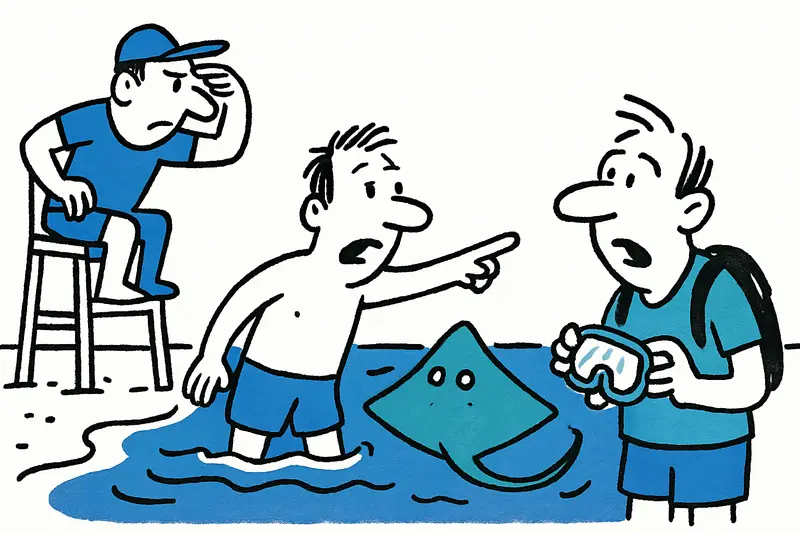
Everyday scene from Mallorca: A lifeguard runs his round at Playa de Muro, a tourist rummages in his backpack for a snorkel mask, children build a castle from snow-white sand. No one is nervous, but few know how to act when a ray appears in the swimming area. The routine of the beaches — umbrellas, ice-cream stands, beach vendors — cannot tolerate panic, but it can handle information.
Concrete proposals:
- Beach information and behavior tips: Local authorities should install simple information boards on main beaches: short guidance on how to avoid encounters (do not wade into shallow holes, follow posted signs) and what to do in case of a sting or injury.
- Better monitoring: Systematic, seasonally repeated genetic sampling and catch data, combined with sighting reports from fishers, dive clubs and citizens (citizen science app), would create a real picture of the situation.
- Local protected areas focused on genetic diversity: Where models show low diversity, time-limited fishing bans or refuge zones could help promote genetic replenishment.
- Support for fishers: If fishing days are reduced, this must be accompanied by retraining, compensation, or innovation programs to prevent illegal circumvention.
Conclusion: The research is a sign of hope — but not a blank cheque. The combination of low genetic reserves and the pace at which coastal uses change makes management demanding. A practical step would be for municipalities to quickly distribute informational material on beaches and for science, fisheries and tourism to set clear, shared criteria in the coming months. That way the sea remains safe for people — and rays have a real chance to remain stable.
A boat bell rings in the harbor. A boy points at a dark shadow near the coast, his mother laughs half fearful, half curious. A little more knowledge would help them — and all of us.
Frequently asked questions
What is the weather usually like in Mallorca in early December?
Can you still swim in Mallorca in December?
What should I pack for Mallorca in the winter months?
Is December a good time to visit Mallorca?
What is Palma de Mallorca like in early winter?
What is the weather usually like in Sóller during December?
Is it windy in Mallorca in winter?
What can you do in Mallorca when the beach weather is over?
Similar News
More water than last year: Mallorca's reservoirs breathe easier
September rain refilled the Tramuntana's reserves: overall fill around 35 percent, Cúber at 40.42 percent, Gorg Blau at ...

Three Luxury Hotels in Banyalbufar: Lots of Money, Many Questions
A Danish investor plans three exclusive accommodations in Banyalbufar — including the historic Son Valentí. The announce...
2.1 tonnes of cocaine on sailing yacht off Spain's coast – a reality check for the coastguard
A 14-metre yacht was seized with 2.1 tonnes of cocaine. Who monitors the ports, how does the international hunt succeed ...

Heat Bonus in Mallorca: 100 Euros Extra for Outdoor Staff at MarSenses
MarSenses pays employees who worked outdoors in August an extra €100 as recognition. Lighter uniforms, reduced hours for...

Renovating in Mallorca: What You Really Can Do Without Neighbour Consent
Many think they can do whatever they want in their apartment. That's partly true — but only as long as structural elemen...
More to explore
Discover more interesting content

Can Cap de Bou

Townhouse Lleo 72
