
Reality Check: How many country houses on Mallorca are really outside building regulations?
Reality Check: How many country houses on Mallorca are really outside building regulations?
An analysis of 55,256 rural houses finds: around 15,800 may have violated building regulations at the time they were built. What does that mean for owners, the landscape and the authorities?
Reality Check: How many country houses on Mallorca are really outside building regulations?
A study by MIT student Miquel Rosselló raises questions — we take a closer look
Key question: How robust is the claim that more than a quarter of the houses built on rural land in Mallorca may be illegal — and what consequences would that have for people and the landscape?
The sober numbers are taken from this work: 55,256 houses were evaluated, 15,817 of them the project "Casas que no existen" classifies as potentially unlawful. Average values mentioned in the report: around 182.75 square meters of living space on plots of about 5,712 square meters, typical year of construction 1996. The study was produced at the Massachusetts Institute of Technology; 67 people contributed to the project, and it was supported by the MIT Center for Social Impact and a scholarship from the La Caixa Foundation. The results are available online at cqne.cat.
That alone, however, is not enough to sound the alarm. Two methodological points are central to the assessment: first, Rosselló used cadastral data and standard size metrics — i.e. comparable, quantifiable indicators. That is strong because it covers large quantities systematically. Second, the author describes his estimate as "conservative": the analysis concentrated mainly on areas where building rules tended to be applied more leniently, and buildings from before 1976 were excluded. That suggests older, different kinds of violations are not captured; at the same time, focusing on more tolerant municipalities may push the share of allegedly illegal properties downward. In short: the number is striking, but not necessarily complete or definitive.
What is often missing in the public debate is the distinction between illegality at the time of construction and the current legal status. Some houses may have been built without all formal approvals, others received subsequent regularizations or are subject to proceedings. Cadastral data provide information about existing buildings and plot sizes, not about court cases, amnesties or later permits. The question of whether a building is "illegal" is often legally more complex than a dataset can show.
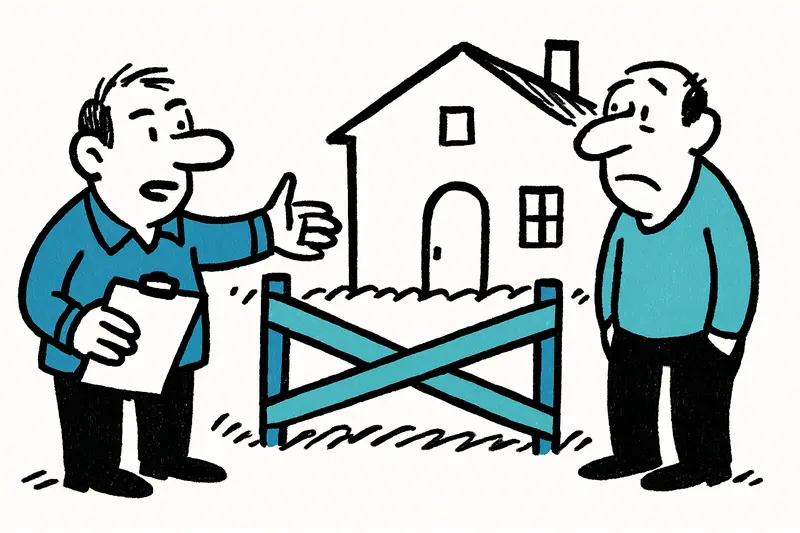
A scene from everyday life: you drive along a dusty farm track near Algaida, a half-finished house with a pool is cordoned off with barrier tape from the island council — an image familiar to many here. The farmer at the side gate shakes his head, the neighbor on the square talks about weekend noise. Such observations link the numbers to reality: land disappears from agricultural use, newcomers and second homes shape roads and supply networks, and the administration is overloaded with individual cases, as illustrated by Illegal Holiday Listings in Mallorca: Why Enforcement Fails and How It Could Work Better.
Also missing from the discourse is a clear perspective for owners and neighbors. Many people bought years ago believing they stood on legally secure ground; others invested with good intentions without fully understanding the regulations. Politics and administration face a conflict of objectives between enforcing the law, social fairness and landscape protection — and that leads to uncertain decisions on all sides, a situation reflected in Madrid draws the line: Stricter rules for holiday rentals — and what Mallorca must do now.
Concrete solutions that emerge from the analysis are pragmatic and technical at the same time: first, a digital reconciliation of cadastral data, municipal building inventories and the land registry — this would quickly filter where contradictions exist. Second, targeted audits in municipalities with a high density of suspected cases, not blanket panic measures; third, transparent regularization procedures that tie environmental protection requirements and tax obligations together so that non-regulation does not become a loophole for tax and rent evasion. Fourth: more staff and training in town halls instead of only higher fines — inspections need expertise. Fifth: local mapping projects with citizen participation so that neighbors and communities know where gaps exist.
Technology helps: a public portal with simple queries (enter a parcel number, check the status) would give owners clarity and reduce speculation, while platform actions such as deletion of unregistered listings complicate enforcement, as discussed in Airbnb Puts the Balearic Islands Under Pressure: Deleting Illegal Listings — What It Means for Mallorca. At the same time, regularizations should only be possible if ecological minimum standards are met — that protects the landscape and water supply.
My conclusion is pointed: the MIT analysis provides an important wake-up call, not a blanket accusation. The numbers show a structural problem, but the solution is not in mass demolition orders or in defending every brick. What is needed are honest inventories, administratively practical instruments and a political agreement that reconciles property security and landscape protection. On Mallorca, between olive trees and access roads with flat tires, this debate will reverberate for a long time — and it demands more clarity for the people on site than sensational headlines.
Frequently asked questions
Are many country houses in rural Mallorca actually outside building regulations?
How reliable is the estimate that many Mallorca houses on rural land are illegal?
What does it mean if a house in Mallorca was built without proper permits?
Can an irregular country house in Mallorca be regularized later?
Why are rural houses near Algaida often mentioned in the Mallorca building debate?
What kind of data is used to check rural houses in Mallorca?
What should buyers check before purchasing a country house in Mallorca?
Why does Mallorca have so many disputes about houses on rural land?
Similar News
High heel slips, car accelerates: accident on Camí de Son Hugo
A woman lost a high-heeled shoe on the forecourt of the sports facility at Camí de Son Hugo. The car accelerated, mounte...

Phone Scam: How Two Hotel Employees at Playa de Palma Lost Thousands of Euros
One morning in September, two reception employees at Playa de Palma were pressured by alleged alarm-company staff — in t...

When the Wallet Becomes a Danger: Attack in Peguera and Lessons for Mallorca
In Peguera, two women are said to have stolen the wallet from a 75-year-old German couple. When the victim intervened, t...
Plata stays Plata: Young people take over, Llonguets remain
A small bar on Carrer de l'Argenteria will continue: Tolo Serra hands the place over to young Mallorcans at the end of t...

Unnoticed in the Luggage Compartment: How a Boy Traveled More Than 100 Kilometers in a Team Bus
A minor traveled in the undercarriage of a team bus for more than 100 kilometers until his cries for help were heard. A ...
More to explore
Discover more interesting content

Can Cap de Bou

Townhouse Lleo 72
