
Red Rope in Palma's Library: What Helps Against Selfie Tourism — and What's Missing
Red Rope in Palma's Library: What Helps Against Selfie Tourism — and What's Missing
Palma's city library cordoned off an area with a red rope to keep selfie tourism away from reading and working activities. A good idea — but is it enough?
Red Rope in Palma's Library: What Helps Against Selfie Tourism — and What's Missing
Key Question
Does a red barrier rope really help protect everyday life in Palma's public library — or does it merely shift the problem elsewhere?
What Happened
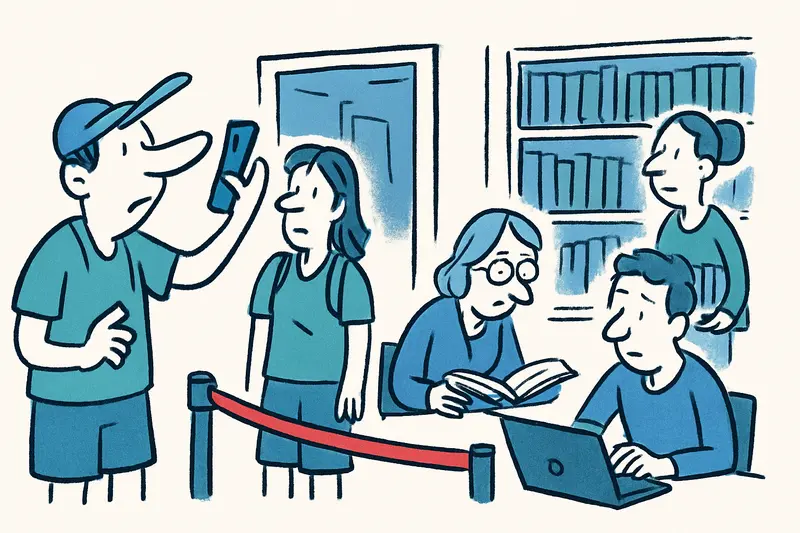
The city administration installed a red rope at one entrance of Palma's public library to separate visitors who come only to take photographs from those who come to read, study or work. First Deputy Mayor Javier Bonet emphasized that the library must remain primarily a quiet workspace. The rope is meant to mark areas more clearly: those who only look or take photos stay outside, while regular users keep their places.
Critical Analysis
At first glance the measure is understandable: readers need quiet, students need sockets and space, and library staff already have enough to do with loans, orders and events. But a barrier is mostly a symptom fix. Selfie tourism does not arise only because tourists suddenly discover famous rooms, but because places in the old town have become public backdrops. A rope works locally, but not sustainably.
What's Missing in the Public Debate
There is a lot of talk about bans and barriers, and less about management and design. Discussions focus on the immediate nuisance — loud groups, tripods, selfie sticks — but hardly on why this culture of photographic documentation is so strong and how the city can sensibly steer spaces and visitor flows. Also rarely discussed are the perspective of librarians, the spatial equipment (signage, visitor guidance) and digital alternatives that could channel photographic demand. Local calls for visible patrols and simple notices in s'Hort del Rei underline the role of basic measures.
Everyday Scene
A Tuesday noon in the old town: street sweepers clatter their shovels, the sun casts short shadows on the stone facade, cups rattle in a nearby café. In front of the library a group with a tripod and colorful T‑shirts stops, a couple argue about the perfect angle. Inside, a student types on her laptop, next to her a retiree quietly flips through a book. The red rope separates worlds, but you can still hear the discussions through the door — the boundary is thin.
Concrete Solutions
1) Clearer visitor guidance: prominent signs at the entrance in German, Spanish and English with short rules. 2) Photo times or a photo zone: designated time windows for visitor photos or a dedicated room that may be photographed without disturbing others. 3) Small permits for professional shoots — with registration and conditions so commercial use does not occur without oversight. 4) Digital alternative: a high-quality 360-degree tour on the website or photo packages from the library to satisfy photo interest without flooding the building with people; other initiatives have experimented with sensors and small cameras at beach access points. 5) Cooperation with tourism offices: information in city maps and for guides about which places are sensitive. 6) Staff and communication: training library staff for friendly but firm instructions; clear escalation steps instead of ad-hoc discussions. 7) Visitor management across the quarter: when several hotspots compete, the old town needs a comprehensive concept, not island solutions.
Legal and Practical Considerations
A rope is legally unproblematic as long as public access rights are not arbitrarily restricted. If the city wants to introduce permanent access restrictions, it must make rules transparent and state comprehensible criteria. Sanctions are rarely effective; information often works better than punishment, as debates over Palma's tighter controls and increased patrols have shown. By contrast some towns have resorted to public notices such as posters with faces of alleged pickpockets in Soller, a contentious approach.
Conclusion
The red rope is a clear signal: the library remains a place for reading and working. But if the city takes the issue seriously, a visible ribbon alone is not enough. It requires planning, communication and alternatives — from limited photo tours to digital tours. Otherwise the disturbance will simply move one door down. For library visitors who come in the morning with coffee and a laptop, one thing matters in the end: that the quiet remains. The red rope can achieve that — if it is part of a larger concept, not the whole concept itself.
Frequently asked questions
What is the best time of year to visit Mallorca for beach weather and manageable crowds?
Should I rent a car in Mallorca or rely on public transport?
What should I pack for a Mallorca trip to handle sun, heat, and coastal walks?
Are Mallorca beaches safe for swimming, and what should I watch for when swimming?
What outdoor activities or natural landscapes should I explore in Mallorca?
How does Mallorca’s weather vary across the year, and when is hiking most comfortable?
What local customs should visitors respect when in Mallorca?
Where can I find fresh food and markets in Mallorca?
Similar News
Rental Car Theft in El Arenal: What This Incident Reveals About Our Gaps
A teenager steals a running rental car in El Arenal, flees on foot, climbs over walls and is caught by the Guardia Civil...

Fort San Carlos: Museum, Harbor Dispute — and a Conflict That Demands Answers
The military museum at Fort San Carlos sits right on Palma's harbor, with unexpectedly quiet rooms filled with cannons a...
Old Town Under Pressure: When a Doorway Becomes a Sleeping and Shower Place
For months a woman has been living with a parasol, a clothes rack and personal belongings next to the social welfare off...
When Shopping Weighs Heavier: Mallorca Demands a Tax Pause on Food and Fuel
Rising prices are putting pressure on households and agriculture. The Balearic Islands are calling for temporary tax rel...
Almost 70 Euros for Just Under Three Hours of Parking: The Trap at Son Sant Joan
A short work errand at the airport ended with a surprisingly high parking bill. Why the two-hour tariff limit raises so ...
More to explore
Discover more interesting content

Can Cap de Bou

Townhouse Lleo 72
