

Residents first: Why Palma's city buses should give priority to residents
Residents first: Why Palma's city buses should give priority to residents
A proposal is causing debate: residents in Palma should be given boarding priority. Why the idea grows out of everyday life, where the obstacles lie and what alternatives exist.
Residents first: Why Palma's city buses should give priority to residents
Key question: Should people who live here be given priority when boarding EMT buses over tourists?
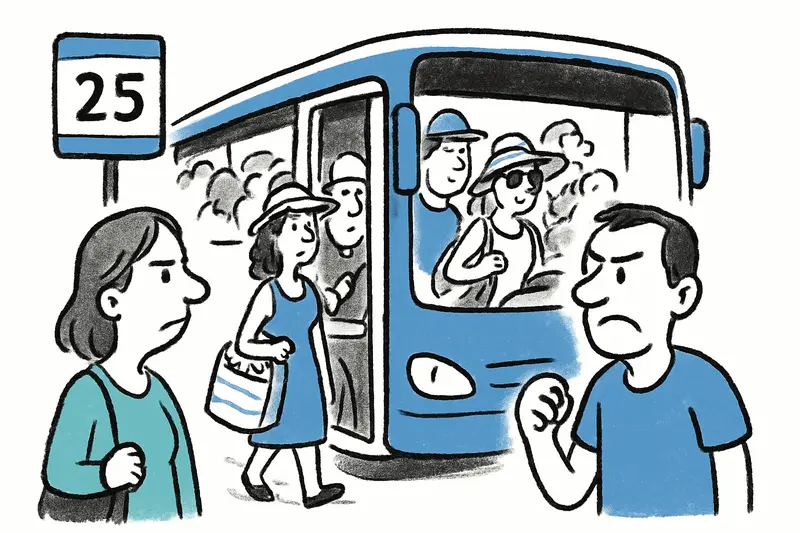
Those who travel daily on EMT buses in Palma (see EMT records millions more passengers — and yet long lines of cars still crowd Palma's main arteries) know the small drama: stops full of suitcases, tourists with beach towels, and in the end the sign at the door reads 'complet' — the bus is full. For many residents this is not a marginal annoyance but everyday life. The demand to allow residents with a valid card to board preferentially was recently raised publicly and strikes a nerve. But is it practical, legally sound and fair?
The idea is understandable: people who have to get to work, school or a doctor's appointment have less flexibility than tourists, who often have a freer daily routine. When lines like the 23, 25, 32, 35 or the 4 are regularly clogged by trips to the beach and day trippers, residents' quality of life suffers. It's frustrating, costs time and in some cases additional money for a taxi.
A pragmatic analysis, however, reveals several hurdles. First: how do you quickly and reliably verify 'resident' status at every door? Second: what impact would such a rule have on Palma's image as a friendly holiday destination? Third: could prioritization be considered discriminatory in court? These questions cannot be ignored; they require solutions.
Public discourse currently often lacks a sober look at the data. How many journeys are actually made by tourists during the critical hours? Where do bottlenecks occur: in the morning, late afternoon, at specific stops? Without transparent statistics much remains gut reaction (see Free buses in Palma: Who pays when the coffers close?). At the same time, pragmatic infrastructure measures are too rarely discussed: Palma eases morning traffic with more buses at the school start, beach shuttle services for day visitors or clearly labelled holiday lines.
One scene I have experienced several times: on a hot morning at Plaça d'Espanya people queued up — students with backpacks, older neighbours with shopping and visitors with parasols. When the bus arrived, the suitcases shoved forward first, the door barely stayed open, and a mother with a small child had to wait for a later bus. Images like these make the demand for priority so understandable.
Concrete solutions should connect several levels. In the short term, EMT could test special 'resident time windows' on heavily used lines: in certain half-hour slots prioritise cards with local ID, allow boarding via the second door for short trips, reserve another door primarily for tourists with large luggage. Central to this would be simple technical support, for example a quick scan of the resident card instead of exchanging paper documents.
In the medium term, structural measures help more: additional runs in the high season, separate shuttle buses to the major beaches, better information for holidaymakers already at the time of booking or in hostels (see Palma per tú: Who really benefits from the winter offer?). An app showing real-time passenger density could help tourists consciously choose a less crowded connection and thus relieve the system.
The legal dimension must not be missing from practical ideas. Any unequal treatment must be transparently justified and proportionate. A rule that ensures residents genuine access to the labour market, school or healthcare has a different quality than a blanket preference. Legal reviews and clear, time-limited rules are necessary here.
What is often missing from public discourse is the voice of bus drivers, who mediate daily between doors and timetables. Their experience could help find practical control points without turning every journey into a confrontation. The hotel industry and landlords must also be involved in solutions: information instead of confrontation can prevent conflicts at the bus.
My conclusion is pointed: the idea of giving residents priority is neither sanctimonious nor ill-conceived. It is a response to real hardships. But it must not be adopted as a one-sided decree. A better approach would be a trial on selected lines, accompanied by measurements, clear communication and alternative offers for day visitors. This way it can be tested whether 'Residents first' truly improves everyday life without making Palma unfriendly to visitors.
In the end it's about simple things: getting to work on time, picking up children, keeping a doctor's appointment. If politicians and public transport providers take this everyday reality seriously, solutions can be found that respect both sides. And that would be a step forward in this city where tourist season and daily life share the streets.
Frequently asked questions
What is Mallorca's climate like throughout the year?
When is the best time for beach days and outdoor activities in Mallorca?
What should I pack for a trip to Mallorca?
How can I get around Mallorca without a car?
Are the beaches in Mallorca suitable for swimming and snorkeling?
What local foods should I try in Mallorca?
Which areas in Mallorca are good bases for exploring the island?
Is Mallorca suitable for solo travelers or families?
Similar News
Residents First at Palma's Stops? A Reality Check on Negueruela's Bus Idea
The proposal to prioritize residents with TIB or Tarjeta Única cards when boarding strikes a nerve. But what would a pri...

Why traffic jams in Mallorca stress us more than elsewhere
A study shows: 40 percent of Balearic residents name traffic jams as a major source of stress. We ask: why is that — and...

When the Artist Sits at the Table: Icon Zar and the Fine-Dining Experiment in Mallorca
A dinner becomes a small cultural event: Icon Zar brings artists, chefs and collectors to the same table. In Palma it so...
Golf, Tapas, Terrace Evening: The MM Autumn Trophy on October 4
On October 4, Mallorca Magazin combines sporting competition with sociability: a get-together at Schwaiger's Xino on the...
Nighttime Thunderstorms over Mallorca: Uncomfortable Questions for Infrastructure and Warning Systems
A severe line of thunderstorms brought locally more than 70 l/m² during the night. Aemet warned, but images of flooded s...
More to explore
Discover more interesting content

Can Cap de Bou

Townhouse Lleo 72
