
Ryanair's Folding Stairs: Why Boarding and Disembarking in Mallorca Can Be More Risky
Ryanair's Folding Stairs: Why Boarding and Disembarking in Mallorca Can Be More Risky
Studies show: In recent years there have been hundreds of injuries on the built-in stairs of the Boeing 737. What lies behind the numbers — and who needs to act to make boarding in Mallorca safer?
Ryanair's Folding Stairs: Why Boarding and Disembarking in Mallorca Can Be More Risky
Key question: How safe are the retractable stairs on the Boeing 737 really — and what needs to change so that passengers at Palma airport don't stumble?
Summary
Investigations that analyzed incidents involving retractable aircraft stairs paint a clear picture: since 2021 several hundred injured passengers related to these stairs have been recorded. Particularly notable is an analysis from Italy documenting incidents during boarding and disembarking in the years 2023 to 2025. The figures show that integrated stairs built into aircraft lead to falls more often than the mobile airport stairs normally used at the gate, as other safety incidents show Frightening Seconds over Palma: Two Flight Attendants Injured.
Critical analysis
The design of the integrated stair is part of the problem. The version installed on some Boeing 737 models consists of twelve steps, is only about 61 centimeters wide and has an incline of roughly 35 degrees; the steps are about 20 centimeters high. That is quite narrow and steep compared with the mobile equipment airports use. Technical standards cited by oversight bodies often specify significantly larger dimensions for fixed passenger stairs — for example a minimum width of around one meter.
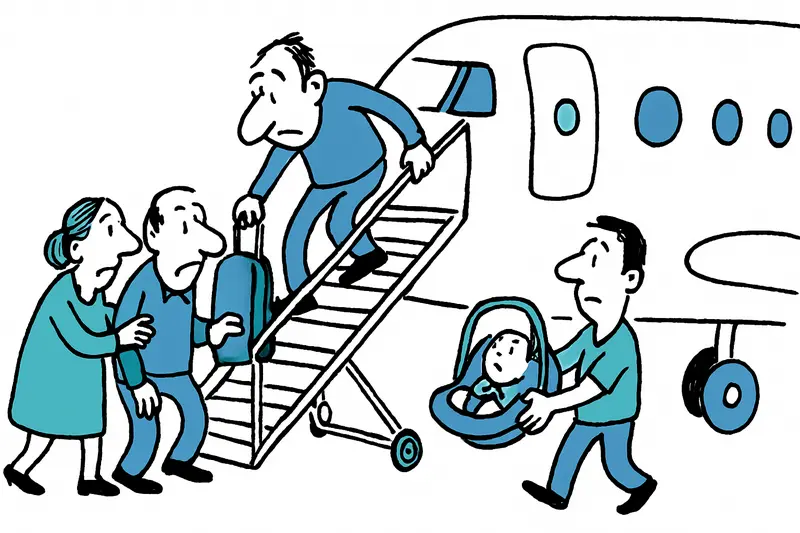
Added to this is an unusual first step right by the fuselage, whose trapezoidal shape makes footing unnecessarily tricky for older people, parents with small children or travelers with carry-on luggage. If you stand in the evening at Palma airport and watch travelers with small wheeled suitcases and child umbrellas climb these steps, it becomes clear: this is not comfortable boarding, it's a balancing act.
What's missing in the public debate
Discussion often focuses only on costs and the speed of turnaround. Hardly anyone asks who bears responsibility for safety on the final stair: the airline, the airport or the aircraft manufacturer? The available figures point to problems — but they do not say clearly how these incidents should be prevented. Another blind spot is the situation for passengers with reduced mobility, for whom the narrow, steep stair can be effectively impossible. In Mallorca, where many families, elderly people and business travelers travel, this is not a marginal issue. Cases such as Back after takeoff: What a 'toilet problem' reveals about flight safety underscore the broader regulatory questions.
Typical scene at Palma
A Tuesday morning at the terminal: buses rumbling, suitcases rolling on the tarmac, voices in Spanish and English. Passengers get off a bus, glance at the tight metal stairs and search for the handrail, which only offers a really good grip on one side. An older woman takes her husband's arm, a father lifts the infant car seat up the steps — the trolley jerks. This is how many of us see the problem every day. It's no surprise that such situations show up in the statistics.
Concrete solutions
- Review mandatory minimum standards: At the national level there should be clear rules on which dimensions and inclines are permissible for integrated stairs. If the standard for mobile stairs specifies a minimum width of around one meter, airlines and manufacturers should be measured against comparable requirements.
- Make airport alternatives mandatory: Airports should have the option to provide their own mobile stairs when the aircraft stair is narrow or in poor condition — and do so without debate over additional costs for the airline.
- Train staff and offer more assistance: More ground staff during boarding and disembarking, especially on flights with many older passengers or families, reduces the risk.
- Transparent reporting statistics: Airlines and regulators must systematically record and publish incidents. Only then can the risk be reliably assessed and reduced in the long term.
- Technical improvements: Fuselage-adjacent first steps should be ergonomically redesigned, possibly with adjustable tread surfaces or better handrails.
Who should do what?
Responsibility is distributed: aircraft manufacturers can improve the design, airlines must adapt operating rules and airports can provide support equipment. Manufacturers' responsibilities are highlighted in reports like Crack in the window — what an aircraft defect means for Mallorca travelers. Regulators are called upon to issue or enforce binding minimum rules. For Mallorca this means concretely: the airport operator, the competent Spanish aviation authority and the responsible airlines should jointly define a procedure for handling integrated stairs — especially in the high season when time pressure and crowds increase the risk.
Conclusion
The figures indicate an avoidable problem. When people with suitcases and children stumble on a hot summer day at Palma airport, it is not only inconvenient — it can be costly and dangerous. Safety must not be an item to cut. Those who want passengers off the plane faster must also ensure they get down safely.
Frequently asked questions
How safe are retractable stairs on the Boeing 737, and what risks do they pose at Palma airport?
What dimensions matter for safe boarding on integrated aircraft stairs?
Who is responsible for the safety of integrated stairs?
What can airports do to improve safety with integrated stairs?
What should travelers at Palma de Mallorca expect regarding boarding with fixed stairs?
What concrete improvements could Mallorca implement to reduce risk?
How does stair safety affect travelers with reduced mobility?
Is there ongoing data collection or investigations about stair-related incidents?
Similar News

Why Mallorca Has Become So Terribly Expensive — A Reality Check
Rents are exploding, staple food prices are rising, wages are lagging behind. A look at the causes, what is missing from...
When Paradise Becomes Unaffordable
Hotel rooms, paella and the weekly grocery shop: Mallorca is becoming more expensive for many. Who pays the bill — guest...
End at Ballermann: What Is Lost with the Dino Mini Golf at Playa de Palma
On October 25 the dinosaur mini-golf course at Playa de Palma will close after more than 30 years. Why the city is recla...

Expensive Address Calvià: What Does First Place Mean for Mallorca?
The National Institute of Statistics (INE) ranks Calvià as Spain’s most expensive municipality for property purchases. W...
Emergency over Spain: Ryanair Dublin–Tenerife flight diverted to Santiago after medical emergency
A Ryanair flight from Dublin to Tenerife was diverted to Santiago de Compostela due to a passenger's acute health proble...
More to explore
Discover more interesting content

Can Cap de Bou

Townhouse Lleo 72
