
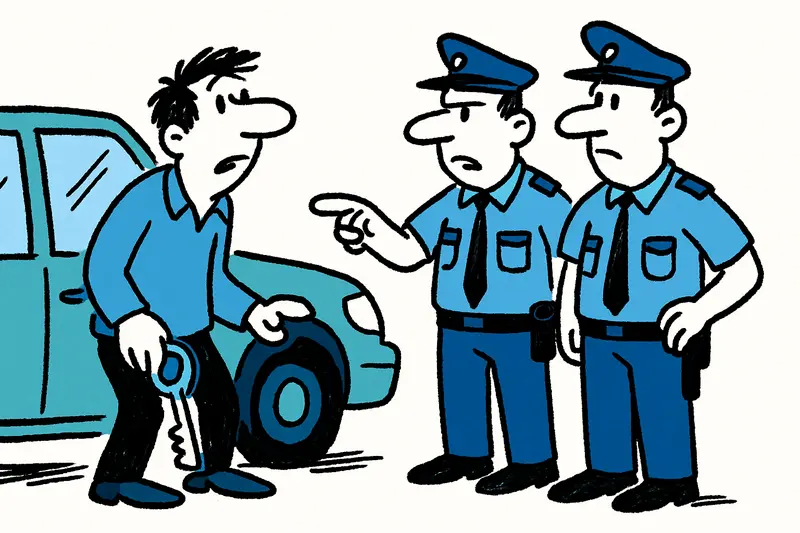
He 'stole' his own car - and now police are investigating in Palma
He 'stole' his own car - and now police are investigating in Palma
A 25-year-old simply retrieved his towed car from the municipal impound - without paying the fees. Why this can be legally considered theft and what is going wrong in Palma.
He 'stole' his own car - and now police are investigating in Palma
When property suddenly becomes theft: A curious case from Sa Riera
Key question: How can it be that someone retrieves their own car and is criminally prosecuted for it?
In the early morning of December 6, a patrol in Palma stopped a car for erratic driving. During the check the systems suddenly showed: the vehicle was declared stolen. The driver - a 25-year-old Spanish man who recovered his towed car - did present documents and claimed to be the owner. The officers dug deeper and found out: the car had been towed on September 15 for illegal parking and taken to the municipal impound in Sa Riera. To collect it, the owner would have had to pay 132 euros in fees. Instead, he took the vehicle from the yard without paying - and now faces a charge of theft.
At first glance the situation seems like a bad joke: a man 'steals' his own car to avoid a fee. Legally, however, the matter is more complicated. When property is taken into custody by an authority or a third party, it is no longer considered freely accessible. Unauthorized removal from an impound affects the security interests of the municipality and the towing company - and that is where investigators focus. It's therefore not primarily about who owns the car, but whether someone has moved property held in custody without permission.
What is often missing in public debate is the administration’s perspective: Why are towing fees perceived as so high that owners resort to such measures? And why are there apparently gaps in the protection of impound lots that allow vehicles to be driven out unnoticed? Both are legitimate questions that are often neglected in the discussion. On the other hand, most conversations lack legal clarity: it is not always clear which actions will lead to charges.
An everyday scene from Palma: on the Sa-Riera slope, when the first trucks and tow vehicles arrive in the morning, you hear the rattling of winches and the clinking of metal. Residents hurrying to work cast furtive glances at the row of parked cars. Garbage trucks pass by, a bus honks in the distance. In this environment a rare reach for one's own key card can quickly be judged as unlawful entry - especially if signs about restrictions and access rules are posted on the gate.
Concrete solutions to prevent escalation: first, the city should provide simple, clearly visible information about towing and storage costs - online and at the tow yard. A digital payment option with a receipt by SMS or email reduces misunderstandings and spares some the trip to the payment desk. Second, impounds must be better secured: clear access logs, cameras, security staff at peak times. Third, the administration could consider social hardship cases - someone who proves they cannot pay the fee immediately might be granted an extension or installment plan instead of confronting criminal prosecution. Fourth: training for officers so that during checks it can be immediately examined why an owner is moving a vehicle and whether formal steps were missed.
Another element in the discussion is individual behavior. A few weeks ago an older man was arrested after a chase from Palma to Llucmajor; the Porsche escape from Palma to Llucmajor began with a towed car and an attempt to avoid the fee. Such extreme cases show how quickly frustration over fines and procedures can turn into dangerous driving.
Conclusion: The case of the 25-year-old is not a harmless curiosity. It reveals a tension between administrative practice, individual pressure and criminal law logic. There are solutions: more transparency, modern payment methods, social mitigation and better security of impounds. If implemented, morning checks at street corners could end with less confusion - and a man would not have to risk 'stealing' his own car just because he does not want to pay the bill.
Frequently asked questions
Can you get in trouble in Mallorca for taking back your own towed car?
What should I do if my car has been towed in Palma?
How much does it cost to recover a towed car in Palma?
Where is the municipal impound in Palma?
Why does a car show up as stolen after being towed in Mallorca?
Is it possible to pay towing fees online in Palma?
What can happen if you drive away from an impound in Mallorca without paying?
How are towing and impound disputes handled in Palma?
Similar News

From the Reality Studio to the Pitch: Aleks Petrovic Makes Mallorca His Base
The former participant in numerous TV shows moves from Dubai to the island and launches a project with FC Germania Mallo...
When the Phone Falls Silent: Concern for Sarah Joelle in Mallorca — and What It Reveals
After days without a response, the TV personality's unreachability in Mallorca sparked concern. Shortly afterwards an al...

Ultraluxury on the Ground: Four Seasons Jet in Palma — a Reality Check for Formentor and the Island
A high-priced flight crosses Mallorca and its guests stay for days at the Formentor resort. What does the island get bes...
Death of a Witness and the Justice Backlog: Why the Kegel Brothers Trial Matters in Mallorca
A witness in the Playa de Palma fire case has died, and the trial against eight German holidaymakers has been delayed un...

Champagne Reception, Red Carpet and Mini Originals: The Pre-Nit del Art at Gallery Mensing
Almost 400 guests, champagne, pop-art feats by Tom Boston and a raffle for the Parkinson's foundation: Gallery Mensing t...
More to explore
Discover more interesting content

Can Cap de Bou

Townhouse Lleo 72
