
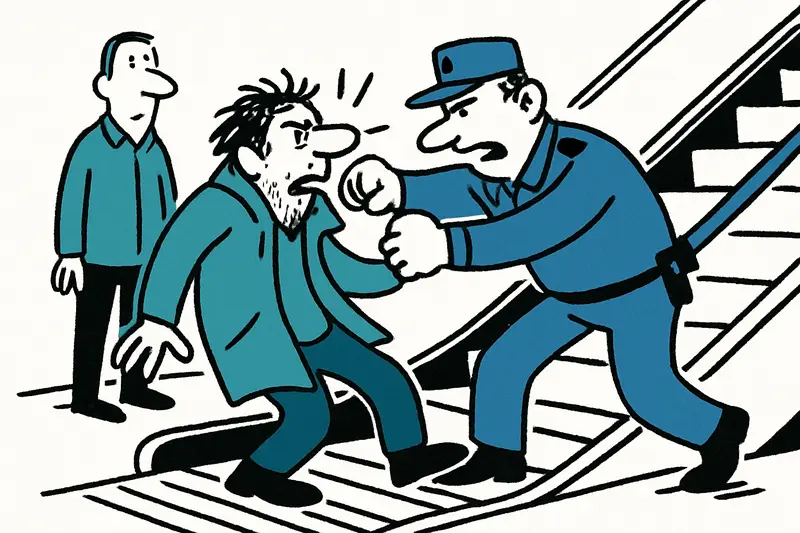
Strike on the Escalator: When Control, Homelessness and Safety Collide at the Intermodal Station
Strike on the Escalator: When Control, Homelessness and Safety Collide at the Intermodal Station
A security guard used pepper spray at the intermodal station after a homeless man allegedly attacked him on the escalator. Why is mere presence not enough?
Strike on the Escalator: When Control, Homelessness and Safety Collide at the Intermodal Station
An incident at Plaça d’Espanya shows how quickly routine can turn into violence — and what is missing in the public debate
Early afternoon at Plaça d’Espanya: street noise, buses, the ringing of a tram, a kiosk selling coffee, delivery drivers maneuvering between taxis. In this mosaic of everyday life and traffic lies the Estació Intermodal, a place where travelers, commuters and people without a fixed home overlap. It was precisely there that a conflict recently escalated: a security employee asked a man to clear a bench at the bus bay. Shortly afterwards a physical attack occurred on the escalator; the guard used defensive spray to protect himself and a colleague. Police arrested the alleged attacker, at a station currently undergoing escalator replacements discussed in Palma's Intermodal Station: New Escalators — Is That Enough to Cure the Bottleneck?.
Key question: What does this incident say about the interaction of private security work, police presence and social care in Palma? This question is not merely rhetorical; it leads directly to the core problems that appear daily in Mallorca’s transport areas, as earlier reporting on related episodes in Sexual assault at the Intermodal: What the incident reveals about safety and accessibility in Palma showed.
Critical analysis: At first glance the scene looks like a classic case of order enforcement. A closer look reveals several weaknesses. First: escalation dynamics. A brief awakening on a bench, a request to leave, a return and finally a physical attack — this is no longer a linear sequence but an interplay of provocation, frustration and uncertainty. Second: role distribution. Security personnel stand between victims, perpetrators, travelers and vulnerable staff. They must decide quickly, often without police backup. Third: prevention gap. If the same person repeatedly appears in incidents, as reported here, it indicates a failure of preventive measures — both police and social.
What is often missing from the public discourse is a sober examination of levels of responsibility. People argue about symptoms — more controls, harsher penalties, videos that prove everything — but hardly anyone asks how city administration, transport companies, police and social services are networked to provide sustainable help to people in precarious situations. Equally rare is a concrete debate about what powers and what training private security personnel should have before they resort to physical countermeasures.
Everyday scene: Anyone who stops at the kiosk at Plaça d’Espanya in the morning for a café con leche knows the faces: commuters with season tickets, the clerk from the small tobacco shop, pensioners on the bench. For years you also see people looking for a place to sleep in open spaces. This normality makes the place complicated: a conflict between two individuals immediately affects dozens of onlookers, bus schedules and the sense of safety of ordinary commuters.
Concrete solutions that do not simply call for more police: first, clear protocols for security companies that prescribe de-escalation techniques and restrictive use of defensive sprays, and mandatory training on the social situation of people experiencing homelessness. Second, immediate interfaces: a fixed contact window between station management, the police station and municipal social services so that people who repeatedly appear are not only registered but actively supported. Third, structural and technical measures: clearly visible emergency buttons on stairs and platforms, additional camera positions with direct connection to the control center, clearer routing that reduces conflict. These proposals align with the broader station redesign debate in Intermodal Station: A little noise today, a more reliable station tomorrow. Fourth, low-threshold on-site offers — a mobile social worker, accessible sleeping places on critical nights, binding day-structure programs.
An important point: transparency about responsibilities. When travelers and staff know who can be contacted in an emergency, expectations change. When security personnel know which police or social resources are actually available within minutes, the likelihood of impulsive countermeasures is reduced. Ultimately, it is about solidaristic safety: measures that do not push the most vulnerable further to the margins while protecting staff and travelers.
What should happen now: an independent review of surveillance footage with participation from station management and municipal bodies; a review of service instructions for deployed personnel; increased presence of social services during peak times; and transparent communication to commuters about planned measures. These are manageable steps that do not require large political debates, but rather willingness to coordinate.
Conclusion: The strike on the escalator is more than a single violent event. It is a mirror of the interfaces between order tasks and social responsibility in Palma. Those who only demand more presence overlook the human component. Those who focus only on help for people without homes misunderstand the risk to staff. Good security concepts need both: clear rules and concrete care. If that succeeds, not only will passersby at Plaça d’Espanya feel calmer, but the situation will improve for those most affected — and for everyone who lives their daily life there.
Frequently asked questions
Why can tensions at Palma’s Estació Intermodal escalate so quickly?
What should I do if I feel unsafe at Plaça d’Espanya in Palma?
Are there social services for people without a fixed home in Palma’s transport areas?
How should private security act in a conflict at a Mallorca transport hub?
Is Plaça d’Espanya in Palma busy all day?
What safety improvements are useful at Palma’s Intermodal Station?
When is the best time to pass through Palma’s Estació Intermodal if I want to avoid stress?
Does a security incident at Mallorca’s bus station affect commuters as well?
Similar News
Rental Car Theft in El Arenal: What This Incident Reveals About Our Gaps
A teenager steals a running rental car in El Arenal, flees on foot, climbs over walls and is caught by the Guardia Civil...
Red Rope in Palma's Library: What Helps Against Selfie Tourism — and What's Missing
Palma's city library cordoned off an area with a red rope to keep selfie tourism away from reading and working activitie...
Fort San Carlos: Museum, Harbor Dispute — and a Conflict That Demands Answers
The military museum at Fort San Carlos sits right on Palma's harbor, with unexpectedly quiet rooms filled with cannons a...
Old Town Under Pressure: When a Doorway Becomes a Sleeping and Shower Place
For months a woman has been living with a parasol, a clothes rack and personal belongings next to the social welfare off...
When Shopping Weighs Heavier: Mallorca Demands a Tax Pause on Food and Fuel
Rising prices are putting pressure on households and agriculture. The Balearic Islands are calling for temporary tax rel...
More to explore
Discover more interesting content

Can Cap de Bou

Townhouse Lleo 72
