
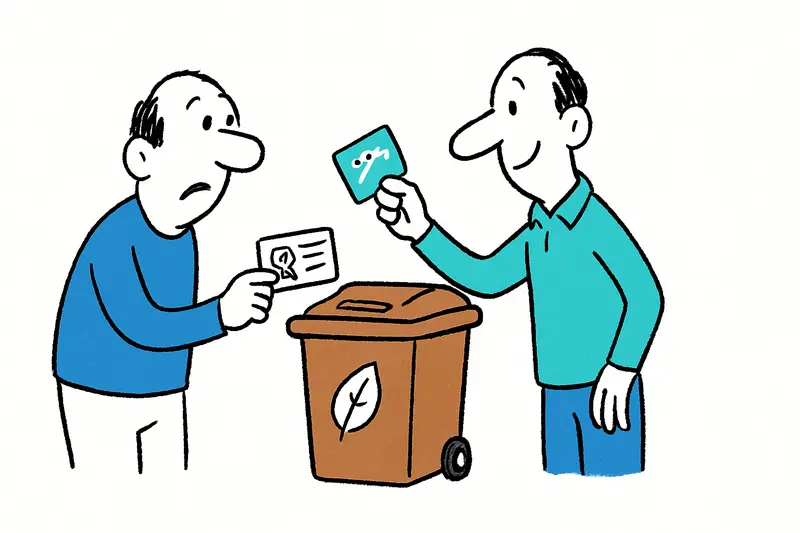
"Tarjeta Llave": New card for bio-waste containers in Palma makes things easier
"Tarjeta Llave": New card for bio-waste containers in Palma makes things easier
In Palma, Emaya is now distributing the free "Tarjeta Llave" for the brown organic-waste containers. The gray citizen card is expected to stop working in June. Anyone who wants to continue disposing of their bio-waste will need an ID and proof of residence.
"Tarjeta Llave": New card for the brown containers in Palma
Free, no appointment — and required from June
Those in Palma who head to the brown bin in the morning with the dog on the Passeig or in the afternoon after the market will need a new companion in the coming weeks: the "Tarjeta Llave". The card opens the brown organic-waste containers and is now available free of charge. At the same time, the previously used gray citizen card is expected to lose its function for opening the containers in June.
The municipal utility company Emaya issues the card without an appointment. At two well-known locations in the city — Calle Joan Maragall and Son Pacs — interested residents can pick up their card. In addition, staff members are out and about in Palma with information stands to bring the card directly to the neighbourhoods. You must bring your ID and proof of residence; that remains the only requirement Emaya mentions.
At first glance this is practical: free, relatively straightforward and with multiple distribution points in the city. I saw a small queue in the afternoon on Calle Joan Maragall — people with shopping bags, retirees, a young family with a stroller. The street noise mixed with the rattling of garbage trucks; from a bakery there was the smell of freshly baked ensaimadas. Many took the opportunity to ask a few neighbours whether the new card would also work for them.
Why all this? The change is part of everyday civic management: controlling access to the containers ensures that only local residents put their bio-waste into the brown bins — not tourists with full plastic bags or vehicles coming from other municipalities. Related local plans include Compost instead of Crematorium: New Biowaste Facility for Llucmajor. For the neighbourhood that usually means less overfilling, less foreign waste and cleaner areas around the containers. For many residents this is a noticeable improvement in daily life.
Some will find the measure bureaucratic. That's understandable — nobody likes extra trips. So a few pragmatic tips from everyday experience: go early to the Emaya office, then the queues are shorter. Check beforehand that you have the proof of residence with you (empadronamiento or a recent bill is often accepted on site). For households with several adult residents it makes sense to apply for several cards at once, so one person does not always have to be responsible for the bio-waste.
Another practical note: if you lose the card, you should have it blocked quickly and request a replacement. Both have not been communicated in detail, but experience with similar systems (see One Ticket for Everything: Can Mallorca's New Fare Really Simplify Everyday Life?) shows that quick replacement avoids problems at the bin. And: keep the card in a sturdy holder rather than loose in a shopping bag — that way it stays readable longer and works reliably with the readers on the containers.
For many districts in Palma — from La Soledat to Santa Catalina — the introduction of the Tarjeta Llave means a small adjustment but also an opportunity. If less foreign waste ends up in the brown containers, the collection points can stay tidier, smells and littering decrease. And it sends a signal: the city is trying to organise the system without charging fees for the cards. A broader move towards single cards for services is also discussed in transport reform, for example Tarjeta Única in Mallorca: A Step in the Right Direction — But Is It Enough?.
I spoke at the information stand with a woman who has worked for years at the Mercat del Olivar. She was pleased that the card was free — "we are not tourists, we pay with our work," she said with a smile, which sounded like a quiet expectation for better neighbourhood conditions. Such small everyday scenes show: it's not just about technology, but about living together on the island.
Where things falter will become apparent soon: during distribution, handling replacements, or if people from neighbouring municipalities continue to "dispose" of their waste here. Then pragmatic solutions will be needed — more distribution points, longer opening hours or mobile actions in residential areas so that people with little time can also get the card.
Conclusion: the Tarjeta Llave is not a revolution, but a useful tool for daily life in Palma. If you want to continue disposing of your organic scraps correctly after June, take your ID and proof of residence and pick up the card — preferably on a quiet morning before the garbage trucks start rattling through the narrow streets again.
Frequently asked questions
What is Mallorca usually like in spring?
Is Mallorca warm enough for swimming in early season?
When is the best time to visit Mallorca if you want good weather without the crowds?
What should I pack for Mallorca if I’m going in the shoulder season?
Are Mallorca beaches busy outside the summer months?
Is Palma de Mallorca good for a short city break?
What is Sóller like for visitors who want a quieter Mallorca trip?
Is Valldemossa worth visiting on a Mallorca itinerary?
Similar News
Magaluf: Watchtower Alarm – Lifeguards Pull Unconscious Beachgoer from the Water
After a drama in the late afternoon, two lifeguards at Magaluf beach rescued an unconscious 44-year-old man. He was stab...
Turquoise in the City: How dangerous is the color play of the Sa Riera?
The Sa Riera in Palma suddenly turned turquoise — a pretty motif, but behind the effect lies a discharge of saline waste...

Jeckliner at Sunnesching: Cologne spirit sets sail from Palma
In September 2027 the Mein Schiff 2 briefly becomes a floating carnival stage: four days with Cologne bands, comedy and ...
Finally Home: Mike and Leyla Heiter Buy Villa with Sea View in Mallorca
The reality TV couple Mike and Leyla Heiter have bought a house in Mallorca with a roof terrace and sea view. An Instagr...
Arrest after series in Palma: Who protects apartments from repeat offenders?
The National Police arrested a man in Palma who investigators say may have broken into several apartments. In one incide...
More to explore
Discover more interesting content

Can Cap de Bou

Townhouse Lleo 72
