
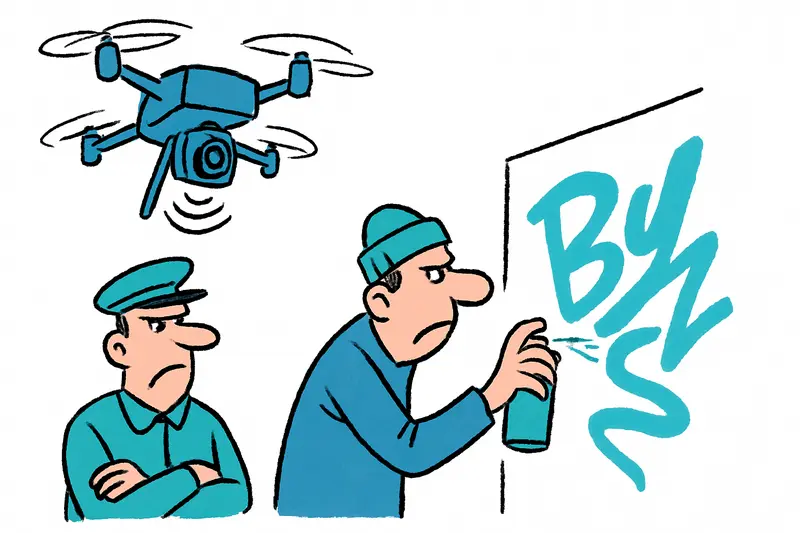
Drones over Son Rutlan: Security or Camera Censorship?
Drones over Son Rutlan: Security or Camera Censorship?
SFM deploys drones at night against graffiti — equipped with cameras, thermal imaging and loudspeakers. An intervention against vandalism, but also a test for law, transparency and effective alternatives.
Drones over Son Rutlan: Security or Camera Censorship?
Who protects the trains — and who watches the island?
In the early morning hours, when over Son Rutlan only the hum of generators and the chirping of cicadas remain, small drones now buzz above the tracks. The rail company SFM has them patrol at night, equipped with visible cameras, thermal imaging and loudspeakers. Goal: to prevent graffiti and vandalism on trains and facilities. It is also a fact that in the first four months of this year SFM reports damages of more than €46,000.
Key question: Do these flying eyes solve the problem — or do they shift costs and risks onto the public?
The answer is not black and white. Drones bring range and rapid response, especially at times when little staff is on site. They can catch or deter offenders. On the other hand, camera and thermal recordings are intrusions into areas that affect residents, workers and passersby. Who records? How long are the data kept? Who has access? Such questions have so far been answered too rarely in the public sphere. Incidents like the device brought down above the Almudaina Palace have highlighted these tensions.
A critical look reveals three blind spots: First, there is a lack of transparency about data processing. Spain has data protection rules and aviation regulations, and state authorities generally demand clear procedures (see the investigation of a drone flight at Palma Airport). Concrete information on retention periods, deletion deadlines or independent oversight of the recordings has not been made public so far.
Second, the effectiveness remains poorly documented. The amount of damage may be high, but how many incidents were actually prevented or solved through drone operations? What are the operating, technology and maintenance costs compared with repair costs? Without clear metrics, measuring success is difficult.
Third, attention to root causes is neglected. Sprayers and vandals react to access, opportunity and often to a lack of alternatives. If entire carriages serve as canvases, that also shows a need for space for expression — neither police presence nor drones address that. There have even been reports of launches in sensitive areas (for example a reported launch in Palma's Old Town), which underlines the complexity of the issue.
An everyday scene: A night worker at the depot gate lights a cigarette, hears the crack of a propeller, sees the beam of a drone sweep across the tracks. He knows the spots where fresh paint reappeared on the carriages just last week. On his way home he passes a legal mural painted by youths from the neighborhood. For him it is clear: control helps, but a little room for color would probably prevent a lot of trouble.
What is missing from the public debate? Concrete procedures for controlling the technology, dialogue with residents and railway staff, and a cost‑benefit accounting. Also missing are ideas for how prevention and repression can work together without sliding into permanent surveillance.
Concrete proposals that could have immediate effect:
1) Transparency requirement: SFM should disclose what data are collected, how long they are stored, who has access and for what purposes recordings may be used. A simple one‑page online statement with this information would reassure many.
2) External oversight: An independent data protection officer or a municipal commission should randomly review recordings and publish reports.
3) Measurable targets: Deployments only with defined metrics — for example number of prevented incidents, perpetrators identified, reduction in repair costs — so it is clear whether the technology is worth its price.
4) Preventive alternatives: Anti‑graffiti coatings, faster remediation, legal walls and accompanying youth programs can address the problem at its root. Often less surveillance and more design is more effective.
5) Limited deployment rules: Use drones only in clearly defined areas and time windows, and limit loudspeaker announcements to hazard prevention, not general deterrence of people.
These measures could restore the balance between protecting infrastructure and safeguarding public freedoms. They also show that technical solutions are not automatically the best or the only answers.
Conclusion: The small flying helpers over Son Rutlan are a pragmatic reflex to a real problem. But without transparency, independent oversight and complementary prevention measures, an attempt to protect trains risks becoming a permanent surveillance regime. A better approach would be a package of clear rules, honest evaluation of effectiveness and more space for legal creativity — then fewer drones would be needed and fewer repairs would be necessary.
Frequently asked questions
What is the weather usually like in Mallorca in late spring?
Is Mallorca warm enough for swimming in spring?
What should I pack for Mallorca in early season?
Is Mallorca a good destination for outdoor activities in spring?
What is Cala Mondragó like in spring?
Is Port de Sóller good for a spring visit?
How does Palma feel in spring compared with summer?
When is the best time to visit Mallorca for mild weather?
Similar News

Mueller continues expanding in Mallorca: Artà in 2026, Can Picafort in early summer 2027
The drugstore chain Mueller is opening two new stores in Mallorca: a 1,400 m² shop in Artà on 5 November 2026 and a bran...
The Painter Who Lived Mallorca: Franz Taussig and His Century-Old Secret
A hundred years ago a young Viennese arrived in El Terreno, sketched the island and called himself Francis Caron. Today ...

Airport dispute: Bridge, forecasts and the question of responsibility
A video by the Spanish transport minister has ignited the dispute over DORA figures, capacities and local governance pow...

The Painter Who Invented Himself: How a Young Viennese Drew Mallorca
A hundred years ago a 19-year-old draftsman arrived in El Terreno. His diary and sheets, long known under the pseudonym ...
Released with Conditions: The Plus Ultra Suspicion and a Mallorcan Finca as Residence
A Dutch entrepreneur, sought in connection with the Plus Ultra case, was extradited to Spain after his arrest in Germany...
More to explore
Discover more interesting content

Can Cap de Bou

Townhouse Lleo 72
