
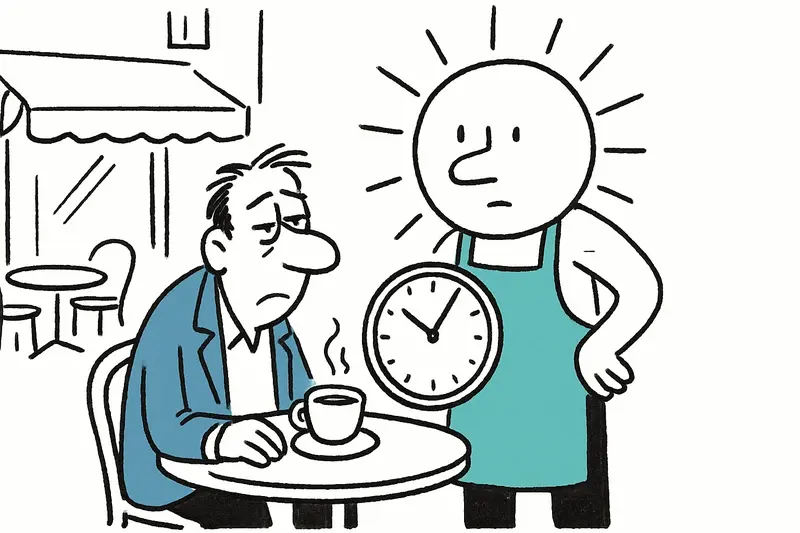
Time in Mallorca: Why our clocks tick differently
History, politics and the position of the sun have created their own rhythm on the island. Why this is more than a curiosity — and which pragmatic steps Mallorca could take now.
Should Mallorca readjust its clocks to the sun — or is pragmatism enough?
When I walk early along the Who decides the time in Mallorca? Between bright mornings and long summer evenings, it is the small things that stand out: the first espresso, the clinking of dishes in the street cafés, the distant rumble of cars and the quiet hum of the streetlights, even though the clock is already well ahead. On paper we live in Central Europe, but in reality the day often feels shifted by an hour. This is more than an anecdote — it affects sleep, work and the island’s entire rhythm.
Historical intervention with everyday effect
The decision to move the hands forward in Spain was made in 1940 for political reasons. Geographically, Mallorca belongs to the Western European Time Zone (UTC+0). That means: mornings stay darker for longer, evenings become light late. For tourism this often feels like an advantage — longer evenings on the beach, later meals — but for commuters, parents and shift workers it can bring real disadvantages. The hour that jumps back — and what Mallorca really gains offers interesting information on the impacts of this time issue.
The key question: symbolism or quality of life?
The debate is often reduced to symbolism: should we hang ourselves back on the sun or remain pragmatic? That is the wrong contrast. More interesting is to ask: how can we shape the real daily timing so that health, safety and economic processes harmonise better? And: which measures can be implemented locally without waiting for a political decision monopoly in Madrid?
What is rarely heard
It is not just about politics. Chronobiological consequences — poorer sleep, longer falling-asleep times, increased accident risk due to tiredness — act quietly and cumulatively. Added to that are structural effects: ferry and flight schedules, hotel check-ins and international working hours tune the island to a tourist rhythm that often collides with that of locals. On the Moll Vell fishermen look at the sea, not the clock; parents bring children to school punctually at nine, even though the streets are still dim; commuters wait in the grey of morning at the stop towards Port de Sóller. These contradictions are often overlooked in public debates.
What science warns — and what it does not solve
Chronobiologists warn that a lasting discrepancy between social and solar time has physiological costs. But a new time zone does not automatically change eating or working patterns. Therefore a mere change of the hands is not a miracle cure. Sustainable effects come from combined measures: more flexible work and school times, improved public transport in the early hours, and local studies that provide concrete data — not just opinions. Goodbye to the Time Change? What Awaits Mallorca's Daily Life, Tourism and Transport on these topics provides useful context and data.
Concrete, actionable steps
Mallorca can proceed pragmatically. A few proposals, not as utopia but as pilot projects:
1. Pilot schools with shifted start times: Trial in municipalities with many commuters. Start half an hour later? Or open later in the morning and finish lessons earlier?
2. Seasonal timetables: Ferries and buses could be scheduled in the off-season so that residents do not have to wait in the dark. That does not change the time zone, but increases safety.
3. Employer initiative: From small businesses to hotels, advise on flexible flextime models and create incentives for earlier working hours in sectors away from tourism.
4. Regional research: Short-term studies on sleep patterns, accident statistics and energy consumption provide strong arguments for discussions with the central government.
5. Awareness campaigns: Practical tips on sleep hygiene, reliable information offers in municipalities and businesses — people often change their routines when they understand why. You can also find further information on Balearic Islands Want Permanent Summer Time: What That Really Means for Mallorca.
Why a local strategy makes sense
The island is not a monolithic block: the needs in Palma, the tourist resorts on the coast and the mountain villages in the Tramuntana differ. That is a strength. Instead of waiting for a central solution, Mallorca can show through local experiments what works. Successful examples would be arguments to open a larger discussion in Madrid — with real data in hand.
Conclusion: The clocks in Mallorca tick differently because history, politics and geography come together. That does not mean we must look on in resignation. With pragmatic, local measures — from school start times to timetables — everyday life can be adjusted so that fewer people start out in half-darkness and health suffers less. And yes, a little more sun with coffee would do many of us good.
Frequently asked questions
Why does Mallorca follow a time that feels later than the sun?
How does the time difference in Mallorca affect daily life?
Is it better to change the clocks in Mallorca or keep the current system?
Why can mornings feel so dark in Mallorca, especially in winter?
What local changes could help Mallorca adapt better to its time rhythm?
Do schools and commuters in Mallorca feel the time difference more than tourists?
What does the time issue mean for ferry and bus schedules in Mallorca?
Why is the time debate in Mallorca different from one place to another?
Similar News
From the Reality Studio to the Pitch: Aleks Petrovic Makes Mallorca His Base
The former participant in numerous TV shows moves from Dubai to the island and launches a project with FC Germania Mallo...
When the Phone Falls Silent: Concern for Sarah Joelle in Mallorca — and What It Reveals
After days without a response, the TV personality's unreachability in Mallorca sparked concern. Shortly afterwards an al...
Ultraluxury on the Ground: Four Seasons Jet in Palma — a Reality Check for Formentor and the Island
A high-priced flight crosses Mallorca and its guests stay for days at the Formentor resort. What does the island get bes...
Death of a Witness and the Justice Backlog: Why the Kegel Brothers Trial Matters in Mallorca
A witness in the Playa de Palma fire case has died, and the trial against eight German holidaymakers has been delayed un...

Champagne Reception, Red Carpet and Mini Originals: The Pre-Nit del Art at Gallery Mensing
Almost 400 guests, champagne, pop-art feats by Tom Boston and a raffle for the Parkinson's foundation: Gallery Mensing t...
More to explore
Discover more interesting content

Can Cap de Bou

Townhouse Lleo 72
