
The Mysterious Leg in the Landing Gear: A Mallorca Case from 1988
A nocturnal sound, the smell of kerosene, and a discovery that still raises questions: in 1988 a human remnant — likely a child — was found in an aircraft's landing gear compartment. Why was the identity never established, and what can the island learn from this case?
A Scent of Kerosene and an Open Secret
On some evenings, when the wind quietly blows over Cap Blanc in the south of the island and the sea hits the rocks, some residents recall 11 November 1988 not as a date but as an image: the Searchlights of Son Sant Joan cutting restlessly through the mist; the distant rattle of a plane; and then the unsettling smell of kerosene. From that night came a discovery that still hangs over Llucmajor like a question mark.
The Central Question
How could a person, likely a child, get unnoticed onto a Boeing bound for Palma — and why was there never a definitive identity? This question runs through files, memories of former responders and conversations at the Llucmajor market. It is not only forensically intriguing. It touches on responsibilities, safety culture and the relationship between the airport, residents and authorities.
What Exactly Was Found — and What Was Missing
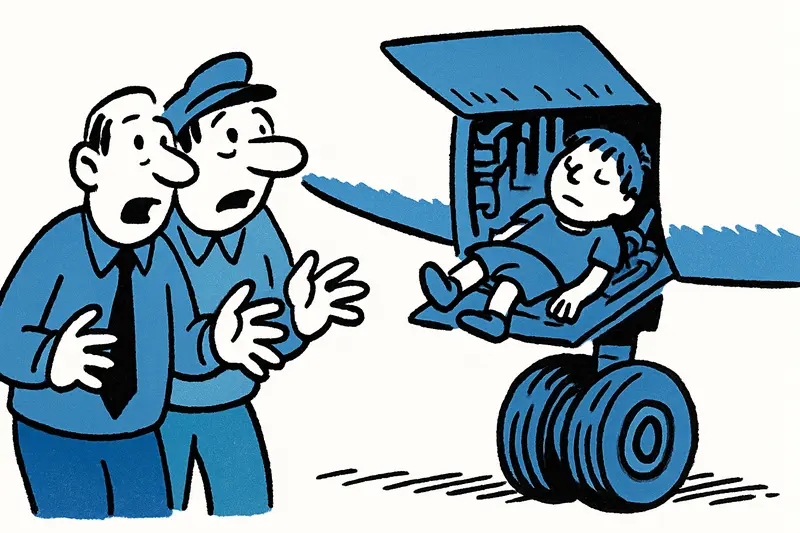
The aircraft was airborne when a landing-gear alarm sounded. The crew circled, the lights of Son Sant Joan blinked in the haze. On the ground the Guardia Civil and firefighters found blood traces, tissue fragments — and a trapped leg in a maintenance panel. A small plastic ring, a candy wrapper: clues that led many to think of a child. Yet it remained conjecture. No identity was ever definitively established, as reported in Hace 37 años sin esclarecer: Presuntamente un niño murió en el tren de aterrizaje de un vuelo con destino a Mallorca.
The investigation felt fragmentary: teams searched beaches, boats were checked, a missing-person report appeared in Hanover — and then vanished again. In 1988 forensics was not the precision science it is today. DNA analysis was in its infancy. CCTV was not ubiquitous, and airport access controls were more open than they are now. Similar unresolved cases from 1988, such as Unsolved discovery off Cala d’Or: The brutal death of a young German tourist in 1988, feed the sense of a year when many coastal mysteries remained unexplained.
What Rarely Appears in Public Debate
The image of the "stowaway" quickly dominates the imagination. Less discussed is how much subcontractors, night-time access points for staff and informal routes beside official operations affected the security situation. And few ask about the social causes: what desperation or hope might drive a child to cling to an aircraft? The practice of quickly filing investigative records as closed also makes later re-examinations more difficult. Contemporary controversies about crew and contracting, like the report on a Fake Pilot in Europe's Skies: Why Mallorca Must Take a Closer Look, underline how operational trust can be fragile.
Analysis: Security Gaps Then — and Now
Of course technology has improved: today there are fences, motion detectors, thermal cameras and stricter separation between public areas and operational zones. And yet Mallorca is not a sterilized space. Fishermen, seasonal workers, tourists and airport staff share paths, workshops and beaches. It is at these interfaces that gaps arise — gaps that concern not only technology but also organization and humanity.
Another problem is the sea. Coasts and waves swallow traces, contamination blurs time markers, and debris from the landing gear can mislead reconstruction efforts. Recent recoveries, such as the case reported in Body Recovered off East Coast: A Sign of Larger Problems at Sea?, show how maritime conditions complicate inquiries. Without a name every clue quickly loses weight: if no one asks, leads are left behind.
Concrete Opportunities and Approaches
1) Cold-case review: A modern re-examination using today’s DNA methods and international coordination could bring new insights. Many samples from older cases are still stored — provided files and evidence are accessible and authorities cooperate.
2) Transparency and communication: Authorities could provide more local information without compromising operations. An open approach builds trust, mobilizes witnesses and prevents myths from developing that cause more harm than clarity.
3) Perimeter protection and social prevention: Not only fences and sensors are needed. Reliable access lists for night work, better oversight of subcontractors and preventive social work for vulnerable families around Llucmajor can help avoid risky situations.
4) Remembrance policy: A dignified gesture for unknown victims — for example a modest memorial plaque at the airport or a public archive that explains former files — would acknowledge dignity and keep questions of responsibility visible.
Why Investigation Is More Than Facts
Finding an answer is not just about discovering a name. It is a response to the expectations of relatives, training for authorities and a moral duty of society. For Mallorca’s residents the case remains a queasy feeling: when the lights of Son Sant Joan flicker at night, the old questions resurface. Who protects the boundary between land and air? Who ensures that hopes for a journey do not break on a cold piece of metal?
The mystery of 1988 is not a purely legal problem. It is a local-political issue, a technical one, but above all a human one. The island can learn from it — with the courage to disclose, modern forensics and a quiet but consistent remembrance of those without a name.
Frequently asked questions
What happened at Son Sant Joan airport in Mallorca in 1988?
Was the person found in the aircraft in Mallorca ever identified?
How could someone get into an aircraft at Mallorca airport unnoticed?
Why is the 1988 Mallorca airport case still discussed today?
What role did Llucmajor play in the 1988 Mallorca case?
Are airport security rules in Mallorca better now than in 1988?
What does the Mallorca case from 1988 tell us about cold cases?
Is there any memorial or public remembrance for the unknown victim in Mallorca?
Similar News
First Day, First Consequences: What Palma's Rent Freeze Really Means
A new decree stops a planned eviction in Palma — but what really changes for tenants and landlords? A reality check with...
When Housing Becomes a Matter of Survival: Mallorca Between Rental Frenzy and Everyday Life
The case of 87-year-old Maricarmen showed that on Mallorca many people's lives are poised between affordable and uninhab...
Autumn in Mallorca: When Melancholy Gets a Window
Why autumn quietly tightens here — and how to make use of the mood: walks, culture, candles and the light from Palma to ...
Near-miss on Lanzarote: Landing Ryanair Jet and Iberia Takeoff — what really went wrong
On Lanzarote there was a dangerous incident: A Ryanair flight (FR5910) from Dublin landed on runway 03 while an Iberia E...
Eurowings introduces new Premium Business seats on Mallorca routes
From December 1, selected Eurowings flights to Palma and other destinations will feature eight particularly generous sea...
More to explore
Discover more interesting content

Can Cap de Bou

Townhouse Lleo 72
