
Vacation ruined at the gate: Why substitute prison sentences at airports become a problem
Vacation ruined at the gate: Why substitute prison sentences at airports become a problem
A 28-year-old German was arrested at the gate of Cologne/Bonn airport — instead of Mallorca it was 56 days in custody. A case that raises questions about substitute prison sentences, checks and fair procedures.
Vacation ruined at the gate: Why substitute prison sentences at airports become a problem
Checks, handcuffs, flight canceled – one case, many unanswered questions
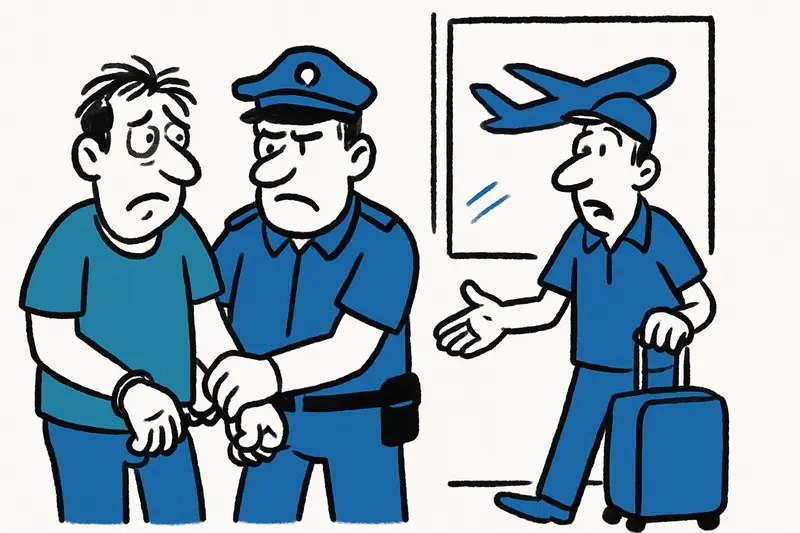
Monday at midday in the terminal: people push suitcases, the snack bar smells of coffee, announcements over the loudspeakers mingle with the rolling of luggage. In this everyday airport scene, the trip to Mallorca ended for a 28-year-old German passenger before it had properly begun. Officers of the Federal Police at Cologne/Bonn airport checked his data, found an outstanding arrest warrant for violations of the Narcotics Act and executed a substitute prison sentence of 56 days because the imposed fine had not been paid. The incident is reported in Handcuffed Straight from Palma: Cross‑Border Manhunts, Mistakes and Mallorca's Image. Instead of Palma, the destination was the correctional facility.
Central question: Is it proportionate to take travelers into custody in handcuffs at the departure point — and what mechanisms ensure that an unpaid fine has such severe consequences?
The problem begins with the substitute prison sentence itself. In Germany the legal alternative reads: Whoever does not pay a fine can instead serve a prison sentence. For many affected people this is not an abstract legal instrument but harsh reality: those without savings or without quick access to support suddenly face the choice between public humiliation and imprisonment. Airports are only unusual but effective places of enforcement — well-networked police databases provide leads, and checks at the gate lead to last-minute arrests, similar scenes have been documented in Checkpoint Son Sant Joan: When unpaid fines can stop a holiday.
The Federal Police confirmed that the check was carried out following a hit in a search system. That sounds efficient. For the individual, however, it means that holiday plans can turn within seconds into incarceration. And from Mallorca's perspective: what happens to those tourists who were supposed to meet friends or family on the island, as highlighted in From the Beach to Handcuffs: Mallorca Holiday Ends with Arrest at Düsseldorf Airport? An empty rental car, an undistributed holiday apartment, missed arrivals — costs that must be refunded and often no one who can immediately be held liable.
What is often missing from public debate is a discussion about alternatives to imprisonment for unpaid fines. There are workable models: installments, binding payment plans, community service instead of imprisonment or the possibility to initiate court proceedings within short deadlines to review the payment obligation. For people without a fixed residence, with precarious income or in psychological distress, legal protection should be easy to access and not tied to cash payment.
Another aspect: timing and location of the check. Airports are sensitive points — people are stressed, often alone with the logistics of departure, and forced to make quick decisions. An arrest at the gate is spectacular and has a deterrent effect. Could search matches be carried out earlier in the process or during routine checks, allow enough time for legal steps and suspend enforcement until after an objection is decided? That would protect the rights of those affected and burden airport operations less.
An everyday Mallorca scene helps to put this in context: on the Passeig Mallorca in Palma neighbors sit with a newspaper and a café con leche, traders place baskets with verbena by their doors, and holidaymakers plan trips to the Serra de Tramuntana, and instances of mistaken checkpoints and brief detentions are described in Accidentally Detained: When a Wrong Turn After Returning from Mallorca Becomes Costly. If someone from Germany doesn't show up, it's annoying but usually solvable locally. If an entire group has to recalculate because one person is in custody, there is economic and emotional damage that goes beyond the individual fine.
Concrete solutions that could be discussed immediately:
1. Mandatory prior notification: Search notices and enforcement warnings should be delivered to affected persons in good time — not only at departure. Electronic notifications or emails to registered addresses could help.
2. Flexible enforcement options: Courts should routinely examine installment payments and community-service alternatives before ordering a substitute prison sentence.
3. Legal advice at the airport: Cooperation between justice authorities and airport administrations so that affected persons can obtain quick legal advice and understand deadlines before enforcement takes place.
4. Staggered timing of search checks: Search matches before boarding are understandable but should provide sufficient lead time so that affected persons can file legal remedies.
These proposals are not cure-alls but pragmatic steps to avoid hardship. Justice must be enforced — but the state can and should ensure that enforcement does not automatically mean the loss of all perspectives.
Conclusion: The case from Cologne/Bonn is a stark example of how criminal sanctions can explode in everyday life. The image of handcuffs at the gate is striking, but the more important question is one of proportionality and alternatives. Mallorca does not need headlines about aborted trips — it needs solutions that combine legal protection with social reality.
Frequently asked questions
Can unpaid fines really stop a Mallorca flight at the airport?
What is a substitute prison sentence in Germany?
What happens if police find an arrest warrant at the airport before a trip to Mallorca?
Are airport checks before boarding to Mallorca common in Germany?
What can travelers do if they cannot pay a fine before flying from Mallorca or Germany?
How early should I sort out legal problems before a Mallorca holiday?
What are the effects of a last-minute arrest on a Mallorca holiday booking?
Why do some people say airport arrests are a problem for Mallorca travelers?
Similar News

More water than last year: Mallorca's reservoirs breathe easier
September rain refilled the Tramuntana's reserves: overall fill around 35 percent, Cúber at 40.42 percent, Gorg Blau at ...
Three Luxury Hotels in Banyalbufar: Lots of Money, Many Questions
A Danish investor plans three exclusive accommodations in Banyalbufar — including the historic Son Valentí. The announce...
2.1 tonnes of cocaine on sailing yacht off Spain's coast – a reality check for the coastguard
A 14-metre yacht was seized with 2.1 tonnes of cocaine. Who monitors the ports, how does the international hunt succeed ...

Heat Bonus in Mallorca: 100 Euros Extra for Outdoor Staff at MarSenses
MarSenses pays employees who worked outdoors in August an extra €100 as recognition. Lighter uniforms, reduced hours for...
Renovating in Mallorca: What You Really Can Do Without Neighbour Consent
Many think they can do whatever they want in their apartment. That's partly true — but only as long as structural elemen...
More to explore
Discover more interesting content

Can Cap de Bou

Townhouse Lleo 72
