
Wet Entrance, Open Door: Why the Ruling Against a Supermarket Is More Than a Damages Case
Wet Entrance, Open Door: Why the Ruling Against a Supermarket Is More Than a Damages Case
A customer slips on a wet floor in a Palma branch. The court orders the chain to pay €12,000 — but the real question is: who ensures safe entrances during storms?
Wet Entrance, Open Door: Why the Ruling Against a Supermarket Is More Than a Damages Case
Key question
Who is responsible when a branch stands open during heavy rain and customers slip on a wet floor — the chain that did not sufficiently reduce the risk, or the customer who enters the store on a rainy day?
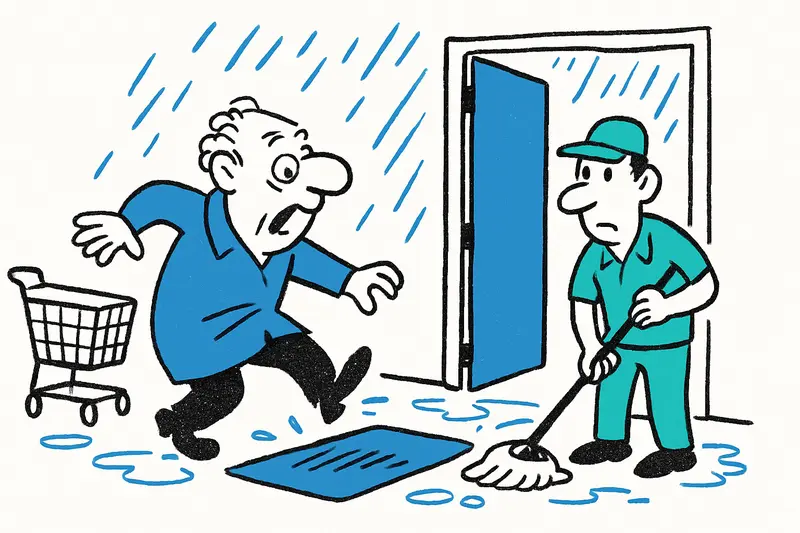
The provincial court in Palma gave a clear answer: the supermarket chain must pay €12,000 in damages because the safety measures at the entrance that stormy day were insufficient. The facts are brief: February 2021, heavy rain and wind, water streamed into the store, a doormat was available, an employee dried by hand, but a warning sign was missing and the door remained open. Another nearby shop closed that day because the water ingress was so severe that the operators could not guarantee customer safety.
Critical analysis
The court follows a simple logic: foreseeability. In heavy rain the intrusion of water at the entrance is foreseeable. A mat and a hasty drying are not enough when the floor presents a continuous slipping hazard. The chain's defense appealed to the everyday situation — "it's raining today, be careful" — and that staff were on site. The court replied: presence alone does not replace organizational precautions, a question examined in Court Hearing After Terrace Collapse: Who Is Responsible?.
Important is the judges' remark that the door could have been kept closed during the rain. That sounds banal but it hits a core point: a safety culture is not made of single elements but of the sum of small decisions — door policy, staff deployment, choice of materials, signage and structural conditions. If a neighboring business closed as a precaution, that suggests the situation was not trivial.
What is missing from public debate
Debates revolve around the amount of damages or whether customers must "watch out." Hardly anyone talks about the larger systemic failure: who checks the entrances of commercial premises in extreme weather? Recent rulings such as Palma must pay €106,700: Ruling after fall in unlit dog zone indicate similar concerns. What standards apply for drainage, door thresholds, slip-resistant coverings or covered entrances? The role of building owners, insurance clauses and municipal infrastructure — such as clogged street drains in front of large stores — is also often overlooked, as discussed in Medusa Beach: Who Bears Responsibility After the Collapse?.
On Mallorca, where winter storms can be severe in some years, that is a dangerously short-sighted view. It's not just about a fine, but about prevention that saves costs and prevents accidents.
Everyday scene from Palma
Imagine the street: spray from the Passeig whips across, umbrellas clang, the squeak of wet soles on the pavement is audible. In front of the supermarket door sits a mat, next to it an employee with a cloth, the voice of a customer calling: "Cuidado, está mojado." A shopping cart leaves a trail, and an older gentleman tries to dry his shoes on the mat before entering. It was this hesitation, this in-and-out — as witnesses describe it — that ended in a fall.
Concrete solutions
The court decision points the way, but practice demands more. Concrete measures stores can implement immediately: 1) closable entrance systems or canopies that temporarily regulate access; 2) high-quality, certified slip-resistant flooring in the first meters beyond the door; 3) conspicuous, multilingual warning signs combined with barriers, not just a small mat; 4) clear internal protocols: during heavy rain the door is only opened by staff who secure the passage; 5) regular checklist exercises and staff training so employees know when a store must be closed; 6) coordination with insurers and landlords so structural improvements (drainage, lowered thresholds) do not fail due to short-term cost considerations.
At the municipal level: inspections and minimum standards for commercial buildings, faster street drain cleaning services and a reporting channel so trade associations can translate AEMET weather warnings into operating instructions.
Punchy conclusion
The ruling is more than an isolated case. It is a wake-up call: safety starts at the threshold. Those who invite customers in bear the responsibility to ensure a dry, non-slip path — especially on stormy days. The €12,000 is a precedent, but what matters more is a system that prevents accidents before courts have to decide.
When we wade across the slabs in front of a supermarket on a rainy morning again, we should not only look at the mat but at visible commitment from operators: closed doors in storms, controlled entry and a floor you can stand on safely. That would be everyday practice worth having — for customers and for the stores themselves.
Frequently asked questions
Can a supermarket in Mallorca be liable if someone slips at the entrance during heavy rain?
What should supermarkets in Mallorca do when it rains heavily?
Is a warning sign enough if the floor is wet in a Mallorca shop?
When should a store in Mallorca close its entrance because of rain?
Who is responsible for safety at a shop entrance in Mallorca, the customer or the store?
What happened in the Palma supermarket slip case?
What safety measures are recommended for shop entrances in Mallorca during storms?
Why does this Mallorca ruling matter beyond one supermarket case?
Similar News

Near-miss on Lanzarote: Landing Ryanair Jet and Iberia Takeoff — what really went wrong
On Lanzarote there was a dangerous incident: A Ryanair flight (FR5910) from Dublin landed on runway 03 while an Iberia E...
Eurowings introduces new Premium Business seats on Mallorca routes
From December 1, selected Eurowings flights to Palma and other destinations will feature eight particularly generous sea...
Car on MA-13 near Inca in flames – a safety check for the island
A vehicle caught fire on the MA-13 towards Alcúdia on Tuesday afternoon. The driver was uninjured, the car was destroyed...

Real Estate in Mallorca: Fewer Buyers, Higher Prices — What's Behind It?
Sales on Mallorca are falling, yet prices continue to climb. Why fewer transactions do not equal relief — and what shoul...
Just Bought — Already Trouble: Water Damage in the Heiters' Villa and What Owners in Mallorca Should Know Now
A newly purchased sea-view property — and within days a water damage. What risks lurk in new properties in Mallorca, and...
More to explore
Discover more interesting content

Can Cap de Bou

Townhouse Lleo 72
