
Window Explosion at 6,000 Meters: What the Incident on Ryanair Flight Means for Mallorca
Window Explosion at 6,000 Meters: What the Incident on Ryanair Flight Means for Mallorca
On a Ryanair flight, a window pane shattered at around 6,000 meters, partially sucking a passenger out of the opening. A sober assessment and calls for greater transparency.
Window Explosion at 6,000 Meters: What the Incident on Ryanair Flight Means for Mallorca
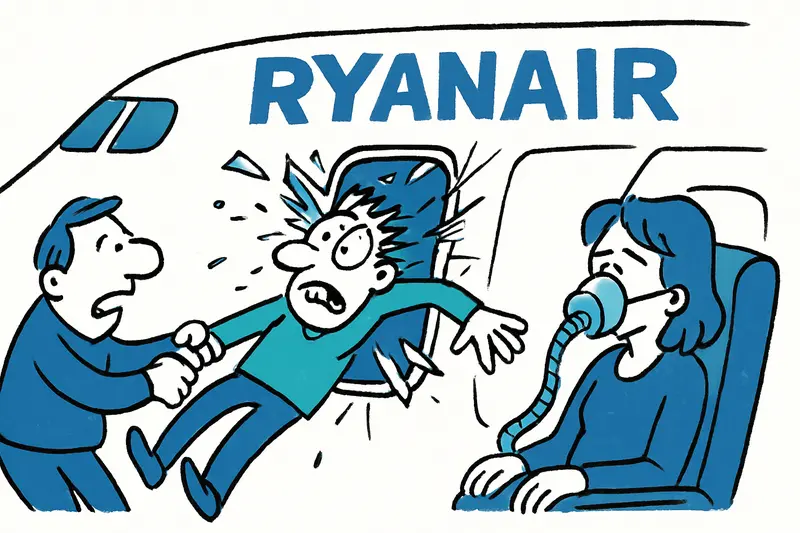
Shortly after takeoff from Thessaloniki, a dramatic incident occurred on board a Boeing 737-800: at about 6,000 meters altitude a window pane shattered and a man seated by the window was partially pulled out through the opening before fellow passengers dragged him back into the cabin. Oxygen masks deployed, the captain initiated a return to the airport — the aircraft circled and landed safely. The injured person received medical attention after landing.
Key question
How can a passenger window pane break during cruise flight, and what lessons should the aviation industry learn, particularly for flights to Mallorca?
Critical analysis
When examining such events, it is important to separate technical facts, maintenance procedures and organizational structures. Aircraft windows consist of multiple layers and are designed to withstand pressure differentials. Nevertheless, material fatigue, manufacturing defects or shortcomings in maintenance are possible causes. Improper work on the cabin lining or fastenings can also create weak points. At this time there is no official clarification of the cause; that makes speculative accusations questionable, but it does not render calls for transparency unnecessary.
Importantly: automatic systems worked to some extent — the oxygen masks deployed, the cockpit initiated a safe procedure and brought the aircraft back. That speaks for a trained crew and functioning emergency procedures. At the same time, the incident shows how quickly a routine situation can turn into a nightmare and how dependent passengers are on professional action; nevertheless other incidents, like Frightening Seconds over Palma: Two Flight Attendants Injured, show different types of in-flight emergencies.
What is often missing in public discourse
The public narrative usually focuses on the dramatic snapshot: the bang, the passenger pulled out, the images from the cabin. Less attention is paid to questions about the certification history of the affected components, who was responsible for maintenance, how often routine inspections are carried out on this exact aircraft type and how transparent this information is to authorities and the public; local coverage such as Crack in the window — what an aircraft defect means for Mallorca travelers has previously reported related window damage. Also rarely discussed are the role of leasing chains, common in many short-haul fleets, and the communication between the airline, the airport and local medical services at the destination — relevant here for Mallorca because many flight connections lead to the island. The economic context is explored in Ryanair threatens further cuts – How at risk is Mallorca?.
Everyday scene from Mallorca
At Son Sant Joan, in the bus waiting hall next to the departure displays, you often see families, seniors with wheeled suitcases and commuters on hot July days. Many glance at their smartphones when news of a flight incident arrives; some simply nod tiredly because they know: in summer the planes are full, and delays and incidents quickly become topics of conversation at the cafés along Passeig Mallorca or at the kiosks in front of the terminal. Incidents reported previously, for example Laser on the approach: Ryanair aircraft at Son Sant Joan dazzled – time to act, feed that conversation. For island residents and tourists alike: safety should not only be a headline, but practice.
Concrete solutions
- Immediate independent technical investigation: not only internal airline checks, but investigations by the responsible aviation authority and, where possible, independent experts. Results should be published as far as the investigation allows.
- Transparency in maintenance and leasing contracts: authorities should have access to chains of responsibility; the public and airports need reliable information about the airworthiness of deployed aircraft.
- Preventive inspections for similar aircraft: airlines that frequently fly to Mallorca should voluntarily commission additional visual checks (especially of window frames and adjacent structures).
- Improved emergency coordination at destination: airports in Mallorca must have fast medical interfaces with island clinics so that injured passengers can be treated immediately.
- Sensitive information policy: passengers on site need clear instructions instead of rumors. A simple, reliable channel at Palma airport would help calm the situation.
Conclusion
The incident was a rare but sobering example of how vulnerable people can be in a modern aircraft. Well-functioning emergency procedures prevented worse outcomes. That is not enough: full clarification and lasting measures are now needed so that safety begins not only at landing but already at the last safety check. For Mallorca, whose life depends heavily on air traffic, this is not an academic debate but a practical obligation to guests and residents.
Frequently asked questions
What is the best time of year to visit Mallorca for nice weather and fewer crowds?
Is it safe to swim at Mallorca's beaches?
What should I pack for a trip to Mallorca?
How can I get around Mallorca?
What are the landscape and activity highlights in Mallorca?
What cultural experiences should I seek in Mallorca?
Do I need to learn Spanish or Catalan phrases for Mallorca?
Are there family-friendly beaches and activities in Mallorca?
Similar News
Mini-tsunamis in Mallorca: Harmless natural phenomenon — or an underestimated danger?
Two harbor towns in Mallorca recorded unusual water level fluctuations. An analysis: How rissagas form, who is at risk —...
Stinging jellyfish in Cala Banyalbufar: Why everyone suddenly fled the water
In Cala Banyalbufar, Pelagia noctiluca washed up in droves. A personal account of why this is no coincidence, what is of...
New low-pressure trough brings rain — and the heat remains: What's missing in Mallorca?
A short, intense window of showers hit Mallorca, yet the air remained muggy and warm. Key question: Why does rain hardly...
Klaus-Michael Kühne has died: The entrepreneur who gave Mallorca a second home
He first arrived on the island at 60; later the holiday house became Castell Son Claret – a hotel, a music venue and an ...
Buying Instead of Moving Away? Why Every Fourth Property Owned by Balearic Residents Isn't Located Here
Almost a quarter of the apartments purchased by Balearic residents are located on the Spanish mainland. A concise analys...
More to explore
Discover more interesting content

Boat Tour with BBQ along Es Trenc Beach

Private transfer from Mallorca Airport (PMI) to Pollensa
