
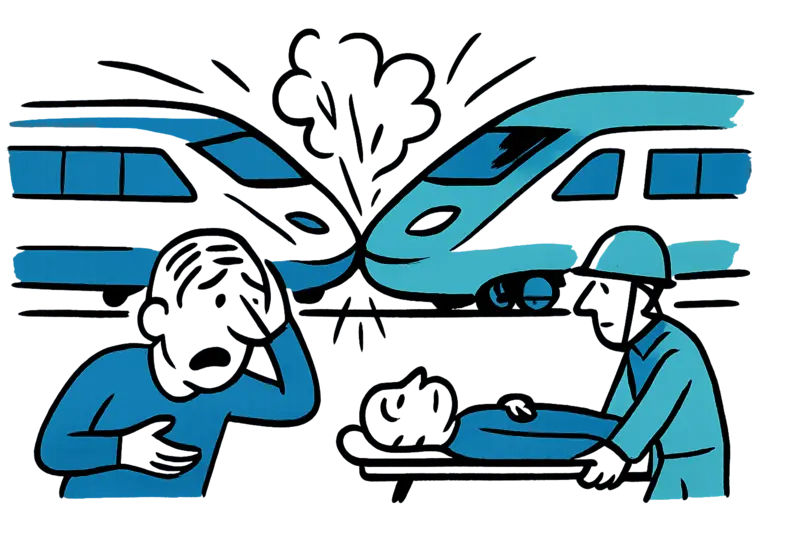
Collision of two high-speed trains near Toledo: How could this happen — and what needs to change?
Collision of two high-speed trains near Toledo: How could this happen — and what needs to change?
At least 64 people died when an AVE collided with an Iryo train near Urda. A passenger describes the force of the impact. Our questions: How did the safety system fail and what lessons do rail operators and authorities need to draw now?
Collision of two high-speed trains near Toledo: How could this happen — and what needs to change?
An eyewitness from the rear AVE carriage describes a violent jolt. Rescue teams with helicopters and mobile intensive care units were on site.
On the morning of the accident, at 08:54 near Urda station there was a secondary collision between an AVE high-speed train of the state rail operator and a train from the private operator Iryo. According to available information, at least 64 people died and dozens were injured. Units from the national emergency dispatch 112 reported a large deployment: fire crews from the Alcázar de San Juan and Orgaz stations, several civil protection units, three rescue helicopters and two mobile intensive care units were sent to the scene.
A passenger who said they were sitting in one of the rear carriages of the AVE recounted that the impact came as a violent jolt; he saw the carriage twist after the hit. Such accounts convey the forces released in milliseconds. That such impact energy occurred at a station raises fundamental questions about traffic control, the safety systems in use and operational organization.
Key question: How could two trains meet on a high-speed line like this when current rules mandate multiple technical safeguards and operational procedures to prevent accidents? Operators, regulators and politicians must now answer this question clearly.
Critical analysis: Several systems run in parallel on the route — dispatchers, automatic train protection and digital traffic management according to European standards. If a collision became possible, there can be several causes: human error by signalling staff, technical failures in the signalling system, incomplete integration between different operators, or errors in the trains' position reporting. Liberalization and competition have opened services in Europe, but they also create interfaces that must be more clearly regulated and monitored; previous local incidents such as MA-10 under scrutiny: Head-on collision between intercity bus and delivery truck near Esporles illustrate consequences when interfaces fail.
What has so far been underdiscussed in the public debate is the duration and quality of training for signal and operations staff, maintenance intervals for critical components, and transparency when testing new digital safety systems. Also little examined is how private operators are technically and organisationally integrated into infrastructure managers' emergency plans; local cases, for example When the Articulated Bus Broke Down: Hours of Chaos at the Estación Intermodal, show how coordination gaps affect responses. Initial reports focus on casualty numbers and dramatic images — that is important, but deeper causes risk being lost in the stream of reports.
An everyday scene from Mallorca: in a café on Passeig Mallorca customers turned the radio on as the first reports came in. The TV above the counter showed a map of the line; people outside the kiosk scrolled through news on their smartphones, some following coverage of incidents like Eight Injured after Hard Braking in Palma – Heated Debate over TIB Working Conditions. Conversations fell quiet and turned to regional infrastructure — far from Toledo, but with immediate concern, because many people here rely on trains or airports daily and wonder whether technical promises hold.
Concrete measures that should now be reviewed and quickly implemented can be summarised: an independent immediate investigation by a technical accident commission with a publicly available timetable; temporary speed restrictions on affected sections of track; a prompt review of interoperability between the digital safety systems of Renfe, infrastructure managers and private operators; additional independent sensors for situational awareness along critical nodes; mandatory emergency drills involving all parties including private operators and rescue services; and transparent reporting on already known weaknesses in the rail network. Past emergencies such as Severe rear-end collision on the Ma-13: Why the stretch between Inca and Palma often becomes a bottleneck underline this necessity.
Also essential: victim and family support, including long-term medical care and psychological assistance, must not be sidelined by technical debates. Responsibilities in liability matters must be clarified without impeding investigations.
Concise conclusion: An accident of this magnitude is not only a technical failure but a breakdown on several levels — planning, operations, coordination. The prompt rescue measures show that emergency services work. What is missing is a consistent examination and a systemic shift toward transparency and prevention. Those who in the coming weeks only look for culprits without identifying structural failures will risk a repeat of this danger.
This text is based on the facts available so far about the time and place of the accident and the information from the emergency dispatch 112; further technical conclusions must be confirmed by an independent investigation.
Frequently asked questions
What factors could lead to a collision between high-speed trains on the same route, and what safety systems are meant to prevent it?
How do European rail safety rules handle interoperability when several operators run on the same tracks, and what can go wrong here?
What immediate steps are typically taken after a major rail accident to improve safety and accountability?
Why is rail safety interoperability important for Mallorca residents who rely on trains and airports?
How are victims and their families supported after a rail disaster?
What does a collision at a station reveal about safety and operations in high-speed rail networks?
How should travelers plan their journeys after a rail incident in Mallorca or elsewhere?
What broader changes are being urged to prevent similar rail accidents in the future?
Similar News
How safe are Spain's high-speed lines? After the Toledo accident
Two high-speed trains collided near Urda in the province of Toledo. At least 46 people died. A reality check: technology...
When Water Became a Fountain in Sant Elm: An Accident, a Fleeing Driver and the Question of Driving Fitness in Old Age
In Sant Elm an over-80-year-old driver in a convertible struck a water meter, sending a meter-high fountain into the air...
Why Falls in the Torrent de Pareis Are Not Inevitable: A Reality Check After a Rescue Operation
A hiker fell about three meters in the Torrent de Pareis and was airlifted to hospital with severe spinal injuries. Why ...
Celebrities, Padel and Pressure: What Lies Behind the Glitz in Mallorca
Between film premieres, padel coaches and runway demands: why Mallorca's glittering celebrity world exposes problems tha...
Water shortage in Sant Llorenç: Why a desalination plant alone is not enough
The municipality of Sant Llorenç plans a desalination plant in S'Illot. A technical intervention — but what's missing fr...
More to explore
Discover more interesting content

Can Cap de Bou

Townhouse Lleo 72
