
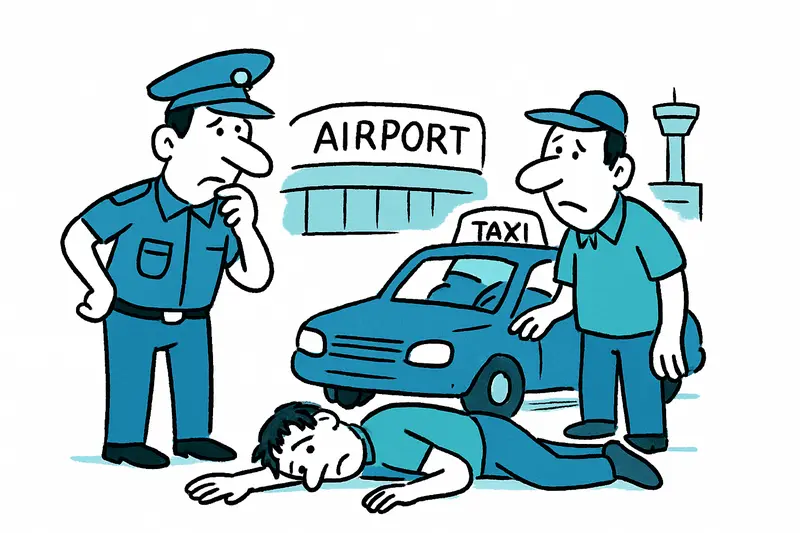
Dead at Menorca Airport: Who Is Responsible for a Man Who Slept on the Road?
Dead at Menorca Airport: Who Is Responsible for a Man Who Slept on the Road?
In the early hours a man was run over by a taxi in front of Mahón's terminal and died. His identity is unclear. Who could have prevented the accident — and what is missing from the discussion?
Dead at Menorca Airport: Who Is Responsible for a Man Who Slept on the Road?
Summary
A man was lying on the road just a few metres in front of Mahón airport's terminal. At around 05:00 he was struck by a taxi and so severely injured that SAMU 061 emergency personnel could only declare him dead. His body was dragged several metres. The driver had zero blood alcohol; cameras inside the taxi provided important footage, and further surveillance videos are to be analysed. The identity of the deceased is not yet known; forensic pathologists and crime scene investigators are involved and an autopsy has been ordered. Local and national police are clarifying the circumstances and checking whether a criminal offence occurred.
Key question
How could a person lie on the carriageway in the immediate vicinity of a busy terminal without anyone coming to help — and who should have intervened to prevent someone being run over?
Critical analysis
The facts are stark: night or early morning, a bend before the bus parking area, poor visibility — that explains why a driver reacted late. But technical explanations alone are not enough. Airports are public spaces with permanent staff, night venues nearby and frequent vehicle traffic. At such hubs there must be clear responsibilities for order and safety around the clock. We are now hearing about cameras, alcohol tests and the autopsy. Those are necessary steps for the investigation. At the same time, structural questions remain unanswered: What patrols took place during the night? What role does the nearby night venue play? Were there indications that people regularly sleep here? And why was there no one on site who could have moved the man out of danger?
What is missing from the public discourse
Most discussions focus on questions of blame and the technical details of the accident. That is important, but another issue disappears from view: the presence of social services at transport hubs during the night. On Menorca the nightly scene at terminal entrances and exits is not an isolated case; a similar incident is described in MA-19 at Night: Why Was a Pedestrian on the Airport Access Road?. People who are exhausted, intoxicated or have nowhere to rest lie down. Who helps them before vehicles start moving? And why is there not a systematic check of whether lighting, road markings and reflectors are adequate, especially at curves and entrances?
Everyday scene
Imagine the early morning in Palma: taxi drivers waiting at Passeig-Moll, thermoses with strong coffee, garbage trucks already rumbling down Calle Blanquerna, and refuse collectors sorting beer bottles into sacks, a scene similar to the one reported in Fatality on the MA-19 near Palma: How did a pedestrian get onto the highway?. One driver changes the playlist in the streetlight glow, another rolls down the window to light the first cigarette. It could have been the same in Mahón: quiet, only the hum of air conditioners and the distant clatter of a bus. In that quiet people are easy to overlook.
Concrete solutions
- Increase visibility: add reflective elements to road markings, improve lighting especially at curves and stopping zones. Airports and municipalities should assess this together.
- Speed and approach limits: route taxi and delivery traffic more slowly through blind spots; separate access ways clearly and, if possible, install provisional barriers.
- Extend presence: systematise night patrols by airport police or security services; schedule regular rounds with fixed breaks.
- Night social patrols: cooperation between municipalities, social services and security firms to proactively approach people in need and take them to safe facilities.
- Driver training: require taxi companies to provide night-shift hazard training covering blind curves, sleeping people on carriageways and accident handling.
- Accelerate data and video analysis: network cameras so that anomalies (lying persons, group gatherings) are reported automatically and on-call teams are alerted.
Conclusion
A person has died. Technical measures, reports and tests will clarify the immediate circumstances. Beyond that, we need an honest debate about public night-time spaces: who ensures that people do not sleep on carriageways? Airports, municipalities and taxi companies are part of the chain of responsibility, as shown after the Fatal accident near Son Castelló: Three passengers come forward — where are the gaps in responsibility?. If we do not act, the key question will remain unanswered — and the risk is that similar incidents will happen again.
Our thoughts are with the deceased, even though his name is not yet known. The investigation is ongoing; the answers must follow — not only on paper, but in brighter lighting and concrete presence where people rest dangerously close to traffic at night.
Frequently asked questions
Who is responsible for night-time safety around Mallorca's airports?
What measures reduce the risk of people lying on roadways near Mallorca airports?
How can night patrols and social services help at Mallorca transport hubs?
What role do cameras and video analysis have near Mallorca airports?
Should taxi operators in Mallorca receive night-shift safety training?
What public questions should be considered about night-time safety at Mallorca transport hubs?
What should I pack for a Mallorca trip to stay comfortable at airports in changing weather?
What steps should authorities take when reviewing night-time safety around Mallorca's airports?
Similar News
Cafetería San Siro: A Meeting Place on Schinken Street Since 1966
In the middle of Schinken Street, Cafetería San Siro has been offering Mallorcan hospitality for more than six decades —...
From Ballermann to Prison: What the Verdict Against the Femina Operator Means for Palma
The Munich Regional Court convicted a German operator for subsidy fraud. What does the verdict mean for the Femina Club,...
Underpass Verge de Lluc: 19-year-old fights her way out of flooded car – a warning sign for Palma
A 19-year-old recently escaped swimming from her car after the Verge de Lluc underpass held up to one and a half meters ...
When the Floodgates Open Again: Why Palma's Floods Aren't a Coincidence
A sudden heavy downpour around 5 p.m. brought Palma to a standstill: flooded streets, full basements, panicked commuters...
Playa de Palma: Life-saving at Balneario 11 – Lifeguards Act Quickly
A German holidaymaker suffered cardiac arrest at Playa de Palma. Lifeguards resuscitated her on the beach; emergency ser...
More to explore
Discover more interesting content

Can Cap de Bou

Townhouse Lleo 72
