
Who clears up in Cala Marmassen? Decaying refugee boat harms the seabed
Who clears up in Cala Marmassen? Decaying refugee boat harms the seabed
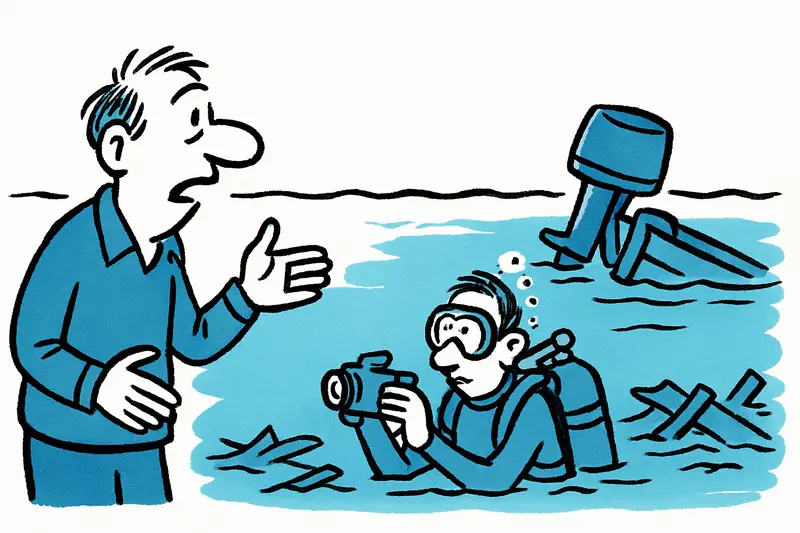
A shipwrecked refugee boat in the remote Cala Marmassen near Andratx decayed over the winter. Remains now lie on the seafloor, the engine still protrudes above the water. What consequences does this have for Posidonia, fish and swimmers — and who must take action?
Who clears up in Cala Marmassen? Decaying refugee boat harms the seabed
A diver documents: remnants of an abandoned boat lie on the seabed, storm damage has disintegrated it
During one of his dives at the end of winter, local diver Ramón Javier Fernández Barea discovered in the small bay of Cala Marmassen near Andratx the remains of an apparently abandoned refugee boat. What was initially visible as a several-meter-long wreck now lies mostly underwater; only the engine still protrudes above the surface. On the seabed are fragments of the hull and also a metal ladder that once allowed bathers to enter the water.
Key question
Who takes responsibility for the rotting boat — and how can one prevent such incidents from recurring and causing permanent damage to coastal ecosystems?
Critical analysis
The images Fernández Barea captured show not only rusting sheets of metal. They mark a process observable on many coasts: unattended watercraft disintegrate through wind, waves and salt, releasing pollutants, lightweight parts become microplastics, sharp metal edges injure marine life. In bays with shallow bottoms there is a real risk that sensitive seagrass meadows like the endemic Posidonia will be damaged. These meadows are habitat, sediment stabilizer and carbon sink at once; damage means loss of fish spawning grounds and poorer water quality. Large clean-up operations have highlighted the scale of debris in the region, see Who cleans up the sea? Almost eight tons of waste off the Balearic Islands — and the uncomfortable answers.
What is missing from the public discourse
The debate often narrows to the boat's origin or to symbolic aspects of migration. Practical questions remain underexposed: Who maps such objects? Are there binding procedures for securing and salvaging them? What financing options exist for swift measures? On Mallorca responsibilities meet: municipality, island council, port authority, coast guard — but a clear, publicly known protocol for removing smaller wrecks seems rare. Broader discussions on responsibility and cost are explored in Who Pays the Beach Bill? 365 Boats, €365,000 and an Unresolved Problem.
Everyday scene from the bay
Those who know this little bay understand how quickly calm turns to trouble: a narrow path through pine trees leads to the pebble beach, in the afternoon a small group of fishermen folds their nets, a couple lets their dog splash at the shore. The engine now sticking out of the water is an alien element in this picture. If children continue diving there to inspect the shiny parts, the risk of accidents is tangible. The smell of sea and pines mixes with the faint scraping of metal under the waves.
Concrete solutions
Pragmatic, immediately implementable steps are needed: 1) A local inventory of all unusual objects in bays by diving associations and harbormasters. 2) An emergency kit for small recoveries: oil absorbers, lift bags, certified dive teams with liability insurance. 3) A clear reporting channel for citizens and divers (a phone number or an online form at the municipality of Andratx), so findings are quickly documented. 4) Financial reserves at island or municipal level for timely measures; state funding could supplement this. 5) Prevention: information to boat renters and marina operators about safe disposal and reporting obligations. 6) Volunteer beach clean-ups and coordinated dive actions with protection concepts so helpers do not become a danger themselves. Similar local impacts have been recorded in South Coast at the Limit: When Boats and Plastic Overwhelm Communities.
Why a quick response makes sense
The longer a wreck lies in the water, the greater the risk that pollutants will enter the sea and micro particles will spread. Salvage can become much more expensive and technically demanding afterwards. A coordinated approach saves money, protects biodiversity and preserves bathing quality for residents and visitors; municipal costs for salvage are illustrated in Wrecks in the Bay of Pollenca: Municipality pays – but who bears responsibility?.
Punchy conclusion
The decaying boat in Cala Marmassen is more than a photo motif; it is a wake-up call. It's not only about the origin of the people, but also about responsibility for the sea on whose coasts we live. Who is responsible is not only a question of morality, but of organization: quick reporting, clear procedures, adequate resources. Otherwise, such silent witnesses remain in the bays — until a small bay suffers visible damage or people are injured. The solution is practical and local: report, secure, recover, and turn incidents into a better system.
Frequently asked questions
What should happen when an abandoned boat is found in a bay on Mallorca?
Can a damaged boat harm Posidonia in Mallorca?
Why do abandoned boats become a pollution problem in Mallorca?
Who is responsible for removing a wreck in a small bay near Andratx?
Is it safe to swim near a decaying boat in Mallorca?
What is Cala Marmassen near Andratx like?
Why should boat wrecks in Mallorca be removed quickly?
How can residents and divers report a boat wreck in Mallorca?
Similar News

Four goals, heart-stopping moments, a message: Germania Mallorca takes three points in Consell — questions remain
The new German club on the island won its first away game in Consell 4:3. Celebration, a 4:0 lead, then a nervous finish...

Mueller continues expanding in Mallorca: Artà in 2026, Can Picafort in early summer 2027
The drugstore chain Mueller is opening two new stores in Mallorca: a 1,400 m² shop in Artà on 5 November 2026 and a bran...

The Painter Who Lived Mallorca: Franz Taussig and His Century-Old Secret
A hundred years ago a young Viennese arrived in El Terreno, sketched the island and called himself Francis Caron. Today ...

Airport dispute: Bridge, forecasts and the question of responsibility
A video by the Spanish transport minister has ignited the dispute over DORA figures, capacities and local governance pow...

The Painter Who Invented Himself: How a Young Viennese Drew Mallorca
A hundred years ago a 19-year-old draftsman arrived in El Terreno. His diary and sheets, long known under the pseudonym ...
More to explore
Discover more interesting content

Can Cap de Bou

Townhouse Lleo 72
