
Lost between rocks and beachgoers: Dolphin in Cala Tirant raises question of assistance
Lost between rocks and beachgoers: Dolphin in Cala Tirant raises question of assistance
A lone dolphin surfaced on Monday in the shallow bay of Cala Tirant. Lifeguards tried to guide the animal into deeper waters using a surfboard. Why wasn't that enough — and who is responsible when marine animals need help?
Lost between rocks and beachgoers: Dolphin in Cala Tirant raises question of assistance
Rescue attempt with a surfboard in front of beach visitors — but no specialists on site
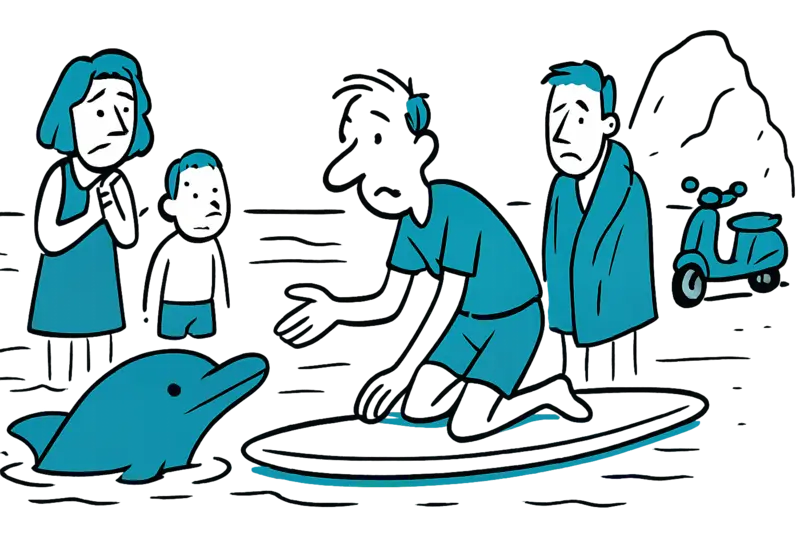
On a clear October late morning a solitary dolphin surfaced in the shallow water of Cala Tirant. The animal repeatedly swam close along the edge between sand and rock, poked its rostrum through the surface and appeared disoriented. Families on the shore paused, children stopped splashing, and the usual engine noises faded into the background for a few minutes.
The lifeguards of the bay acted quickly: they approached with a surfboard, tried to steer the animal toward the open sea and created a small safety zone so that bathers kept their distance. The action was bold and visible — but it apparently was not enough to bring the dolphin safely out of the danger zone.
What exactly happened can be reconstructed from on-site observations: the seabed in Cala Tirant initially slopes gently but has narrow rock formations and shallows. In such areas a strong, possibly sick or exhausted dolphin can repeatedly end up in shallow zones and then be unable to maneuver back toward depth on its own.
There are several plausible reasons for this behavior: natural curiosity or hunting, fleeing a predator, irritation from underwater noise or a health disorder. The range spans from harmless causes to cases that would require medical help — distinguishing them on site is difficult, as shown by the mystery of a dead striped dolphin at Palma's Club de Mar.
The scene raises a clearly formulable guiding question: why is there no standardized, visible escalation chain between beach rescue and specialized marine mammal teams for such cases? In Cala Tirant the lifeguards were the only ones responsible — support from specialized units or equipment did not arrive. Similar issues have had tragic outcomes, as in a fatal rescue attempt at Son Bauló.
It is critical to note that public discourse often stops at the moving snapshot: a dolphin, concerned people, a brave rescue attempt. What is missing is the discussion about responsibilities, reporting channels and preventive measures — especially in Menorca's northern coves, which are frequently visited by day trippers, and which echo debates raised when lifeguards at Playa de Palma staged a 'collective drowning' protest.
A practical everyday scene to close this gap: in front of the small kiosk on the access road to Cala Tirant people stand with wet towels, a scooter stands in the gravel parking area. A simple posted notice could make a difference here: emergency numbers for marine mammals, behavior recommendations, reminders to keep distance and not to touch. Such small measures reduce stress for the animal and for rescue personnel alike.
Concrete solutions that could be implemented quickly: first, mandatory training for beach guards on first-response measures for stranded or disoriented marine mammals; second, a clearly defined hotline and rapid alert chains to the environmental authority or specialized NGOs; third, basic protective equipment (e.g., soft lines, inflatable boats with quiet propulsion systems) at selected stations; fourth, regular exercise scenarios between rescue teams and environmental services.
Furthermore, long-term measures should be on the agenda: better mapping of shallows in heavily visited coves, noise controls for boat traffic in sensitive zones and public information campaigns that make tourists and locals aware of how to behave when encountering dolphins, similar to debates provoked by the third sea turtle nest in Menorca.
A pointed conclusion: the single incident in Cala Tirant shows more than a lost dolphin — it exposes a gap in the chain of responsibility. The lifeguards on site did what they could. Now the next question for politicians and those responsible is: will they ensure that specialized help is on hand more quickly next time?
Frequently asked questions
If I spot a dolphin near a Mallorca beach, what should I do?
Are there standardized rescue procedures for stranded dolphins on Mallorca?
What equipment might be used in dolphin rescue efforts off Mallorca’s coast?
What factors can lead a dolphin to become disoriented in shallow bays around Mallorca?
How can visitors help protect dolphins when visiting Mallorca’s beaches?
What role do lifeguards play in dolphin rescue situations on Mallorca?
How can the public access guidance on encountering dolphins in Mallorca?
What long-term steps could prevent dolphin incidents in Mallorca’s coves?
Similar News
Deadly accident at 550 Challenge: What the Zero Car deployment leaves unresolved
A lead vehicle crashes, a well-known participant dies, the rally is cancelled. We ask: Are the safety requirements suffi...

Housing Pressure on the Islands: Why Ibiza Sets the Bar for High Rents
New rental contracts on Ibiza average almost €2,000 — despite a sharp decline in private tourist beds. What does this me...

After a Powerbank Fire on a Plane: What Mallorca Travelers Need to Know
A powerbank fire on board makes clear: batteries belong in carry-on luggage — and travelers, airports and airlines must ...

Fire in Can Pastilla: Supermarket behind hotel burns down completely – a reality check
A small supermarket behind a hotel in Can Pastilla burned down completely in the early morning hours. Why a second water...

Private Ambulance in Mallorca: Why a Father Had to Pay €695 Out of Pocket
A German holidaymaker paid €1,095 after an emergency involving his nine-month-old son. His health insurer reimbursed onl...
More to explore
Discover more interesting content

Can Cap de Bou

Townhouse Lleo 72
