
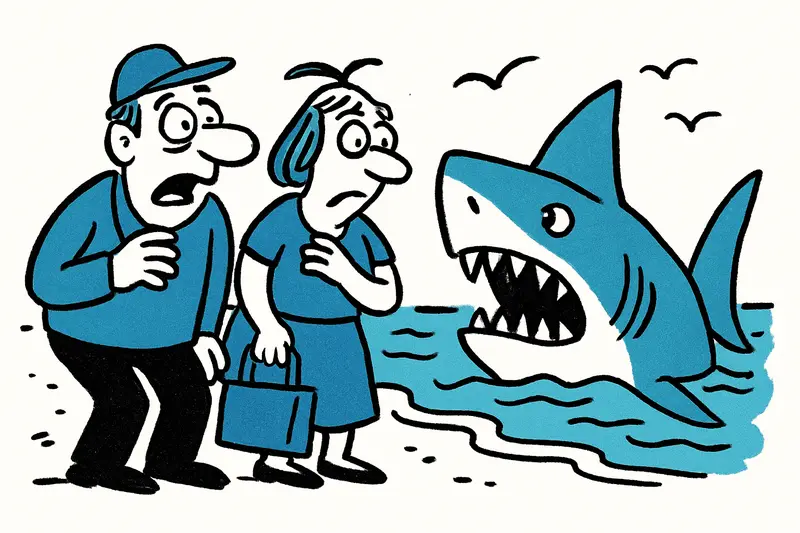
Earlier and More Frequent Than Thought: Great White Sharks off Mallorca's Coasts
Earlier and More Frequent Than Thought: Great White Sharks off Mallorca's Coasts
Between 1941 and 1976 several large great white sharks were caught off northern Mallorca. The historical cluster, the modern sighting in 2018 and a recent confirmation in the Spanish Mediterranean call for sober answers rather than panic.
Earlier and More Frequent Than Thought: Great White Sharks off Mallorca's Coasts
When you stand on the mole of Port de Pollença in the morning, you hear the screeching gulls, smell diesel and freshly cut nets — and rarely think of the great white shark. Yet records from the 20th century show that especially in the north of the island between 1941 and 1976 at least 18 large specimens ended up in tuna nets. Other sources even estimate the total number for the Balearic Islands to be higher.
Guiding question
How should we deal with the knowledge that the great white shark was historically part of the western Mediterranean, and what does that mean for our coasts today?
Critical assessment
The numbers from the middle of the last century are not explained by myth but by the fishing operations of that time: rigid tuna nets anchored to the coast attracted prey fish — and with them predators. Documents and fishermen's recollections show that some animals were more than six meters long and over 2,000 kilograms in weight. From the late 1970s onward such concentrations became significantly rarer; the last large, documented capture dates from 1976.
Nevertheless there are modern signals: in 2018 a scientific team filmed an individual of about five meters near Cabrera, and recently researchers from the Spanish Institute of Oceanography (IEO) together with the University of Cádiz reported a new confirmed record of a great white shark in the Spanish Mediterranean. All this suggests that the great white shark has not completely disappeared — but nor has it returned as a resident population. Recent strandings reported in the local press, for example Dead Shark at Playa Can Pere Antoni: Bite Marks Raise Questions, have kept the issue in the public eye.
What is missing in the public discourse
On Mallorca the debate often oscillates between sensationalism and soothing downplaying; coverage such as Dead shark on Palma's city beach: a sign of a bigger problem? exemplifies the former. Three things are frequently left out: first, systematic long-term data on large predators in the Balearic Sea; second, concrete plans for monitoring and preventive protection of bathers and fishermen without killing animals; third, dialogues between science, fishing communities and tourism stakeholders.
An everyday scene
In the late afternoon you can see retirees walking their dogs in Cala Sant Vicenç, children with snorkels at the edge of the sandbank and older fishermen folding their nets. Such a moment illustrates why panic-mongering is harmful: beaches are habitat, workplace and recreation space at once. At the same time the grey ropes and spread-out nets on the quay remind us how human technology once trapped animals.
Concrete solutions
1) Expand monitoring with scientific methods: increase eDNA sampling along coastal sections such as Pollença, Alcúdia and Cabrera, complemented by satellite tagging of larger shark individuals where possible.
2) Early-warning and safety concepts without killing: drones, stationary sonar devices at popular bathing beaches, additional training for lifeguards and clear information systems for beachgoers.
3) Involvement of fishing communities: use fishermen's historical knowledge, adapt fishing methods and create incentives for damage-reducing practices instead of escalating conflicts.
4) Protect the food base: measures to preserve tuna stocks and other prey species can indirectly influence predator behavior and are part of an ecological approach.
5) Long-term research and education: cooperation between local institutions, universities and research centers to build a robust data basis and to educate the public. Incidents covered in the local media, such as Dead Shark on the City Beach: What the Large Wound Reveals About Mallorca, underline the need for coordinated coastal protection and clear communication.
Conclusion
The great white shark off Mallorca is not a horror vision from the past, but neither is it the return of an established population. The reality lies in between: sporadic visitors, historically driven clusters and a deficit of knowledge regarding monitoring and prevention. Rather than oscillating between panic and denial, a sober, locally anchored plan would be sensible — one that brings fishermen, scientists, lifeguards and beachgoers to the same table. That way the island's coast can remain both safe and part of a healthy sea.
Frequently asked questions
Are great white sharks still found around Mallorca today?
Was the great white shark really more common off Mallorca in the past?
Is it safe to swim in the sea around Mallorca if great white sharks are present?
What should beachgoers in Mallorca do if they hear about a shark sighting?
Why were great white sharks caught more often in tuna nets near Mallorca?
What place near Mallorca was recently linked to a great white shark sighting?
What are scientists suggesting for shark monitoring around Mallorca?
Why is Mallorca’s shark debate not just about tourism?
Similar News

Released with Conditions: The Plus Ultra Suspicion and a Mallorcan Finca as Residence
A Dutch entrepreneur, sought in connection with the Plus Ultra case, was extradited to Spain after his arrest in Germany...

Haute Nuit in Puerto Portals: Fashion, Art and Indulgence by the Water
On October 2 the Lobster Club in Puerto Portals will be transformed into a stage for curated fashion, art and culinary e...
Magaluf: Watchtower Alarm – Lifeguards Pull Unconscious Beachgoer from the Water
After a drama in the late afternoon, two lifeguards at Magaluf beach rescued an unconscious 44-year-old man. He was stab...

Turquoise in the City: How dangerous is the color play of the Sa Riera?
The Sa Riera in Palma suddenly turned turquoise — a pretty motif, but behind the effect lies a discharge of saline waste...

Jeckliner at Sunnesching: Cologne spirit sets sail from Palma
In September 2027 the Mein Schiff 2 briefly becomes a floating carnival stage: four days with Cologne bands, comedy and ...
More to explore
Discover more interesting content

Can Cap de Bou

Townhouse Lleo 72
