
When the island groans under heat: What explains the extreme summer in Mallorca?
When the island groans under heat: What explains the extreme summer in Mallorca?
Four heatwaves, new records (40.8 °C in Llucmajor) and muggy nights — we ask why summer heat is increasing, what is missing from the debate and what can help locally.
When the island groans under heat: What explains the extreme summer in Mallorca?
Central question: Why do heatwaves on the island now occur more frequently and last longer — and what does that mean concretely for everyday life and safety?
The facts are brief: This summer Mallorca has experienced several particularly hot phases, and another heatwave has recently rolled over the island. In Llucmajor a new high temperature of 40.8 °C was recorded in July. This was documented in Nearly 40 °C: Mallorca's Daily Life Under Heat Stress — How the Island Can Respond. Meteorological services report a clustering of heatwaves in recent years and observe a shift in summer patterns since around 2017, as discussed in Third-warmest summer since 1961: More tropical nights, more questions for Mallorca.
This is more than an annoying warm spell. The combination of long, dry periods and then very intense rainfall changes how we live with the island: vegetation suffers, the risk of fires increases, nights hardly cool down — many people lose sleep over it. On the mainland, in addition to higher temperatures, there are also more large fires; this is not an isolated phenomenon — see Heatwave reaches 42 °C: How Mallorca should cope with the new temperature peak for a recent local peak.
A sober analysis shows two levels: First, short-term weather constellations — blocking high-pressure systems, hot air masses from the south — that repeatedly lead to heatwaves. Second, a longer-term background trend: the rising average temperature, which makes extreme values easier to reach. Together these explain why in some summers we experience several stressful heat phases in a row.
What is often too shortchanged in the public debate is the local perspective: How do neighborhoods, beaches and rural communities respond concretely? There is a lack of clear, location-specific plans for heat preparedness: shade concepts in residential areas, working-time rules for outdoor workers, cooling options for people without air conditioning, targeted measures against vegetation loss on slopes that become slippery during heavy rain. Local preparedness is examined in When Mallorca Cooks: How Prepared Is the Island for the Next Heatwave?.
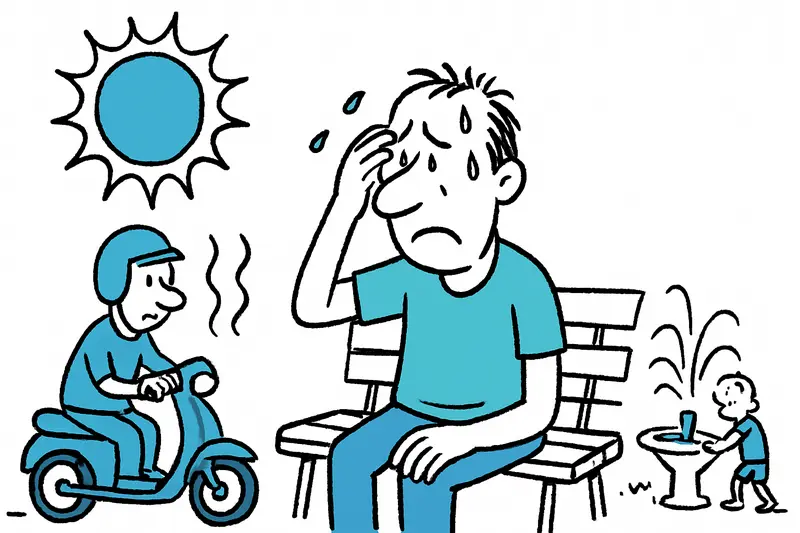
An image that illustrates this: late afternoon on the Passeig del Born. Café tables stand empty, the parasols are fully open, several elderly residents sit on the bench in front of the Palau March and rub their foreheads. A delivery driver waits, sweating, next to his motorcycle, children play at the fountain — but the water hardly bubbles, too warm to cool off. The scent of sunscreen mixes with the smell of heated asphalt. Such everyday pictures repeat in Palma, in Portixol, at the Plaça de la Quartera as well as in smaller towns out to Llucmajor.
Concrete proposals that can work locally:
- Establish local cooling hubs: Open municipal buildings, libraries or cultural centers flexibly as air-conditioned rest points — with clear communication about opening hours and accessibility.
- Shade and greening programs: More trees along main routes, mobile sun sails on school routes, green roofs on public buildings to dampen temperature peaks.
- Adjust work and school schedules: Flexible hours for outdoor work, cooler hours at schools and daycares, more breaks and drinking stations.
- Water management and fire protection: Store firefighting water reserves in high-risk zones, early access restrictions to vulnerable forest areas when fire danger is high, local fuel-management programs.
- Early warning and information systems: Easily accessible via SMS, social media and signs at beaches; multilingual notices for tourists are important because they do not always know local risks.
In the long term, these changes demand different urban and rural planning: fewer sealed surfaces, more natural retention areas for heavy rain, renaturalization of slopes, more permeable pavements in new construction projects. That also means: reprioritizing municipal budgets and targeting funding toward heat- and water-sensitive projects.
It is important that measures are socially equitable. Not all households can afford air conditioning; many elderly people and workers are immediately at risk. Public offerings must not remain merely symbolic but must be practically accessible — along bus lines, in town centers and where the people most affected live.
Another blind spot in the debate is autumn: Meteorologists point out that after hot and dry summers the likelihood of very heavy rain events increases. Such episodes can lead to flooding and landslides — the sad memory of the Sant Llorenç flood remains present. This makes the combination of heat preparedness and flood protection a priority.
Conclusion: Summer brings not just higher thermometer readings but real changes to everyday life, infrastructure and safety. Anyone who now speaks only of "a few hot days" misjudges the situation. Locally implementable concepts are urgently needed — shade, water, warning systems, socially accessible cooling rooms and forward-looking spatial planning. Otherwise the coming summers will not only be warmer but also harsher for those who rely on help.
On the streets of Palma, when the evening heat slowly subsides and the streetlights shimmer, you can feel how present the issue is: close, loud and occasionally breathless.
Frequently asked questions
When is Mallorca's best time to visit for good weather and outdoor activities?
Can you swim in Mallorca year-round, and what should you know about the sea?
What should I pack for a Mallorca trip to cover beaches, hiking, and city days?
What’s the best way to get around Mallorca for a first-time visitor?
Which beaches in Mallorca are best for families or clear water?
What cultural experiences should I seek in Mallorca?
How does Mallorca's weather vary across the island?
What practical safety tips should I know for a Mallorca trip?
Similar News
Magaluf: Watchtower Alarm – Lifeguards Pull Unconscious Beachgoer from the Water
After a drama in the late afternoon, two lifeguards at Magaluf beach rescued an unconscious 44-year-old man. He was stab...
Turquoise in the City: How dangerous is the color play of the Sa Riera?
The Sa Riera in Palma suddenly turned turquoise — a pretty motif, but behind the effect lies a discharge of saline waste...

Jeckliner at Sunnesching: Cologne spirit sets sail from Palma
In September 2027 the Mein Schiff 2 briefly becomes a floating carnival stage: four days with Cologne bands, comedy and ...
Finally Home: Mike and Leyla Heiter Buy Villa with Sea View in Mallorca
The reality TV couple Mike and Leyla Heiter have bought a house in Mallorca with a roof terrace and sea view. An Instagr...
Arrest after series in Palma: Who protects apartments from repeat offenders?
The National Police arrested a man in Palma who investigators say may have broken into several apartments. In one incide...
More to explore
Discover more interesting content

Can Cap de Bou

Townhouse Lleo 72
