
Giant scare before Mallorca flight: what passengers experienced at the gate
Giant scare before Mallorca flight: what passengers experienced at the gate
During boarding in Madrid passengers heard a loud, metallic noise. Takeoff was halted, announcement: "we have a problem." What was missing: clear information, accountability and a plan for such situations.
Giant scare before Mallorca flight: what passengers experienced at the gate
An observed incident at Gate E81 in Madrid and the questions it leaves open
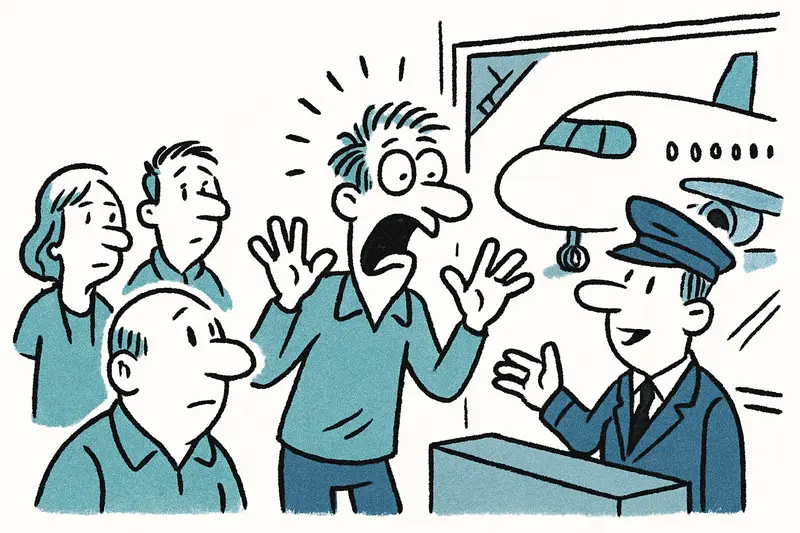
Early in the morning in Terminal 1 at Barajas: a Boeing 737 at Gate E81 was being prepared for the flight to Mallorca. The usual onboard announcements were played, suitcases were stowed, seatbelts checked. Then a sound that few on the plane missed – a loud, metallic clatter that ran through the cabin and put visible unease on some faces.
The aircraft of the airline Air Europa was scheduled as UX6031. Shortly after pushback the plane moved toward the runway but stopped after a short distance. For about 20 minutes nothing happened. Finally the cockpit announcement came: they could not take off because "we have a problem." The aircraft taxied back to the gate under its own power. A long queue of around 200 metres formed in front of the airline's desk; more than a hundred passengers were rebooked onto other flights. Despite the delay the atmosphere remained calm; there were no angry scenes or physical altercations.
Central question: How well are passengers protected and informed when technical irregularities occur before departure? This question is not merely rhetorical; it concerns consumer protection, operational procedures and the fundamental trust in aviation safety.
Critical analysis: What stands out here is not only the technical problem – such incidents, like an aborted takeoff in Basel, are part of aviation reality – but the information vacuum. A brief, vague announcement like "we have a problem" leaves room for speculation and fear. Passengers in a cabin expect clear, comprehensible information, a realistic timeframe and guidance on the next steps. Instead, the aircraft returned to the gate and there was a long wait at the desk, organised in sequence, without visible acceleration measures such as additional check-in counters or coordinated digital rebookings.
What is missing from the public discourse is an independent explanation of the technical causes. Was a mechanical component found, a sensor error, a problem with engine control? Or was it a precaution prompted by an alarm? The public usually only learns the outcome – flight cancelled or rebooked – not the cause. Equally important is the question of responsibility: Who decides on site? The crew, the airline's technical service or the airport staff? And how quickly will an independent inspection be initiated?
A commonplace scene from Mallorca: an elderly couple arriving at Son Sant Joan Airport in the afternoon wearily glance at the departures board and murmur how exhausting the trip from Madrid had been. A taxi driver on Avenida Jaime III says he often sees late passengers who had little information and were therefore unsettled. Such small, recurring impressions show: delays leave an impact, they cost nerves – and sometimes money, as with a Zurich stowaway incident.
Concrete solutions: First, better communication standards on board and at the gate. A short, bilingual explanation of the nature of the problem and a realistic timeframe calms more than a generic formula. Second, speed up automated digital rebookings: in the event of a technical anomaly the airline app should instantly offer alternative flights, issue vouchers for meals and manage priority lists. Third, independent documentation: airports and aviation authorities should centrally record incidents and publish anonymised reports so patterns become visible. Fourth, visible readiness measures at the desk – additional staff, separate priority counters for families, seniors and connecting passengers – reduce stress and waiting. Finally: transparent information obligations to travellers about compensation under EU law (EU Regulation 261/2004), where applicable, as seen in other long-disruption cases like the hours-long delay at BER.
In conclusion: technical faults are unavoidable, panic is not. What hurts on Mallorca flights like this is not the problem itself but how the airline accompanies passengers and how ground procedures are handled. More transparency, faster digital solutions and clearer responsibilities would turn a "giant scare" into a manageable event – for passengers, for crew and for neighbouring gates.
Anyone affected by such an incident should keep evidence like boarding passes and receipts and check with the airline about rebookings and possible claims. And when calm returns to Palma in the evening: the taxi from the airport rolls along Avenida Aragó, somewhere a bar opens its doors, and the stories of missed connections are processed over a café con leche — that's everyday life on our island.
Frequently asked questions
What is the weather usually like in Mallorca in early summer?
Can you still swim in Mallorca in the shoulder season?
What should I pack for a trip to Mallorca in spring?
Is Mallorca a good place to visit in the off-season?
What is Port de Pollença like for a relaxed day out in Mallorca?
Is Sóller worth visiting if you want scenery in Mallorca?
How do temperatures in Mallorca change between day and night?
What are the best things to do in Mallorca when the weather is mild?
Similar News

Mueller continues expanding in Mallorca: Artà in 2026, Can Picafort in early summer 2027
The drugstore chain Mueller is opening two new stores in Mallorca: a 1,400 m² shop in Artà on 5 November 2026 and a bran...
The Painter Who Lived Mallorca: Franz Taussig and His Century-Old Secret
A hundred years ago a young Viennese arrived in El Terreno, sketched the island and called himself Francis Caron. Today ...
Airport dispute: Bridge, forecasts and the question of responsibility
A video by the Spanish transport minister has ignited the dispute over DORA figures, capacities and local governance pow...

The Painter Who Invented Himself: How a Young Viennese Drew Mallorca
A hundred years ago a 19-year-old draftsman arrived in El Terreno. His diary and sheets, long known under the pseudonym ...
Released with Conditions: The Plus Ultra Suspicion and a Mallorcan Finca as Residence
A Dutch entrepreneur, sought in connection with the Plus Ultra case, was extradited to Spain after his arrest in Germany...
More to explore
Discover more interesting content

Can Cap de Bou

Townhouse Lleo 72
