
Heat and Off-Grid Living: What Happens to People like "Bauchi" in Mallorca?
Heat and Off-Grid Living: What Happens to People like "Bauchi" in Mallorca?
Georg "Jesus Brother Bauchi" Berres struggles on his finca with heat, no electricity and scarce water. His case raises a bigger question: How does the island protect people living outside infrastructure from summer extremes?
Heat and Off-Grid Living: What Happens to People like "Bauchi" in Mallorca?
Key question: How are people who live on the island outside the regular grid supposed to survive heat waves — without working electricity and with only a little water?
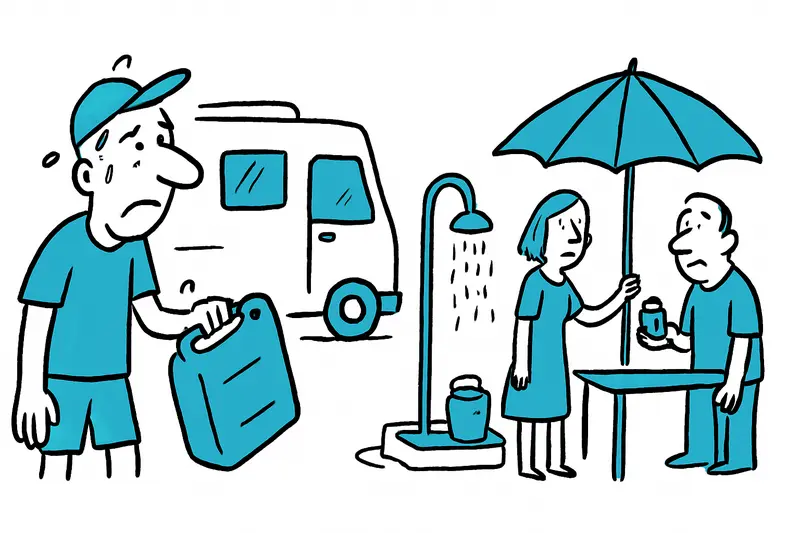
The name Georg Berres, better known as "Jesus Brother Bauchi", is not just a quirky story from the Becker-finca era. His daily life on a finca near Artà shows how fragile life beyond normal services can be when summer turns harsh. He lives in a motorhome, helps tend the estate, fetches drinking water in 5-liter canisters and currently has no electricity because the inverter has failed. The consequence: no cooling, no functioning cooler box, and the water in the pool has long since become only lukewarm.
Critical analysis: This is not an isolated case. Many people in Mallorca live in improvised accommodations — motorhomes, simple casitas, converted barns — where service shortages on hot days quickly become a health issue, as shown in Mallorca's Streets Are Growing Longer: Why More Than 800 People Are Homeless and Nothing Solves It by Itself. Public debate often revolves around beach capacities, tourist routes and firefighting planes, and less around people who do not have air conditioning, whose water containers heat up or whose solar systems suddenly fail. Official heat warnings (AEMET regularly reports extreme summer temperatures; see Heat alert on Mallorca: How well is the island prepared for infernal heat days?) address broad groups but often do not reach those living offline.
What is missing from the discourse is an honest assessment of the interfaces between the energy grid, water supply and social protection. There are no concrete offers for people without a fixed electricity connection: mobile charging points, public shade, drinking water stations or a routine to quickly assist households with provisional technology. Maintenance — for example, repairing inverters or solar batteries — barely appears in the heat debate, a gap noted in No official heat protection for the homeless in Mallorca.
Everyday scene on the island: An early morning near Artà. Cicadas begin to chirp, the roads shimmer with heat, and on the finca you hear the clatter of a canister being rolled to the supermarket. Next to the motorhome stands a garden shower that only helps sparingly because the water is rather warm. A neighbor brings in ice, a woman from the village puts up a parasol over the table — small, improvised rescues against the oven-like heat; similar vignettes were reported in Nearly 40 °C: Mallorca's Daily Life Under Heat Stress — How the Island Can Respond.
Concrete solutions: First: mobile cooling and charging centers in areas with many off-grid residents, run by municipal authorities or NGOs. Second: municipal drinking water fountains and refill stations for canisters, clearly signposted. Third: a maintenance fund for simple electrical generators and solar storage — so a broken inverter does not become a health risk for days. Fourth: targeted information work in analog form (posters, municipal letters, local meeting points) for people without digital access. Fifth: more greenery at homes — simple shading and plants that locally lower air temperature.
Some of these measures require little money but more organizational will. Municipalities like Artà, Manacor or smaller local councils could introduce coordinated neighborhood checks during the hottest months: a quick knock, ask about water and power, and arrange help if needed. Health centers and local fire stations can serve as temporary cooling points.
Concise conclusion: Heat in Mallorca is not an abstract environmental problem, it is a social one. The case of "Bauchi" is a warning: those who live on the margins often suffer visibly during heat waves. Politics and community are called upon — not only with images of temperature records, but with pragmatic, local solutions so that no one is left lying in the baking sun.
Frequently asked questions
What is the best time of year to visit Mallorca for good weather and lighter crowds?
Can you swim in Mallorca year-round, and what is the water like?
What are the best ways to get around Mallorca without a car?
What should I pack for a Mallorca trip?
What kind of activities suit families visiting Mallorca?
Are there safety tips for swimming and beach days in Mallorca?
Is it worth planning a peak-season visit to Mallorca, and how should I prepare?
What makes a good coastal day in Mallorca, and how should I plan it?
Similar News
Magaluf: Watchtower Alarm – Lifeguards Pull Unconscious Beachgoer from the Water
After a drama in the late afternoon, two lifeguards at Magaluf beach rescued an unconscious 44-year-old man. He was stab...
Turquoise in the City: How dangerous is the color play of the Sa Riera?
The Sa Riera in Palma suddenly turned turquoise — a pretty motif, but behind the effect lies a discharge of saline waste...

Jeckliner at Sunnesching: Cologne spirit sets sail from Palma
In September 2027 the Mein Schiff 2 briefly becomes a floating carnival stage: four days with Cologne bands, comedy and ...
Finally Home: Mike and Leyla Heiter Buy Villa with Sea View in Mallorca
The reality TV couple Mike and Leyla Heiter have bought a house in Mallorca with a roof terrace and sea view. An Instagr...
Arrest after series in Palma: Who protects apartments from repeat offenders?
The National Police arrested a man in Palma who investigators say may have broken into several apartments. In one incide...
More to explore
Discover more interesting content

Can Cap de Bou

Townhouse Lleo 72
