
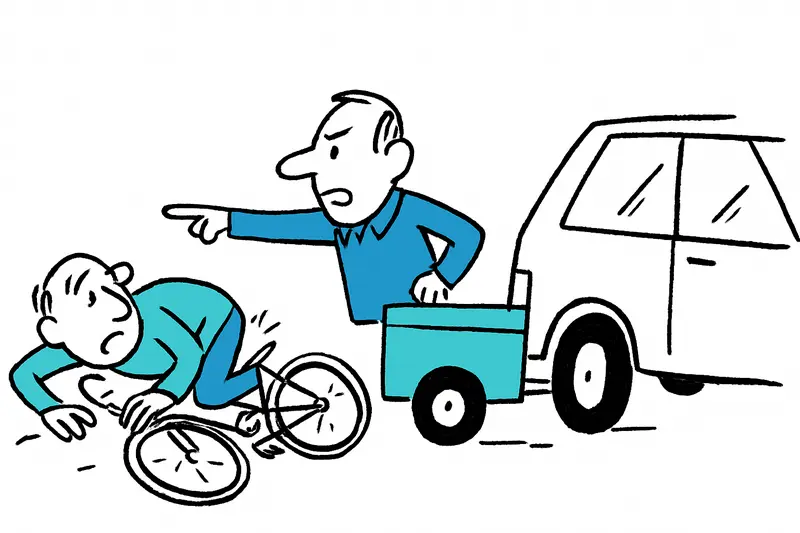
Hit-and-run near Pollença: 84-year-old cyclist dead — Who bears responsibility?
Hit-and-run near Pollença: 84-year-old cyclist dead — Who bears responsibility?
An 84-year-old cyclist was fatally struck by a car with a trailer on the country road to Pollença in the morning. The driver fled. The Guardia Civil is investigating.
Hit-and-run near Pollença: 84-year-old cyclist dead — Who bears responsibility?
On Monday morning, at around 07:55, a routine training ride for an elderly man ended fatally: on the country road to Pollença, at kilometer 54, an 84-year-old cyclist was struck by a car pulling a trailer. Rescue teams from SAMU 061 and the Guardia Civil arrived quickly, but the man died at the scene. The driver of the vehicle drove away. A Mercedes ML280 with the license plate 6317 FFB is being sought; it was towing a pink fairground trailer.
Key question
Why does a morning ride on one of our secondary roads end in death — as in a recent cyclist dies near Selva — and why does the perpetrator apparently think they can simply drive off?
Critical analysis
The facts are sparse but clear: an overtaking maneuver with a trailer, a return to the lane, a violent collision. Technically, this is a classic case of insufficient lateral clearance or a misjudged oncoming vehicle. But that alone is not a full explanation. Mallorca's country roads bring together many risk factors: narrow lanes, often no shoulder in the rural north, dazzling morning sun and cycling groups that are experienced yet vulnerable. Added to that are trailers, which change driving behavior and restrict the driver's field of vision. When a driver flees immediately after an accident — as in the head-on crash in Palma where a driver fled — it speaks not only of fear or panic — it indicates a lack of perceived consequences. Those who believe they won't be found because the island is small underestimate modern investigative work and the attentiveness of the community.
What is missing in the public discourse
In talk shows and social-media outbursts the focus quickly falls on blame and indignation — but rarely on structural issues: Why is there so little space for cyclists on busy connecting roads? Where are speed controls on routes shared by commuters, farmers with trailers and leisure cyclists? And what are the rules and practices for registering and securing trailers on the island? These debates are often technical but receive too little attention. Also missing is discussion of the psychological component: why do people flee instead of stopping? Is deterrence through clear penalties lacking, or is it simply panic? Both must be named.
Everyday scene from Mallorca
Anyone who knows the road to Pollença on a summer morning knows the picture: early risers on their way to the market, a baker packing the first ensaimadas, cycling groups with water bottles and the crunch of gravel at the edges. Near kilometer marker 54 one sometimes hears the distant clatter of a trailer, the hum of insects and the scent of pine resin. That silence is torn apart in an instant when an accident occurs — and people who usually chat become witnesses to a catastrophe. The neighbor who puts out the trash in the afternoon remembers the car with the pink trailer; such observations are often decisive for investigations, as in the Son Castelló crash where occupants fled.
Concrete solutions
There is no simple patent solution, but several measures could help: first, targeted traffic controls on roads with high bicycle traffic, including mobile speed checks and Guardia Civil presence at times with a high likelihood of accidents. Second, structural adjustments: wider shoulders, reflective guideposts and occasional pull-out bays where overtaking can be planned more safely. Third, stricter rules for trailers: highly visible colors, additional warning markings and mandatory safety couplings that improve handling. Fourth, educational campaigns for drivers and cyclists alike — practical behavior when overtaking, maintaining the correct distance, and visibility in the early morning. Fifth, a local reporting system: neighbors, farmers and commuters should have easy ways to report useful observations online or by phone without high hurdles.
What the investigations must achieve now
The Guardia Civil has taken over the case. For effective clarification, forensic work, witness statements and photos are important — as is the analysis of technical traces: skid marks, dent patterns on the bike, damage to the trailer. Surveillance cameras along the route or private recordings from residents can also clarify the case; similar forensic reinterpretation helped in the Port d'Alcúdia crash. Public help matters: tips from people who saw the vehicle are often the decisive factor.
Pointed conclusion
A dead cyclist and a fleeing driver are a double breach of trust: against life and against the rules that make our coexistence possible. Mallorca is small enough for neighbors and forensics to close the circle — but large enough that structural changes remain necessary. Anyone who cycles in the morning deserves better roads, clear rules and the assurance that a collision must not be punished by driving away. Now it is up to the justice system — and we as a community should insist that concrete improvements follow from this case.
Frequently asked questions
What safety measures could prevent hit-and-run accidents involving cyclists on Mallorca's rural roads?
Why do some drivers flee after hitting a cyclist on Mallorca?
How is the hit-and-run near Pollença being investigated?
What practical tips can help cyclists stay visible on Mallorca’s roads at dawn or morning hours?
What infrastructure changes could help Mallorca’s rural routes protect cyclists?
How can residents help in cases like the Pollença hit-and-run?
How does a hit-and-run affect the sense of safety for Mallorca cyclists?
What does daily life on a Mallorca road near Pollença look like before an accident?
Similar News
Mistaken identity with fatal consequences: Brutal assault in S'Aranjassa — what's missing in the follow-up?
At S'Aranjassa a visitor to a finca was tied up, beaten and thrown out of a van. Three men have been arrested, including...
High heel slips, car accelerates: accident on Camí de Son Hugo
A woman lost a high-heeled shoe on the forecourt of the sports facility at Camí de Son Hugo. The car accelerated, mounte...
Phone Scam: How Two Hotel Employees at Playa de Palma Lost Thousands of Euros
One morning in September, two reception employees at Playa de Palma were pressured by alleged alarm-company staff — in t...
When the Wallet Becomes a Danger: Attack in Peguera and Lessons for Mallorca
In Peguera, two women are said to have stolen the wallet from a 75-year-old German couple. When the victim intervened, t...
Plata stays Plata: Young people take over, Llonguets remain
A small bar on Carrer de l'Argenteria will continue: Tolo Serra hands the place over to young Mallorcans at the end of t...
More to explore
Discover more interesting content

Can Cap de Bou

Townhouse Lleo 72
