
Life-threatening cliff jump at Cala Mosques: What this accident reveals about Mallorca's rescue gaps
Life-threatening cliff jump at Cala Mosques: What this accident reveals about Mallorca's rescue gaps
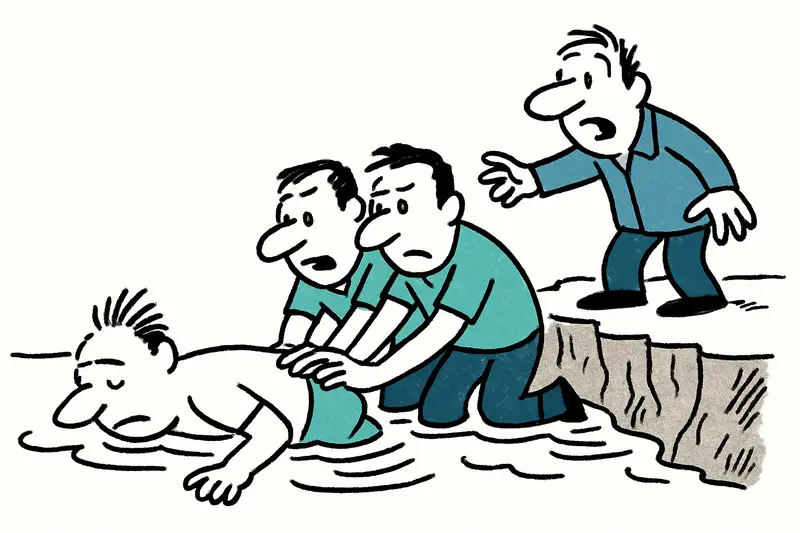
A 28-year-old tourist dived headfirst from the rocks at Cala Mosques and floated unconscious in the water. Two police trainees who happened to be nearby rescued him with 15 minutes of resuscitation — but the incident exposes structural shortcomings.
Life-threatening cliff jump at Cala Mosques: What this accident reveals about Mallorca's rescue gaps
Two police trainees jumped into the sea and kept an unconscious man alive — but why do laypeople have to step in so often?
On a quiet morning at Cala Mosques near Llucmajor: the bright screech of seagulls, the scent of sea and pine, and the casual slapping of bathers on the rocks. Then a jump, a man plunging headfirst into the water — and moments later he was floating face down. Two police trainees who happened to be nearby did not hesitate. They entered the water, pulled the 28-year-old ashore and immediately began resuscitation. For about 15 minutes they sustained the CPR efforts until further helpers arrived; later emergency responders took over, administered oxygen and finally transported the man to the Son Espases University Hospital.
Main question: Does survival in coastal accidents have to depend on the luck that trained people happen to be nearby?
The facts of this case are clear: cliff jumps can cause severe injuries to the skull, neck and spine; they often end as a combination of trauma and drowning. In this case the quick action of the two trainees was probably decisive, as documented in When Dares Turn Deadly: Examining Cliff Jumps on Mallorca's East Coast. But one rescued person must not be used to sweep structural problems under the rug.
Critical analysis: Mallorca has hundreds of small coves without permanent lifeguard coverage. Cala Mosques is one of these remote spots: no lifeguard tower, no permanent medical station, often only a steep path down from the car park. In such a constellation rescue routes are extended and professional equipment is not immediately available. A waiting time of around 25 minutes for an ambulance to arrive is not unusual at remote coastal sections — but for an unconscious person it is a long time. At the same time prevention is weak: warning signs are missing or only in one language, and the issue of risky behavior (alcohol, peer pressure, daredevil acts) is rarely addressed systematically.
What is often missing from the public debate: hard numbers and binding measures. There is a lot of concern, few transparent statistics on cliff jumps and their consequences, and hardly any coordinated list of particularly dangerous spots; this pattern is highlighted in Pruebas peligrosas de valentía en la costa este de Mallorca: cuando los acantilados se convierten en trampa. The question of financial resources and priorities is rarely publicly debated either: should more money go into permanent rescue stations, seasonal reinforcement, drone technology or prevention campaigns?
An everyday scene for perspective: in the late afternoon the same groups of holidaymakers who hours earlier were posing on the cliffs can be seen along the Llucmajor promenade. Parents with sun hats buy ice cream, a café waiter wipes a table on the plaza, and further out the waves lap against the cove. This contrast between everyday life and life-threatening risk is typical of the island: laughter on the rocks, and beneath it the real danger that can strike in a moment.
Concrete solutions that could be implemented immediately: first, multilingual warning signs at known jumping spots and more visible markers at particularly dangerous drops. Second, a digital map with risk points accessible to rescue services, tourism businesses and the public; GPS coordinates shorten search times. Third, targeted seasonal reinforcement of beach rescue services on weekends and in transitional months when many people bathe at less supervised spots. Fourth, small local measures: emergency call stations or QR codes with quick access to SOS services; first aid and resuscitation courses for municipal employees, hospitality workers and rental operators. Finally: licensing authorities for boat or rental car companies could be required to distribute safety information.
In the long term the discussion should also make room for technical aids: drone-supported observation, mobile rescue buoys for remote coves and unified protocols between the municipality, Policía Nacional, Guardia Civil and medical rescue teams. And last but not least more transparency: accidents on exposed coasts must be systematically recorded so trends become visible and countermeasures can be planned effectively; past incidents such as the Tragic Fall in Cala Sant Vicenç: A Wake-Up Call for Greater Coastal Safety underline this need.
Pointed conclusion: The fact that two young police trainees were able to bring someone back to life through courageous intervention is a stroke of luck and deserves recognition. But it must not become the status quo that lives depend on chance and the presence of individual heroes. Mallorca is rich in beautiful but treacherous coastal spots. If the island seriously wants to prevent such incidents from becoming the rule, it needs less luck and more planning, clarity and visible prevention — otherwise next time it might simply be "too late."
Frequently asked questions
Is cliff jumping in Mallorca dangerous?
What should I do if someone is unconscious in the sea in Mallorca?
Are remote coves in Mallorca slower for rescue services to reach?
When is it safest to swim at Mallorca’s less supervised coves?
What warning signs should I look for before jumping into the sea in Mallorca?
Where is Cala Mosques in Mallorca and why is it considered risky?
Do Mallorca beaches have enough lifeguard coverage?
What can local businesses in Mallorca do to improve coastal safety?
Similar News
When the Wallet Becomes a Danger: Attack in Peguera and Lessons for Mallorca
In Peguera, two women are said to have stolen the wallet from a 75-year-old German couple. When the victim intervened, t...
Plata stays Plata: Young people take over, Llonguets remain
A small bar on Carrer de l'Argenteria will continue: Tolo Serra hands the place over to young Mallorcans at the end of t...
Unnoticed in the Luggage Compartment: How a Boy Traveled More Than 100 Kilometers in a Team Bus
A minor traveled in the undercarriage of a team bus for more than 100 kilometers until his cries for help were heard. A ...

Cap Vermell Grand: Second Michelin Key – a Gift for the East
The Cap Vermell Grand in Capdepera has been awarded its second Michelin key. For the region this elevates the luxury off...
Eurowings lets four aircraft carry names – a friendly idea that also reaches Mallorca
Eurowings is launching a campaign: four Airbus A320s are to carry the first names of people who help others in everyday ...
More to explore
Discover more interesting content

Can Cap de Bou

Townhouse Lleo 72
