
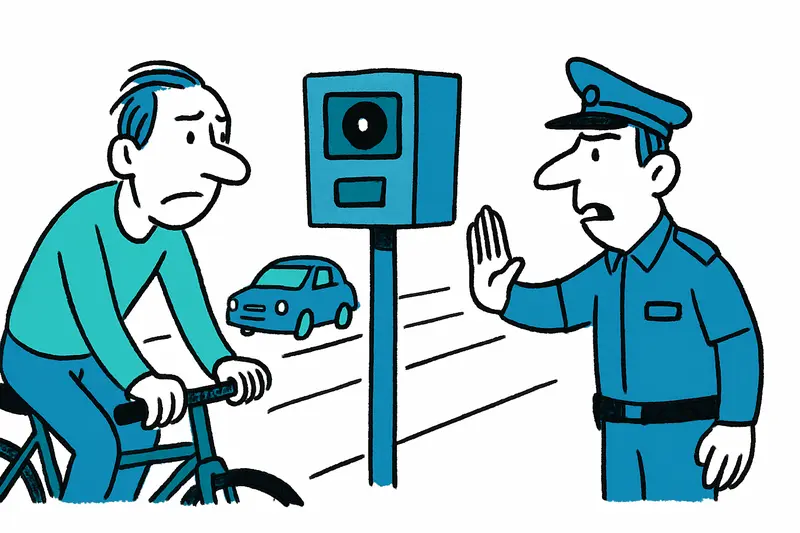
Three new speed cameras on Palma's Cathedral Street: More safety or a revenue source?
Three new radar devices on Avenida Adolfo Suárez have been active since today. The city cites safety reasons — residents also see a revenue motive. A look at risks, noise displacement and possible solutions.
Three new speed cameras on Avenida Adolfo Suárez are active
If you've passed through the area around the cathedral in recent days, you'll notice it right away: on a stretch of only around 500 metres of the Avenida Adolfo Suárez — a development covered in More radar on Cathedral Street: Do the boxes plug the real gaps? — three new speed cameras have been monitoring the flow of traffic since the beginning of November. After a calibration phase, the devices are now active and recording speed violations.
The official justification — and the central question
The city administration speaks of a reaction to a cluster of accidents in this heavily frequented section. In the mornings and evenings commuters, tour buses, delivery vans, cyclists and pedestrians meet in close quarters. The central question that often gets short shrift in the debate is: Is this primarily about traffic safety — or does the revenue side also play a role?
The rumble of bus engines, the cathedral bells on the hour and the constant beeping of indicators are part of everyday life here. Many residents report dangerous lane changes and risky overtaking manoeuvres. At the same time, some doubt that spot speed cameras solve the core problem — they fear the risk will simply be displaced onto side streets.
Effects and side effects
In the short term, the radar stations are likely to lead to more speed control on the monitored section, as similar cases such as Four speed cameras in 500 meters: safety or rip-off on the Paseo Marítimo? have shown. Those who would otherwise "quickly" exceed 50 km/h must now expect a fine. For pedestrians and cyclists, the lower speeds at intersections can indeed bring noticeably more safety.
But there are side effects that often get lost in the public discussion: first, the so-called displacement effect — drivers who want to avoid the risk divert to parallel, often narrower streets. These residential roads are not designed for heavy through traffic and suffer from noise, exhaust and dangerous situations in front of schools and cafés. Second, it remains unclear how long the controls will remain in place and whether the city will earmark the revenues for traffic safety measures.
What's missing in the debate?
Transparency. Specifically, numbers are missing: accidents before and after the installation, speed distribution measurements, average fine amounts and information on whether the controls are time-limited. Without this data, the measure remains for many residents a black box that "collects money" — instead of being part of a long-term strategy. This concern has also been raised in coverage of New red-light cameras in Palma: safety measure or hidden revenue source?.
Another point: urban design adjustments. Speed enforcement alone falls short. Narrower lanes, protected bike lanes, raised crosswalks or visual narrowings (so-called road humps or "chicanes") would permanently influence the behaviour of all road users — not only while the camera is watching.
Concrete proposals — what would make sense now
From a local perspective, a few pragmatic steps can be named that would bring more than spot controls:
1. Publish the data: The city should make accident statistics, measurement data and fines transparent. That builds trust.
2. Consider 30 km/h: In many old-town zones, a permanent limit of 30 km/h noticeably reduces the number and severity of accidents.
3. Physical measures: Access restrictions, lane narrowings, raised crossings and genuine protected lanes for cyclists prevent diversion traffic and slow things down.
4. Time-focused controls: Especially during morning and evening peaks, but also at school start times, increased enforcement and police presence could be useful.
5. Citizen participation: Information events with residents, shop owners and bus companies so that measures are accepted locally.
What you can do now
Practical advice for drivers: stay calm, allow a few extra minutes and pay attention to the new signs. For cyclists: keep your distance and watch intersections carefully. Those travelling by bus should expect slightly altered routes or waiting times if traffic redistributes.
Many voices from the neighbourhood are divided: some feel relieved and hope for fewer risky overtakes; others see the cameras mainly as a new revenue source. Realistically, both are possible — and that is precisely why Palma now needs more than just three boxes on the roadside: a visible strategy for liveable, safe streets.
And in the end, when the cathedral bell strikes seven again, one should not only ponder over fee-based photos, but over how a part of the city can be planned so that fewer people have a reason to speed.
Frequently asked questions
Why have new speed cameras been installed on Avenida Adolfo Suárez in Palma?
Can new speed cameras in Palma really make a road safer?
Are the new speed cameras on Cathedral Street in Palma mainly for safety or to raise money?
What should drivers know before using Avenida Adolfo Suárez in Palma?
Will traffic simply move onto nearby streets in Palma because of the cameras?
What data should Palma publish about the new speed cameras?
When is it best to drive more carefully around Palma Cathedral?
What wider traffic changes could help around Palma Cathedral besides speed cameras?
Similar News

Caro Robens: 15 kilograms lighter — and again in the crossfire of online comments
Bodybuilder Caro Robens, who lives in Mallorca, has lost 15 kilograms. Her success on Instagram was met with applause — ...

Meager Industry in Mallorca: How the Island Can Be More Than Just Tourism
The industrial sector in Mallorca is shrinking, productivity is falling and firms remain tiny. The key question: can the...
Pre-Nit de l'Art: Galerie Mensing invites to a special evening with Tom Boston
Before the big art night, Galerie Mensing opens its doors: pop art, champagne, a DJ and a hand-signed print by Tom Bosto...

Sea view and more seats: Cappuccino Grand Café reopens in Port d'Andratx
After a long renovation, the Cappuccino Grand Café on the Port d'Andratx harbor promenade has quietly reopened. Larger t...

Enric Mas wins the Vuelta – a triumph that resonates in Mallorca
Mallorcan Enric Mas has won the 82nd Vuelta — the first Spanish overall victory since 2014. Cyclists and neighbors on Ma...
More to explore
Discover more interesting content

Can Cap de Bou

Townhouse Lleo 72
