
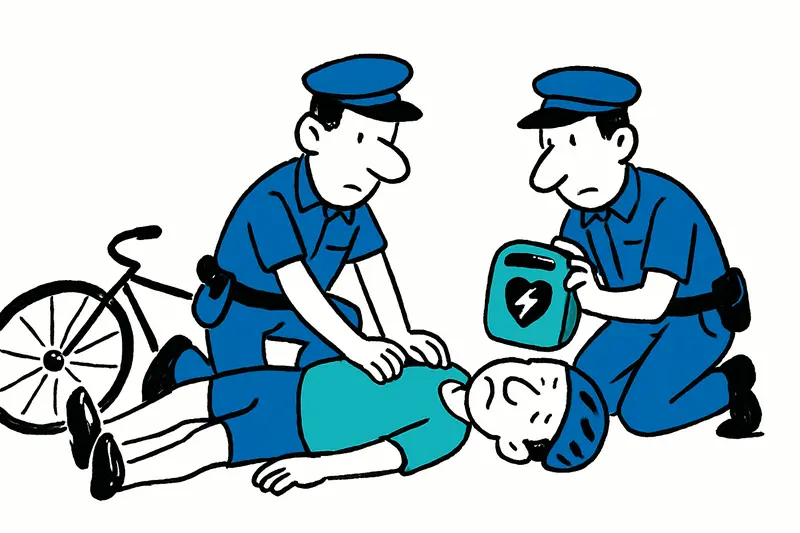
Police resuscitate cyclist on the Soller–Deia route
Police resuscitate cyclist on the Soller–Deia route
On the winding stretch between Soller and Deia a 63-year-old cyclist suffered a cardiac arrest. Two police officers immediately began resuscitation and used a defibrillator — the man was revived before the arrival of the emergency services.
Police resuscitate cyclist on the Soller–Deia route
Morning on the MA-10: quick help from a police team saves a life
It is one of those spots where you can see the sea before reaching Deia: tight bends, pine trees along the road and the typical early-morning calm of the Tramuntana. Exactly here, around 9:15 a.m., a 63-year-old cyclist suddenly lost consciousness and fell. Passersby alerted the local Soller police.
The officers who arrived found the man unconscious and not breathing. Without hesitation they began cardiopulmonary resuscitation and used a defibrillator. Thanks to these measures, the responders managed to revive the cyclist before the medical emergency team 061 arrived. Similar quick responses have saved lives, such as Port d'Andratx: Tourist Resuscitated by Bystanders and Police After Cardiac Arrest.
Scenes like this often make us pause in the morning at the Plaça de Soller: the smell of fresh coffee mixes with the metallic sound of bicycle chains, and you realize how many people here travel daily on two wheels. That the police were able to act made the difference that day.
The good news first: the man survived the cardiac arrest. He was handed over to medical rescuers who took care of further stabilization and transport. More details about the diagnosis and the cyclist's condition are not yet publicly known. Other incidents with worse outcomes have been reported, for example Serious Traffic Saturday: Cyclist Dies in Selva, Motorcycle Crash in Sóller Tunnel.
What makes this story so positive is less the event itself than what stands behind it: well-trained personnel, a functioning defibrillator and the quick reaction of people on site. On Mallorca many routes are winding and sparsely built up – every minute counts.
A small everyday scene: a delivery van honked briefly to make way; a hiking group watched from a safe distance; the siren of an ambulance started, and a notice with the emergency number hung on a small house corner. Many rescue situations here look similar – improvised, but with heart.
There are concrete lessons to be learned. First: defibrillators save lives; second: CPR training should not be reserved only for emergency personnel, as underlined by Cardiac Arrest in Caimari: Are Mallorca's Villages Prepared for Medical Emergencies Involving Tourists?; third: clear signage for emergency points along the MA-10 could shorten the time until professional help arrives.
Practical suggestions for Soller and neighboring communities would be, for example, clearly visible emergency-point markers at bends, regular first-aid workshops for tourism workers and bike rental providers, as well as simple information leaflets in several languages for cyclists on what to do in an emergency and what details are best kept in a helmet or on clothing. This kind of discussion also arose after Cardiac Arrest on Can Picafort Beach: Questions Remain and Ideas for the Future.
For the people who live and work here, the news is a reminder: we are an island, but not an island of complacency. Those who use the mountain or coastal roads can reduce risk with little effort – a small first-aid kit, an ID bracelet, knowing the emergency numbers.
The thanks go to the two police officers who did not wait but acted that morning. Such decisions are often made in seconds and are precisely why they are instructive: training pays off, equipment too. And sometimes the combination of both is enough to give someone their life back.
In the end one image remains: the sun has now climbed higher over the Tramuntana, cyclists roll on towards Deia or back to Soller, and at one spot on the MA-10 exactly the right thing appears to have been done that day. It is a small but tangible reassurance for the island.
Frequently asked questions
How common are CPR and defibrillator measures on Mallorca’s cycling routes?
What happened on the MA-10 between Sóller and Deià?
What lessons can Mallorca communities take from this incident?
How can cyclists stay safer on Mallorca's winding routes?
Where should emergency points be placed on Mallorca’s cycling routes?
What should cyclists carry to help in emergencies on Mallorca routes?
What role do police and local responders play on Mallorca’s cycling routes?
What does this incident say about Mallorca’s cycling culture and safety?
Similar News
Rats in Llucmajor: How Uncollected Garbage Became a Health Problem
In Llucmajor, uncollected trash bags, overflowing containers and rain are leading to increased rat sightings. An assessm...
Sly Distraction Scam at Ballermann: How Tourists Became Targets — and What Must Be Done Now
Five suspected pickpockets were arrested. Their method: distract, secure the loot, return the wallet — without the cash....
Eviction in El Arenal: Who protects neighbors — and who protects the homeless?
A vacant hotel on Carrer Girona was cleared and secured. The neighborhood breathes a sigh of relief. But the action trea...
'La Tapita' loses its home: Who will protect Palma's last affordable meeting places?
The bar 'La Tapita' on Simó-Ballester Street will close at the end of December. For neighbors, police officers and small...
Million Heist at Bulgari: Who Is Responsible for Palma's Security Gaps?
Three men stole jewelry worth around one million euros – the crime series began at the end of September and was likely c...
More to explore
Discover more interesting content

Can Cap de Bou

Townhouse Lleo 72
