
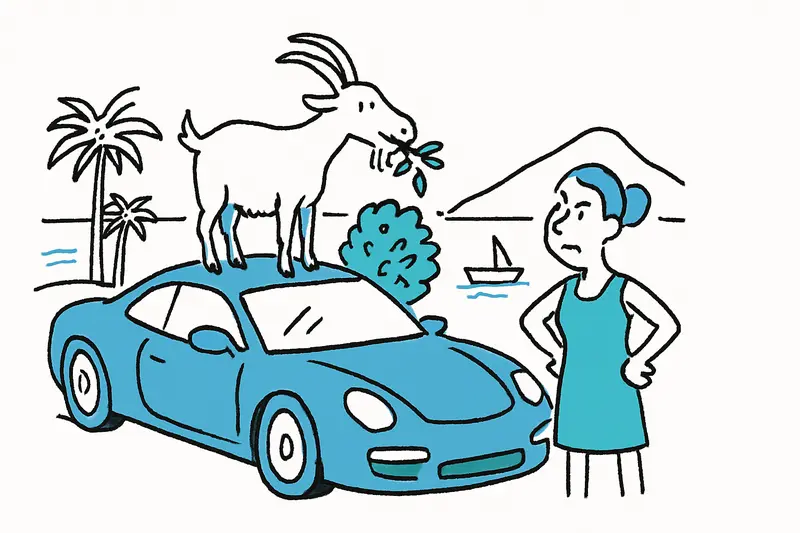
Port d'Andratx: When Goats Climb Sports Cars — and What We Should Learn From It
Port d'Andratx: When Goats Climb Sports Cars — and What We Should Learn From It
In the marina of Port d'Andratx a wild goat was recently spotted on the roof of a parked sports car. The scene is amusing but highlights a growing problem: feral goats in the town center and the question of how humans and animals can live together safely.
Port d'Andratx: When Goats Climb Sports Cars — and What We Should Learn From It
Key question: How do we deal with a growing wild goat population in residential areas without losing sight of animal welfare?
Last week a picture surfaced that you might expect in a luxury marina: a shiny hood, a few palm trees, the murmur of boats — and on top of it a goat nibbling on a shrub. The photo is funny and viral-ready. But for many residents of Port d'Andratx this is no longer a laughing matter.
The animals have been coming down from the mountains into the town for years. If you sit on the quay, you no longer just hear the clinking of coffee cups and the distant hum of an engine, but also the sound of hooves on stone. Gardens are grazed, hedges stripped bare, and pedestrians, cyclists or drivers can find themselves in dangerous situations when goats suddenly jump onto the road.
In short: the incident with the sports car is a symptom. The causes are obvious and known: fewer natural predators, settlements close to food sources, easy access to food through open trash bins or deliberately placed feeding spots by people. Ornamental plants and Mediterranean fruit trees also attract the animals.
Critical analysis
The discussion often goes in two directions: either the animal is celebrated as "cute," or people demand quick, harsh measures. In both camps something is missing for me: a long-term plan that unites animal welfare, traffic safety and the quality of life for residents. The fact that the municipality has already carried out capture operations for stray animals shows measures are being taken. But capture operations alone are not a sustainable concept if the underlying causes are not addressed in parallel.
Public debate usually focuses on individual photos and incidents. What happens too rarely is an open discussion about responsibility and prevention. Who is feeding the animals — deliberately or inadvertently? What role do waste management and urban planting play? How can traffic risks from wildlife collisions be better mitigated? And: which humane means of population control are available in the long term?
An everyday scene from Port d'Andratx
Imagine the scene: eight in the morning, cafés by the harbor are rinsing cups, a retiree reads the newspaper, children run by with baguettes. Suddenly a shout, then laughter, then a honk — a goat has been feasting on the cherry laurel and is balancing on a parked car. The neighbor across the way rolls her eyes, shakes her shopping basket and says, "This happens far too often now." These little encounters are charming — until the charm runs out and only trouble remains.
What is missing in the public debate
Some keywords are discussed too little: systematic monitoring of herds, development of a binding emergency plan for traffic and crowds, clear rules against feeding — Mallorca's feeding ban — combined with a consistent information campaign for tourists and residents. Also often missing is the link between short-term measures (capture, deterrence) and long-term solutions (fertility control, habitat management).
Concrete solution approaches
1) Better securing of trash bins and waste in harbor and residential areas so that no easy food source is available.
2) Information signs at the harbor and popular photo spots: please do not feed, keep distance from animals. Inform tourists — they often do not realize the harm a piece of bread can do.
3) Targeted, humane capture operations coupled with veterinary vaccination campaigns and registered relocation or other ethical procedures. Capture alone without follow-up does not help in the long run.
4) Examination of long-term methods such as immunological fertility control in consultation with veterinary and conservation authorities — this is not a quick fix, it requires planning, but it reduces populations without killing.
5) Road safety measures at known crossing points: better signage, reduced speed, barriers at particularly vulnerable sections.
Conclusion
The photo of the goat on the sports car is a starting point. The real question is: how do we as a community want to live with wild animals near settlements? A mix of prevention, education and humane, long-term population management would not be a lack of compassion, but an expression of it. Otherwise we will be left with an endless series of curious pictures — and ultimately less quality of life for humans and animals.
Frequently asked questions
Why are goats increasingly present in Port d'Andratx and what does this mean for residents?
What steps can Port d'Andratx take to reduce goat encounters on streets and at the harbor?
How can residents and visitors prevent goats from scavenging in harbor areas?
Are there humane, long-term options to control goat populations near towns?
Why is a long-term plan essential for wildlife near Mallorca towns?
What can tourists do to help reduce wildlife conflicts when visiting Mallorca?
What road-safety improvements are considered at goat crossing points on Mallorca's coast?
What would a sustainable approach to living with wild animals near Mallorca settlements look like?
Similar News
Nearly Poisoned Sisters at Ballermann: Where the Hotel Failed — and What Must Happen Now
Two German sisters in a hotel on the Carretera Militar apparently lost consciousness due to carbon monoxide. Guests had ...

German Tourist Killed in Southern Spain: Questions We Must Ask Now
A 47-year-old German woman was found dead on the coast near Isla Cristina. The suspected partner has been arrested. The ...
Water, Words, Responsibility: The Dispute over Horse-Drawn Carriages in Palma
A German tourist in Palma is sprayed with water by a carriage driver. Protests, accusations and a city investigation sho...
Can Malle hits really work in Hamburg? A reality check for the premiere of "ALLE LIEBEN MALLE"
Premiere at the Großmarkt: thousands of attendees, stars from the Megapark and long beer queues. Why the concept works —...
Adrien Brody strolls through Mercat de l'Olivar – celebrity visit leading to Sa Pobla
Actor Adrien Brody was casually spotted at the Mercat de l’Olivar: tapas, fish stalls and later a stop in Sa Pobla spark...
More to explore
Discover more interesting content

Boat Tour with BBQ along Es Trenc Beach

Private transfer from Mallorca Airport (PMI) to Pollensa
