
When Radio Falls Silent and the Runway Is Brittle: A Mallorca Pilot in Caracas and the Unresolved Safety Questions
An experienced Mallorcan pilot diverted from landing in Caracas after strong earthquakes in Venezuela. The silence on the ground frequencies and the decision to divert raise fundamental questions about safety and minimum crew requirements.
When Radio Falls Silent and the Runway Is Brittle: A Mallorca Pilot in Caracas and the Unresolved Safety Questions
Key question: How well protected are passengers and crews when ground infrastructure fails due to natural events and the usual communication channels break down?
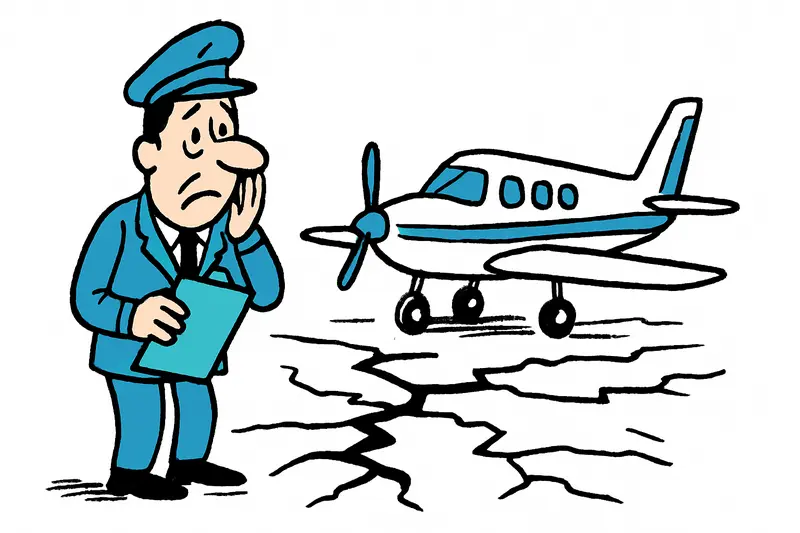
On the evening of June 24, a long-haul flight with a Mallorcan crew found itself in a situation that seems surreal to many of us: on approach to Caracas airport nobody in the control tower responded, there was radio silence, and the region had experienced two strong earthquakes shortly before. The pilot in command, a man with over thirty years of flying experience, decided together with his copilot to abandon the planned approach and instead continue to the island of Curaçao. The decision saved hundreds of lives, because the runway at Maiquetía was damaged and would not have been suitable for a safe touchdown.
Critical Analysis
What in a sober description looks like a sequence of fortunate circumstances actually contains several vulnerabilities: First, the incident shows how quickly central information — runway status, the condition of tower communications, the situation of other inbound aircraft — can be missing. Pilots must make decisions under uncertainty; here experience and intuition played a decisive role. Second, the case reveals modern aviation's dependence on functioning ground infrastructure and redundant communications. VHF radio is robust, but not invulnerable; in natural disasters ground stations can be damaged or overloaded. Third, the question of minimum crew and task distribution under high-stress moments comes into focus: when steering, radio communications, and passenger information must be managed simultaneously, a single person’s capacity is quickly reached.
What Is Missing in Public Discourse
Public debate after such events often focuses only on dramatic images. People less frequently talk about practical gaps: Are there mandatory automatic status reports for runways (sensors that report online: passable/not passable)? How quickly do satellite-based emergency channels work for communication between aircraft and ground? Are pilots regularly trained for scenarios in which ground frequencies fail completely? And: what rules exist for minimum crew on long-haul flights when unexpected multiple tasks arise? (Local episodes such as the car breaking through the airport fence near Palma's runway highlight surveillance shortcomings.) These questions are discussed on Mallorca at the bar of the café in the Plaça Major, between the clinking of espresso cups and the chatter of taxi drivers — and they should be answered seriously by those responsible.
An Island Everyday Scene
You can imagine it like this: on a hot morning along the Passeig Marítim in Palma I watch a city bus squeal as it turns, holidaymakers with sun-kissed shoulders make phone calls, and an older captain from the Club de Mar flips through the headlines of the daily papers. Those headlines have included local stories like the drone incident over Palma that forced a refueling stop. None of them want to wake up one morning knowing that a transatlantic flight was put at extreme risk by avoidable communication failures. Such events are not abstract — they touch families, friends and the island’s tourism economy.
Concrete Solutions
1) Strengthen redundant communication channels: Airlines and airports should be required to have backup systems, such as automatic satellite messages (SATCOM) for status information and direct data links between runway sensors and incoming aircraft. Such measures would also improve responses to diversions after events like the burst tire in Seville. 2) Runway sensors and automatic broadcasts: Sensors along the runway, linked to a public emergency portal of air traffic control, could report conditions (cracks, collapse, contamination) immediately. 3) Training for "zero-communication" scenarios: Regular simulator exercises in which radio and ground information fail will make crew decisions more comprehensible and reproducible. 4) Review and defend minimum crew levels: Operators and regulators must ensure that long-haul flights carry enough personnel on board to share control, communication and passenger information tasks. 5) International coordination: ICAO-like guidelines should include emergency protocols that work across national borders — especially in earthquake and hurricane-prone regions.
Pointed Conclusion
The incident in Venezuela shows: technology, procedures and personnel must be arranged so that human skill is not the only safety reserve. Experience saved lives that evening — but in the long run the system must not rely on individuals improvising. We on Mallorca, who use flight connections and have family members who travel long distances, should demand that airline and authority leaders learn the lessons: more technical redundancy, clear crew rules and transparent information for passengers. Then there will be less feeling and more certainty when the radio falls silent.
Frequently asked questions
When is the best time to visit Mallorca for warm weather and easy beach days?
What should I pack for a Mallorca trip in spring?
Can you swim in the sea in Mallorca year-round?
What are the best outdoor activities in Mallorca?
How can I get around Mallorca without a car?
What makes Sóller a nice day trip from Palma?
Is Valldemossa worth visiting for a Mallorca village experience?
What should families know about beaches and safety in Mallorca?
Similar News

Palma markets itself in the USA — but who is the city really for?
The tourism foundation is investing over €200,000 in US promotions to attract affluent visitors to Palma. Does that acco...
From Deposit to Arson: How a Dispute over Jet Skis in El Molinar Escalated
After a nighttime fire in El Molinar a detainee is in pretrial detention. How could a conflict between a rental company ...

Lying Instead of Standing: How Prone Paddling Is Conquering Mallorca's Waters
On your belly across the sea — prone paddling is bringing fresh energy to Mallorca's watersports. Where to start, which ...
Housing Shortage in Mallorca: Assessment, Questions, Proposals
Over 2,000 new housing units through repurposing and special rules – sounds like a success. But do they really help peop...
Garbage, Stench, Fire Risk: What Is Really Going Wrong in Son Bauló
An apartment ensemble illegally built for years near Son Bauló is falling into disrepair, largely occupied and creating ...
More to explore
Discover more interesting content

Boat Tour with BBQ along Es Trenc Beach

Private transfer from Mallorca Airport (PMI) to Pollensa
