
Where the Red Roses Stayed: Sant Miquel of Campanet Rediscovered
Where the Red Roses Stayed: Sant Miquel of Campanet Rediscovered
A reader's story leads us to the small hermitage Sant Miquel near Campanet: a bricked-up pointed arch, a weathered memorial stone and the memory of Isabel Pons — a find that shows how alive Mallorca's everyday history is.
Where the Red Roses Stayed: Sant Miquel of Campanet Rediscovered
A reader's story among natural stone, cicadas and an old trace of love
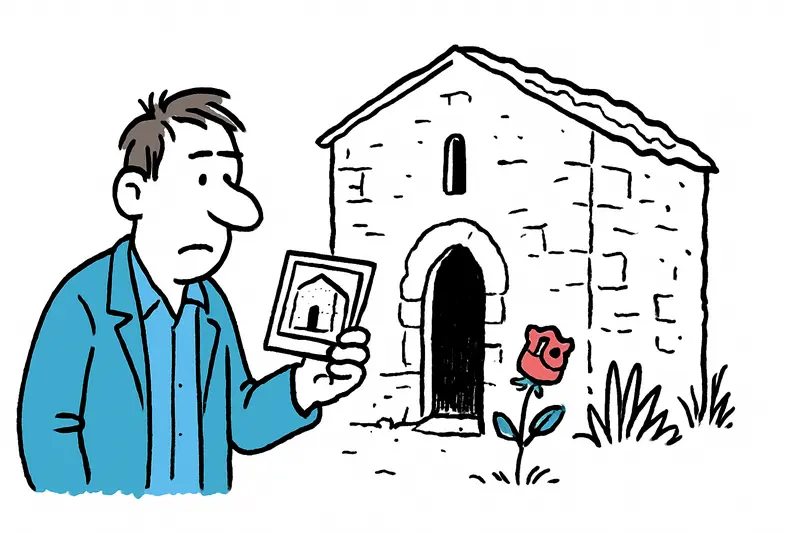
Sometimes a dusty photograph is enough to bring an old memory back onto the map. A reader, Wolfgang Klesper, wrote to us: about thirty years ago he and his wife had seen an inconspicuous, very old sacred building on a small country drive. Now he has found the place again: the hermitage Sant Miquel, a section of the northern Tramuntana near Campanet, where stone, time and a legend collide.
Anyone heading to Sant Miquel today leaves the lively village center and drives along a narrow country road, accompanied by the shrill song of cicadas and the scent of pine resin. The small chapel nestles against a slope, the masonry roughly hewn, the plaster flaking in places. On one exterior wall a large, bricked-up pointed arch immediately catches the eye — not an ornament, but an open chapter of building history.
Architecturally Sant Miquel tells of layers: the first secure mention goes back to 1248. Yet what you feel on entering has more of the late Middle Ages: substantial Gothic elements date from the late 14th and early 15th centuries, with further adaptations in the 15th century. Inside the church remains plain: a single-nave space, striking diaphragm arches, a clearly defined presbytery with the altar table, all settled in stone and silence.
The bricked-up pointed arch is no whim of time but a visible scar. Such changes show how small houses of worship had to adapt to shifting communities, uses and construction techniques. Sant Miquel was apparently once the parish church for the area; later the building lost that function, the village center moved — and the once important church became a quiet hermitage.
But Sant Miquel is not only stone and architecture. In one of the old photos Mr. Klesper brought, a weathered memorial stone was visible. Parts of a Spanish inscription remained, similar to before: “SU PADRE ... HABIENDO PERDIDO UN ANGEL TAN QUERIDO PUSO ESTE RECUERDO A SU MEMORIA.” The name “Isabel Pons” could still be deciphered.
Local tradition adds to the fragmentary record: in the 19th century a young woman named Isabel Pons Bennàssar apparently died in an accident when parts of the church choir collapsed. Her fiancé, Matías Pujades, was left behind — and with him the small, romantic story that is still told today: he is said to have brought her red roses, and it is said that a red bloom repeatedly appeared at her grave.
How much legend and how much fact this story contains cannot be verified in every detail today. Names, fragments of the inscription and the local memory, however, are tangible enough to make the connection between place, person and mourning palpable. These traces are what make small chapels so binding: they are places where everyday life, longing and history meet.
For Mallorca this rediscovery has something reassuring about it: it reminds us that the island is not only beaches and promenades, but also unobtrusive places full of stories, as in Discover Costitx: Flowers, Ancient Stones and a Sky That Tells Stories.
Anyone who passes Sant Miquel can stop briefly, listen to the wind against the wall, perhaps see a bee fly over the pinkish moss. People who live here still tell of flowers at the grave — small, daily rituals that create identity, which sit alongside larger island traditions such as Assumption of Mary on Mallorca: Between Devotion and Cossiers.
What should be done with such places? One suggestion: visit respectfully, take photographs, get in touch with the parish and pass such hints on to local heritage conservators. Even an inventory, a clear note on the municipal map or a conservation inspection can achieve a lot. Community-minded approaches and local knowledge, like those celebrated in Palma's Quiet Favorites: Where Neighborhood Still Comes to the Table, help make preservation practical.
In the end there remains the small comfort of the island: a single photo and a curious look are enough to make a forgotten place visible again. Sant Miquel is more than a chapter in a thick book about Mallorca's churches — it is a place where people loved, mourned and remembered. And sometimes, people here say, a single red rose is enough to keep a feeling alive across generations.
Reader's note: Thanks to Wolfgang Klesper for photos and memories. If you have your own discoveries from your time in Mallorca, write to us — the island is full of stories waiting to be brought back into the light.
Frequently asked questions
When is the best time to visit Mallorca for warm weather and quieter beaches?
Do I need a car to explore Mallorca, or is public transport enough?
What should I pack for a Mallorca trip?
Are there family-friendly beaches or safe swimming spots in Mallorca?
What are the must-see sights in Palma de Mallorca?
What makes Sóller worth visiting in Mallorca?
Are there good beaches near Alcúdia for families?
Is Cap de Formentor a good day trip for viewpoints?
Similar News
Bloody clash in Canòdrom Park: What is missing in addressing violence on Mallorca's streets?
At midday on October 23, an 18-year-old man was critically injured in Canòdrom Park in Palma. The attack raises question...

Palma raises bus fares: Who pays the bill for public transport?
Single tickets rise from €2 to €3, airport trips have a reference price of €4.50. It remains unclear whether residents w...

Palma's New Indoor Pool: Sea View, Sunbeds and Space for Everyone
At Aigua Dolça, near the Paseo Marítimo, Palma has a new municipal indoor pool. For a small fee people can now train, re...

How Four Burglars Emptied Ten Houses with a Simple Trick — and What It Means for Mallorca
Four men used the impressioning technique, posed as delivery workers and accepted two years in prison. A reality check f...

Bundles of Drugs, Containers and Open Questions: A Reality Check for Mallorca
3.3 tonnes of marijuana, 80 kilos hidden in golf-ball vending machines and a 44-year-old German released on conditions i...
More to explore
Discover more interesting content

Can Cap de Bou

Townhouse Lleo 72
