
'Tourists not welcome' on Palma's La Rambla: When trees become a stage for protests
'Tourists not welcome' on Palma's La Rambla: When trees become a stage for protests
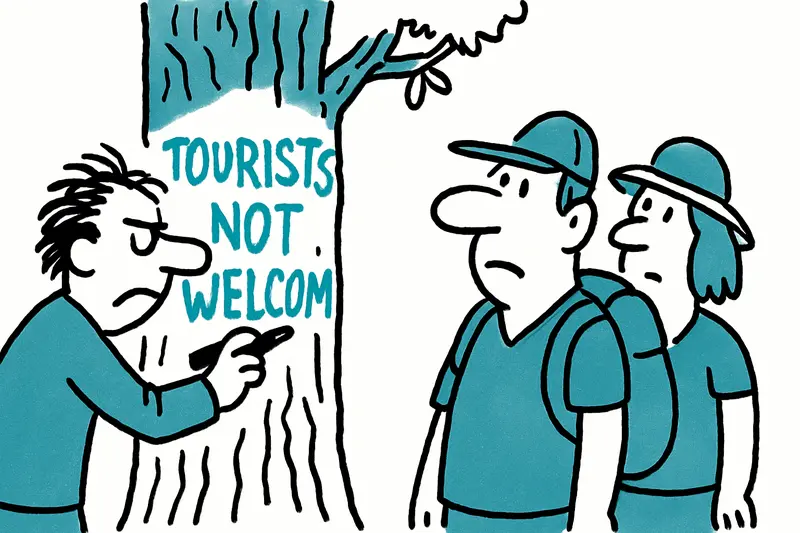
On Palma's La Rambla, a tree was defaced with the inscription 'Tourists not welcome'. The incident shows how deeply the tourism debate has penetrated everyday life in the city — and how unhelpful vandalism is.
'Tourists not welcome' on Palma's La Rambla: When trees become a stage for protests
What does this action say about the mood in the city - and what's missing in the debate?
On the morning of an otherwise mild March day, in the middle of the busy promenade La Rambla, passers-by discovered the message 'Tourists not welcome' on the bark of a tree. The lettering was apparently applied with colored markers; city workers were already carefully removing the marking the same day. The action is not only an aesthetic intervention, it strikes a sensitive symbol: Palma's street trees are part of the city's appearance - and in this case carriers of a political message.
Key question: What is the point when protest takes the form of property damage to urban greenery - and does it even reach those it is intended for? That is the question being discussed in the cafés along the Rambla, amid the scent of coffee, the clatter of the tram and the murmur of tourist groups, a debate that resurfaces after mass demonstrations such as Palma after the Protest: How Freedom of Expression and Everyday Life Can Be Balanced.
Critical analysis: The recent graffiti, most recently also on a new yoga studio in the working-class neighborhood Pere Garau, as reported in Evening Road Closures in Palma: Between the Right to Protest and Traffic Chaos, follow a familiar pattern: anger about rising rents, changes to neighborhoods and the feeling that living spaces are being shaped for visitors rather than residents manifests in visible, often symbolic actions. However, the choice of target is problematic. Damaging trees, breaking shop windows or defacing facades does not solve the structural problem: it shifts the debate toward criminalization instead of negotiation about solutions.
What is missing in the public discourse: concrete spaces and procedures in which residents and businesses can negotiate burdens and interests together with the city administration and the tourism sector. Much is discussed in terms of numbers and bed capacities, but little about the everyday use of public spaces - who needs them when, and under which rules. Also missing is a clear approach to the care and protection of urban greenery; removing paint from bark is time-consuming and can cause lasting damage, a controversy reflected in cases like Dispute over 17 Ombu Trees on Plaza Llorenç Villalonga: Who Decides on Urban Green?.
Everyday scene: A baker on the Rambla wipes crumbs from the terrace, an older man feeds pigeons, next door a group of market vendors advises a young tourist about excursion options. The atmosphere is fragile: open to guests yet tense because of noticeable changes in the neighborhood. The graffiti is perceived here as a disturbance - not only by visitors but also by the neighborhood, which cares for its trees.
Concrete solutions: First, create a low-threshold mediation mechanism - regular neighborhood assemblies, moderated and with a limited mandate to prioritize concrete complaints. Second, a program for the preservation and quick, professional cleaning of urban greenery that documents damage and funds restoration work. Third, find creative alternatives for protest: authorized wall spaces, temporary art projects or paid dialogue formats where protest is visible but not destructive. Fourth, a transparent concept for distributing tourist burdens - nightlife, short-term rentals, traffic - linked to local noise protection and housing measures.
A pragmatic addition: Owners of cafés and small shops could take on sponsorships for trees together with the municipality; this creates proximity, provides care capacity and reduces the symbolic risk of such actions. Also conceivable are municipal mediators who can step in at short notice during escalating debates and moderate conversations between businesses, residents and those affected.
Pointed conclusion: Graffiti like 'Tourists not welcome' are a clear warning - but they are not an offer of solutions. Vandalism damages the shared living environment and narrows the space for productive debate. Those who want change must work at tables rather than on tree bark. Palma has the tools to hold these conversations; what is currently missing is a systemic approach that organizes and makes visible residents' interests, municipal maintenance and the tourism economy equally.
Frequently asked questions
Why did someone write “Tourists not welcome” on a tree in Palma’s La Rambla?
How does tourism protest in Palma affect daily life for residents and visitors?
Is it common for protests in Palma to target trees, walls or shopfronts?
What is the mood like on Palma’s La Rambla when protest graffiti appears?
Can writing on tree bark damage the trees in Palma?
What is missing from the debate about tourism pressure in Palma?
What can Palma do instead of destructive protest against tourism?
Why are urban trees such a sensitive issue in Palma?
Similar News
Serious fall at Port d’Andratx: Who protects cyclists on this route?
A 66-year-old German cyclist fell between Port d'Andratx and Camp de Mar, hit his head and was taken to hospital. One ac...

Four goals, heart-stopping moments, a message: Germania Mallorca takes three points in Consell — questions remain
The new German club on the island won its first away game in Consell 4:3. Celebration, a 4:0 lead, then a nervous finish...

Mueller continues expanding in Mallorca: Artà in 2026, Can Picafort in early summer 2027
The drugstore chain Mueller is opening two new stores in Mallorca: a 1,400 m² shop in Artà on 5 November 2026 and a bran...
The Painter Who Lived Mallorca: Franz Taussig and His Century-Old Secret
A hundred years ago a young Viennese arrived in El Terreno, sketched the island and called himself Francis Caron. Today ...
Airport dispute: Bridge, forecasts and the question of responsibility
A video by the Spanish transport minister has ignited the dispute over DORA figures, capacities and local governance pow...
More to explore
Discover more interesting content

Can Cap de Bou

Townhouse Lleo 72
